Few tattoo subjects are as instantly recognizable as the monarch. The glowing orange wings, the bold black veins, and the white-dotted borders make it one of the easiest butterflies to identify, and one of the most striking to wear on skin.
That recognizability is exactly why a good monarch butterfly tattoo design deserves more thought than it first seems to need. Because everyone knows what a monarch looks like, small choices in anatomy, color, line weight, size, and placement decide whether the tattoo feels crafted or generic.
This guide covers the best monarch butterfly tattoo designs for 2026: styles, combinations, placement, size, color, cost, and aftercare. It works as a cluster article beneath our complete butterfly tattoo guide, which covers every species and style. If you mostly want the symbolism, our butterfly tattoo meaning article goes deeper into what the butterfly can represent.
Quick Answer: What Makes a Great Monarch Butterfly Tattoo?
A great monarch butterfly tattoo uses accurate wing structure, strong black linework, saturated orange placed by an artist who understands color, and a size that suits the amount of detail. The most popular styles are realistic, fine-line, watercolor, blackwork, geometric, and neo-traditional. The most popular placements are the wrist, forearm, shoulder blade, ribs, ankle, and upper back. Most people choose a monarch for its link to transformation, endurance, and remembrance.
Table of Contents
- 1. Why Monarch Butterfly Tattoos Keep Working
- 2. What a Monarch Butterfly Tattoo Symbolizes
- 3. Monarch Butterfly Tattoo Designs by Style
- 4. Monarch Butterfly Tattoo Ideas With Other Elements
- 5. Best Placements for a Monarch Butterfly Tattoo
- 6. Small, Medium, or Large: Choosing the Right Size
- 7. Monarch Tattoo Ideas by Purpose
- 8. Getting the Monarch Anatomy Right
- 9. Color Choices and How Orange Ages
- 10. Cost, Time & Pain
- 11. How to Choose the Right Artist
- 12. Aftercare for a Monarch Butterfly Tattoo
- 13. Our Design Picks for 2026
- 14. Monarch Butterfly Tattoo FAQ
- 15. Final Thoughts
1. Why Monarch Butterfly Tattoos Keep Working
The monarch has stayed popular for a few simple reasons.
- It reads clearly. The orange and black contrast is high, so the tattoo stays recognizable from a distance and at different sizes.
- It has a real story. Complete metamorphosis and a long migration give the monarch more built-in meaning than many decorative tattoo subjects.
- It adapts to almost any style. A monarch can be a delicate outline, a bold blackwork piece, a watercolor wash, or a hyper-realistic portrait of the insect.
- It suits many placements. The wing shape follows curves well, from the wrist to the shoulder blade to the ribs.
The trade-off is that the monarch is common. The best way to make one feel like yours is to personalize the composition: the angle of the wings, what surrounds the butterfly, the color palette, and the placement on your body.
2. What a Monarch Butterfly Tattoo Symbolizes
Before choosing a style, it helps to know what the monarch tends to stand for. Like any tattoo symbol, the meaning is personal, but several associations come up again and again.
- Transformation: Like all butterflies, the monarch goes through complete metamorphosis, from egg to caterpillar to chrysalis to adult. That makes it a natural symbol of change and becoming.
- Endurance: Eastern North American monarchs make a famous migration of thousands of miles to overwintering sites in central Mexico. The Monarch Joint Venture offers background on the monarch life cycle and migration.
- Return and home: The migration happens across several generations, so the butterflies that reach the wintering forests are descendants of those that left. Many people read this as a symbol of belonging and return.
- Remembrance: In Mexico, the monarchs arrive in the forests of Michoacán around early November, close to Día de Muertos. Many families traditionally associate the butterflies with the souls of loved ones who have passed.
- Boldness: The bright orange is a warning color. Monarch caterpillars feed on milkweed, which makes the insects unpleasant to many predators. Some wearers see the tattoo as a symbol of visible strength.
If you want the full symbolism breakdown, including color meanings and how design choices shift the message, read our guide to butterfly tattoo meaning. If you draw on the Día de Muertos tradition for a memorial piece, treat it as a way of honoring someone, not just as decoration, and consider talking it through with an artist who understands the context.
3. Monarch Butterfly Tattoo Designs by Style
Style changes the personality of a monarch tattoo more than any other decision. Here are the main directions, with the kind of person each tends to suit.
Realistic monarch butterfly tattoos
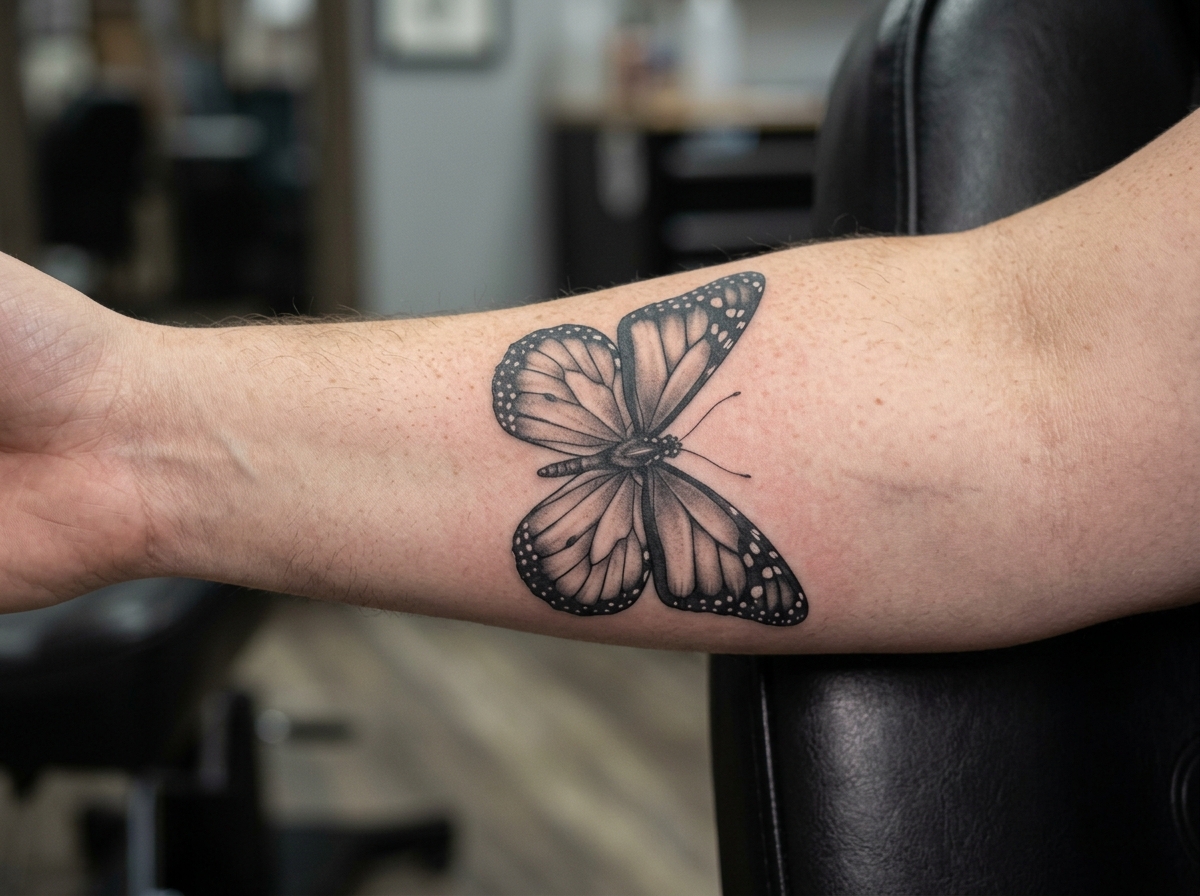
Realism recreates the insect with accurate vein structure, shading, and the white dots along the wing borders. It is the most detail-heavy style and usually needs a medium or large size to stay readable. Choose it if you love the species itself and want the tattoo to look like a specimen that landed on your skin. Best for: forearm, calf, thigh, shoulder blade, upper back.
Fine-line and minimalist monarch tattoos
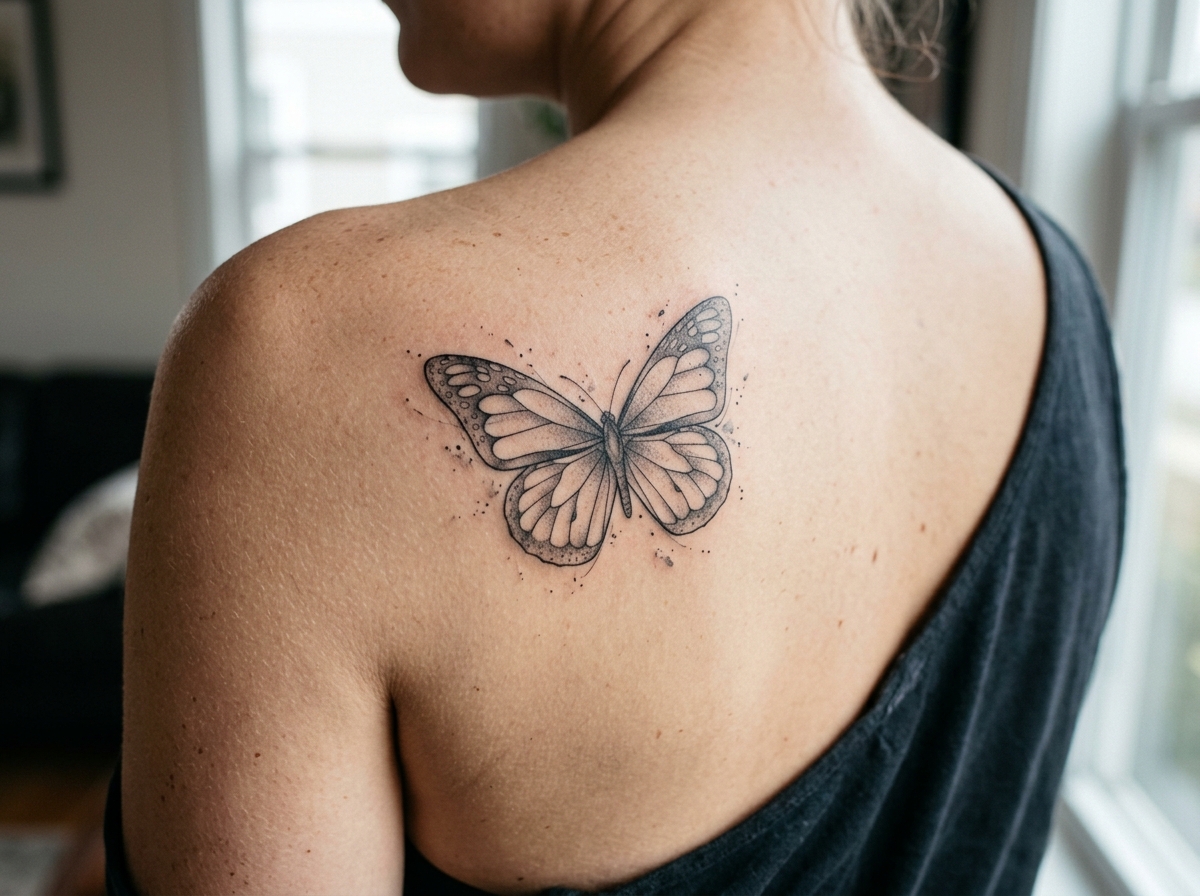
Fine-line monarchs use thin, delicate lines and a simplified structure, sometimes with only a hint of orange or none at all. They suit people who want a quiet, personal symbol. Keep the detail level modest, since very thin lines in very small tattoos can soften over the years. Best for: wrist, ankle, behind the ear, collarbone, finger-adjacent areas with an experienced artist.
Watercolor monarch tattoos
Watercolor designs let orange, yellow, and sometimes red bleed softly past the outline, as if painted. Many artists combine the color wash with a thin black outline so the shape stays defined as the tattoo ages. Ask to see healed watercolor work before booking, because soft, outline-free color can change more than bold traditional work over time. Best for: shoulder, ribs, thigh, upper arm.
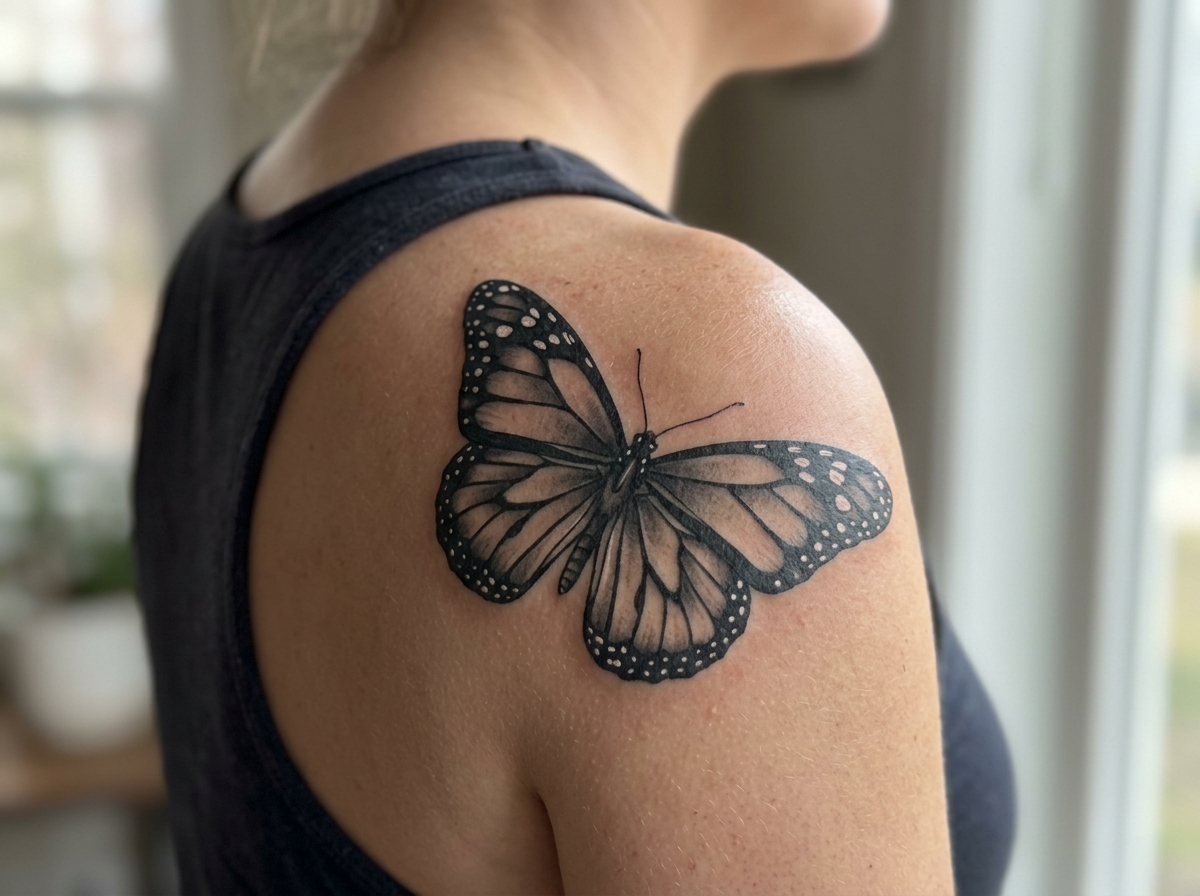
Blackwork and dotwork monarch tattoos
Blackwork skips the orange and builds the monarch from solid black shapes, linework, or stippled shading. It is one of the most durable approaches because black pigment tends to hold well, and the high contrast reads clearly years later. Dotwork adds texture through thousands of tiny dots, which suits ornamental and geometric versions. Best for: upper arm, back, thigh, sleeves.
Geometric monarch tattoos
Geometric monarchs break the wings into triangles, hexagons, or clean angular panels. The result feels modern and graphic, and it pairs well with symmetrical placement such as the sternum, spine, or center of the back. Geometric versions can also bring in themes of balance and structure. Best for: forearm, upper back, chest, thigh.
Neo-traditional and illustrative monarch tattoos
Neo-traditional work uses bold outlines, rich color, and decorative flourishes. The monarch becomes a stylized illustration, often surrounded by flowers or ornamental details. Bold outlines make this approach one of the most readable and longest-lasting for color tattoos. Best for: calf, upper arm, thigh, shoulder.
Ornamental and mandala monarch tattoos
Here the wings are filled with mandala patterns, lace-like linework, or filigree. The result is more decorative than anatomical, which gives the artist freedom to design something unique. This works especially well in black and gray, with orange used sparingly as an accent. Best for: upper arm, back, ribs, chest.
Stained-glass monarch tattoos
The stained-glass look divides the wings into color panels separated by thick black lines, echoing the monarch’s natural veins. It is a clever way to use the monarch’s existing structure while making the design feel artistic and a little unexpected. Best for: forearm, calf, shoulder, thigh.
4. Monarch Butterfly Tattoo Ideas With Other Elements
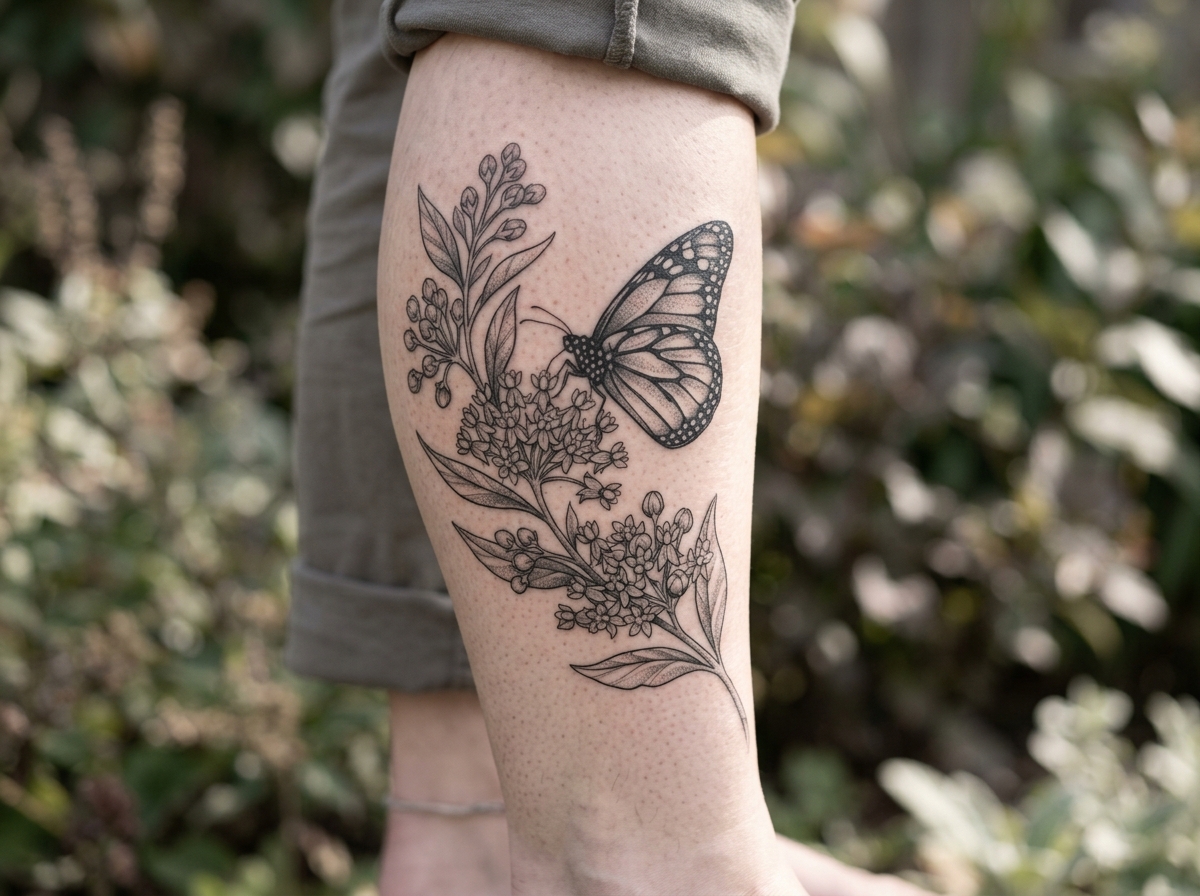
A monarch on its own is classic, but the elements around it can add meaning and make the design more personal.
- Monarch with milkweed: Milkweed is the plant monarch caterpillars depend on, so this pairing carries real ecological meaning as well as beauty.
- Monarch with wildflowers: Softer, more natural, and easy to scale from a small wrist piece to a larger botanical composition.
- Monarch with a birth flower: A simple way to add a personal detail for yourself or a family member.
- Monarch with marigolds: Marigolds are closely tied to Día de Muertos, so this combination is often chosen for memorial tattoos.
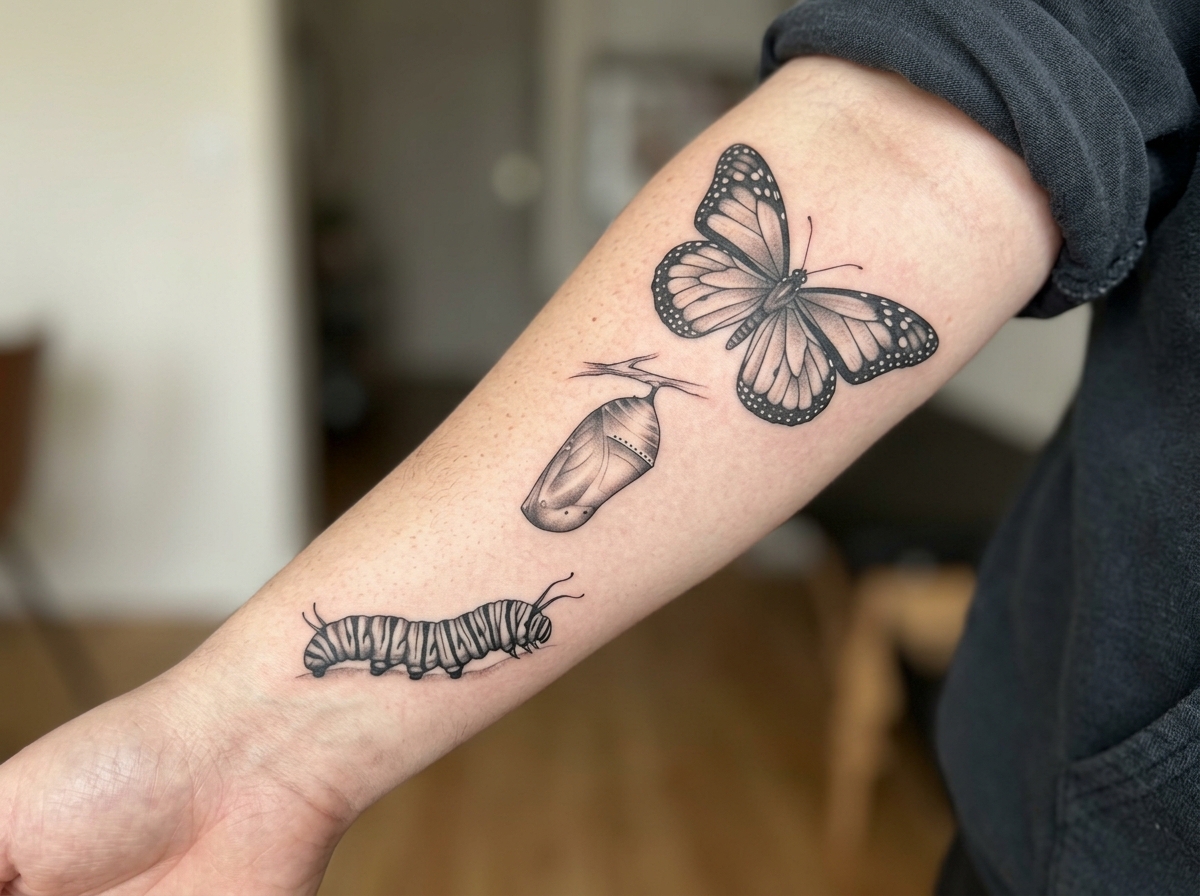
- Life cycle tattoo: A caterpillar, chrysalis, and adult butterfly together tell the complete transformation story. The monarch chrysalis is a distinctive jade green with a row of small gold-colored dots, which looks striking in color.
- Cluster of monarchs: Several monarchs flying together can suggest migration, community, family, or resilience after a hard period.
- Migration trail: A dotted or curved line behind the butterfly suggests a journey, a move, or a path through life.
- Monarch with moon or stars: Adds a quieter, more reflective mood.
- Monarch with initials, a date, or a short word: Keeps the symbolism private while still anchoring the tattoo to a specific person or moment.
As a rule, one or two meaningful additions work better than five. A crowded composition can lose the clean silhouette that makes the monarch so effective.
5. Best Placements for a Monarch Butterfly Tattoo
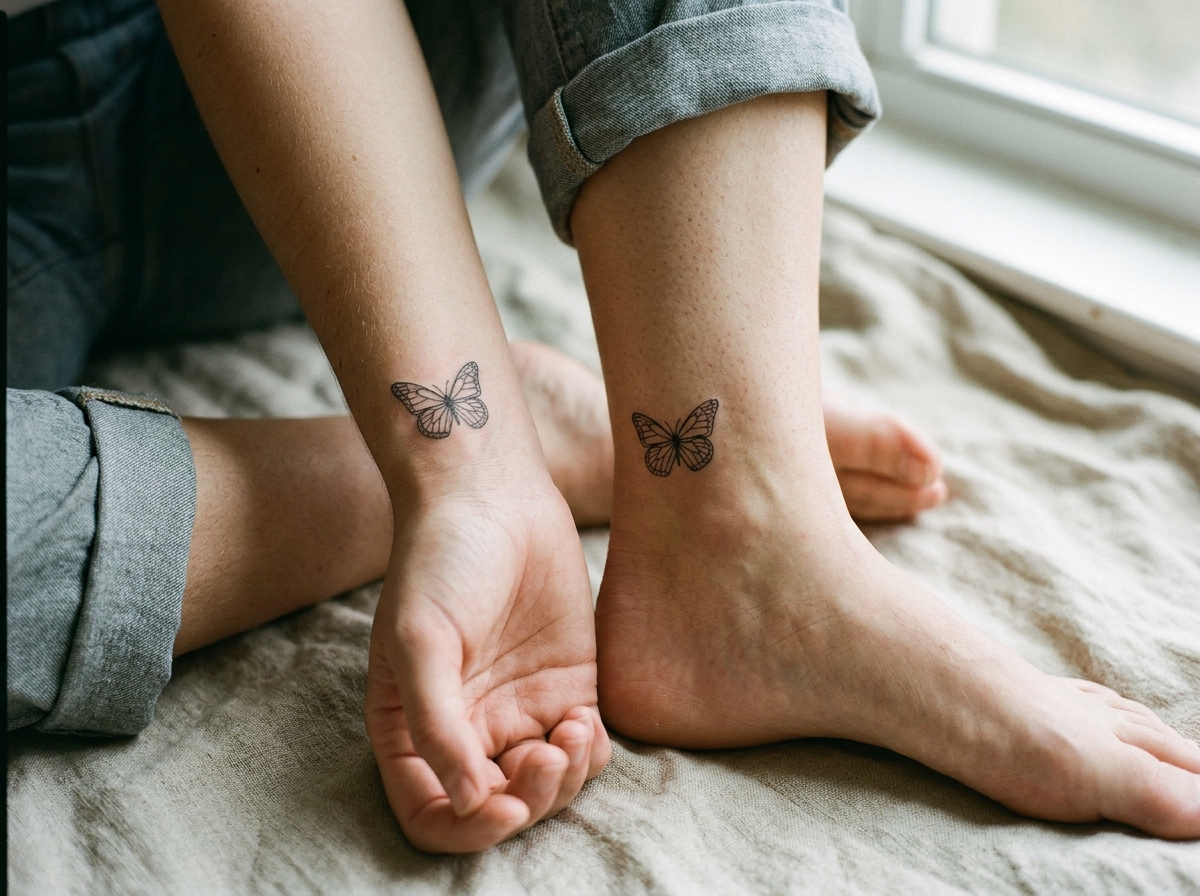
Placement affects how the wings sit, how visible the tattoo is, how it ages, and how it feels to get. The table below is a general guide. Pain is personal, so treat the comfort column as a rough pattern rather than a promise.
| Placement | Best size | Best styles | Notes |
|---|---|---|---|
| Wrist | Small | Fine-line, minimalist | Very visible and easy to show off. Frequent sun exposure, so protect it. |
| Inner forearm | Small to medium | Realistic, watercolor | Flat canvas that shows wing detail well. Usually one of the more comfortable spots. |
| Outer forearm | Medium | Geometric, neo-traditional | Highly visible and room for botanical extras. |
| Shoulder or upper arm | Medium to large | Any style | Easy to cover or show. Generally well tolerated. |
| Shoulder blade or upper back | Medium to large | Realistic, ornamental, geometric | Symmetrical and elegant, with room for a full-wingspan design. |
| Ribs | Small to medium | Watercolor, fine-line | Private and flowing, but commonly reported as one of the more painful areas. |
| Ankle or foot | Small | Minimalist, fine-line | Can be more sensitive and can heal slowly because of friction and swelling. |
| Calf or thigh | Medium to large | Realistic, neo-traditional, stained-glass | Large, forgiving canvas for detailed color work. |
| Behind the ear or neck | Small | Minimalist, blackwork | Subtle and sensitive. Consider workplace and long-term visibility. |
| Collarbone or sternum | Small to medium | Geometric, ornamental | Naturally symmetrical, though bony areas are often more sensitive. |
Ask your artist to place a stencil before you commit. A monarch’s wings should follow the natural curve of the body part. A stencil that looks right when you are standing still may sit differently when you move, so test it from several angles.
6. Small, Medium, or Large: Choosing the Right Size
The monarch’s wing pattern contains a lot of fine detail: veins, borders, and rows of white dots. How much of that detail survives depends largely on size.
- Small (about 1 to 2 inches): Works best as a simplified outline or a minimal silhouette with a touch of orange. Fine detail at this size can blur over time, so keep the design simple.
- Medium (about 3 to 5 inches): The sweet spot for most designs. There is enough room for visible veins, white dots, and a little shading without needing a large commitment.
- Large (6 inches and up): Ideal for realistic, ornamental, or composition-heavy tattoos with flowers, multiple butterflies, or a flowing migration path.
If you are torn between two sizes, many artists recommend going slightly larger than your first instinct, especially for color tattoos. A design that has room to breathe usually ages better than one squeezed into a tiny space.
7. Monarch Tattoo Ideas by Purpose
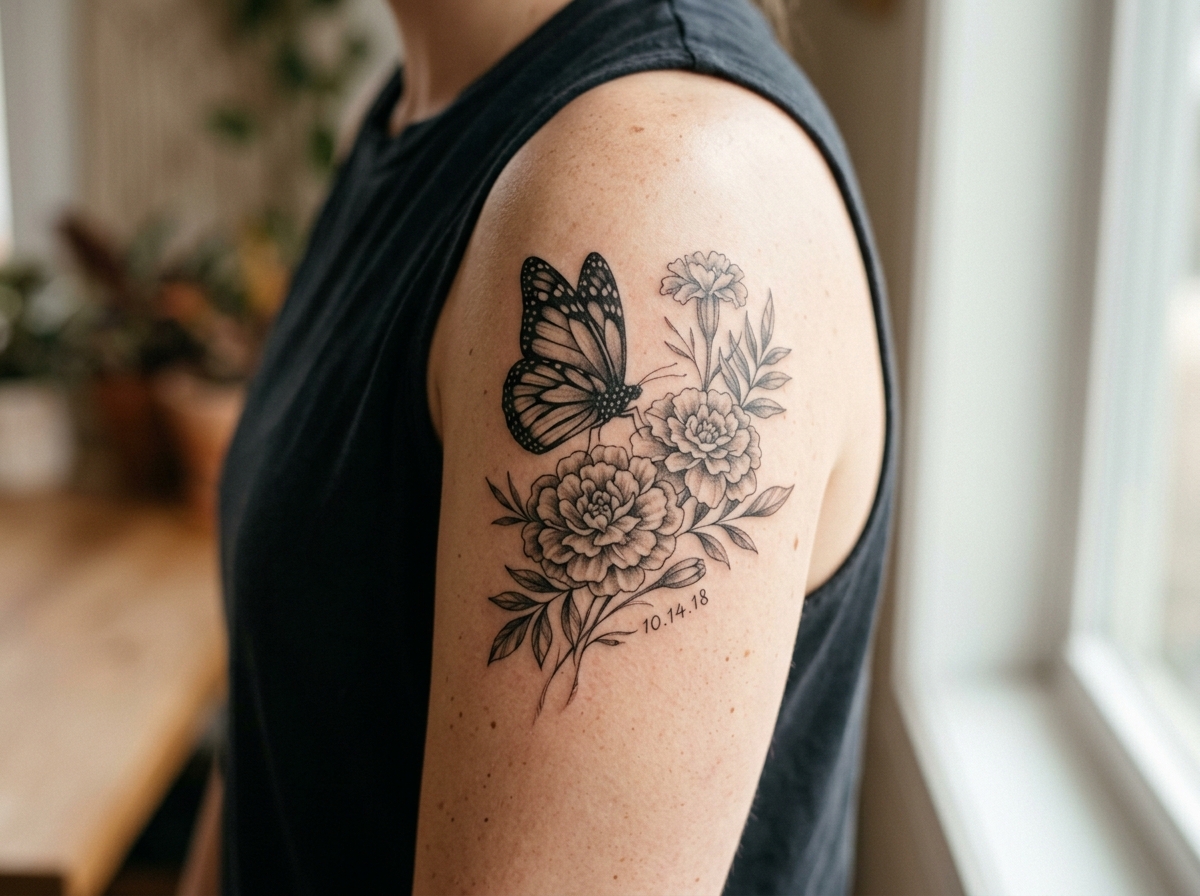
Many people choose a monarch because it connects to a specific moment or person. These are the most common reasons, with design ideas for each.
- Memorial: A monarch with marigolds, initials, or a date. Keep it simple and let one detail carry the meaning.
- Personal transformation or recovery: A life-cycle design, or a monarch emerging from a chrysalis, to mark a hard chapter that changed you.
- Family: A cluster of monarchs, one for each family member, or a larger monarch with smaller ones nearby.
- Heritage and connection to Mexico: A monarch with marigolds or traditional decorative elements, ideally designed with an artist who respects the cultural context.
- Travel, moving, or finding home: A monarch with a dotted migration path, a compass, or a small map detail.
- Love of nature and conservation: A monarch with milkweed and wildflowers, rendered in realistic style. For up-to-date information on the species, see the U.S. Fish and Wildlife Service monarch page.
8. Getting the Monarch Anatomy Right
If you want a realistic or semi-realistic monarch, accuracy matters. A few details separate a convincing monarch from a generic orange butterfly.
- Black veins: The orange wings are divided by distinct black veins. Females typically have thicker, darker veins than males.
- Black spot on the hindwings: Males have a small black spot on a vein of each hindwing. Females do not.
- White dots: Rows of white spots appear along the black wing borders and on the body and head.
- The viceroy lookalike: The viceroy butterfly is often confused with the monarch, but it has an extra black line crossing the hindwing. If species accuracy matters to you, check that your reference does not show that line.
Bring two or three high-quality reference photos to your consultation. A skilled artist will adapt the design to your body, but a good reference helps them get proportions and pattern right.
9. Color Choices and How Orange Ages
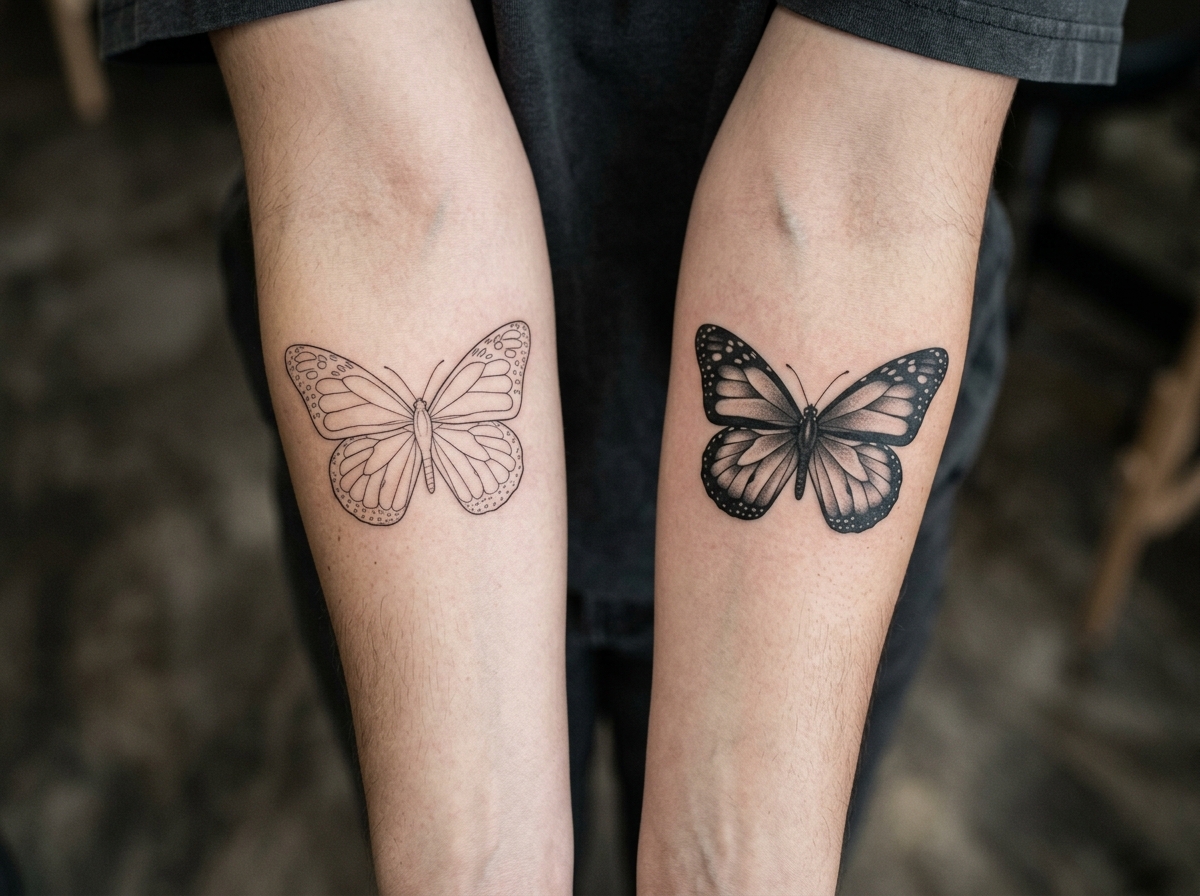
The classic monarch palette is orange, black, and white, with touches of yellow in the wing borders. You can follow it closely, or take a different route.
- Natural palette: Saturated orange with strong black veins and white dots. The most recognizable choice.
- Black and gray: Timeless and durable, and a good choice if you worry about color fading.
- Black with one orange accent: A modern compromise. The color draws the eye without needing full saturation across the whole design.
- Warm watercolor palette: Orange blending into yellow and soft red for a painterly effect.
Bright colors, especially lighter oranges and yellows, can soften with time and sun exposure. Strong black outlines help the design hold its shape even if the color mellows. Daily sunscreen on the healed tattoo and occasional touch-ups can keep the orange looking fresh. For general guidance on caring for tattooed skin, see the American Academy of Dermatology’s tattooed-skin care guide.
10. Cost, Time & Pain
These numbers vary widely by artist, city, and design, so use them as rough orientation rather than a quote.
- Cost: Small, simple monarchs often start around $100 to $200, partly because many studios have minimum prices. Large, detailed color pieces can run to several hundred dollars or more than $1,000, depending on the artist and the hours involved.
- Time: A small design can take 30 minutes to an hour. A detailed realistic monarch often takes two to three hours or more, and large compositions may be split into several sessions.
- Pain: This depends on placement and personal tolerance. Fleshier areas like the outer arm or thigh are generally easier, while bony or thin-skinned areas like the ribs, ankle, and sternum are commonly described as more intense.
Cheap tattoos are rarely a bargain with detailed color work. It is usually better to wait and pay for an artist whose healed portfolio matches the look you want.
11. How to Choose the Right Artist
A monarch looks simple, but doing it well takes control of color saturation, fine line work, and symmetry. Use this checklist when comparing artists.
- Look for healed photos, not just fresh ones, especially for color and fine-line work.
- Check that the artist’s portfolio includes the style you want, such as realism, watercolor, or blackwork.
- Ask how they handle orange and yellow pigments and what they recommend for long-term appearance.
- Request a consultation and a stencil so you can judge size and placement before the session.
- Confirm that the studio is licensed, clean, and follows proper hygiene practices.
- Ask about their deposit, touch-up policy, and cancellation terms.
12. Aftercare for a Monarch Butterfly Tattoo
Good aftercare protects the color and the fine lines. Always follow your own artist’s instructions first, because they know the products and techniques used on your tattoo. In general:
- Keep the tattoo clean and follow the cleaning routine your artist gives you.
- Moisturize lightly as directed, without over-applying ointment.
- Do not pick or scratch scabs or flaking skin, since that can pull color out.
- Avoid soaking in pools, baths, or the sea while it heals.
- Stay out of direct sun during healing, then use sunscreen on the healed tattoo to help protect the orange.
Mild redness and tenderness are normal early on. If you notice spreading redness, swelling, pus, fever, or pain that gets worse instead of better, contact a medical professional. The American Academy of Dermatology guide to tattoo skin reactions explains what to watch for.
13. Our Design Picks for 2026
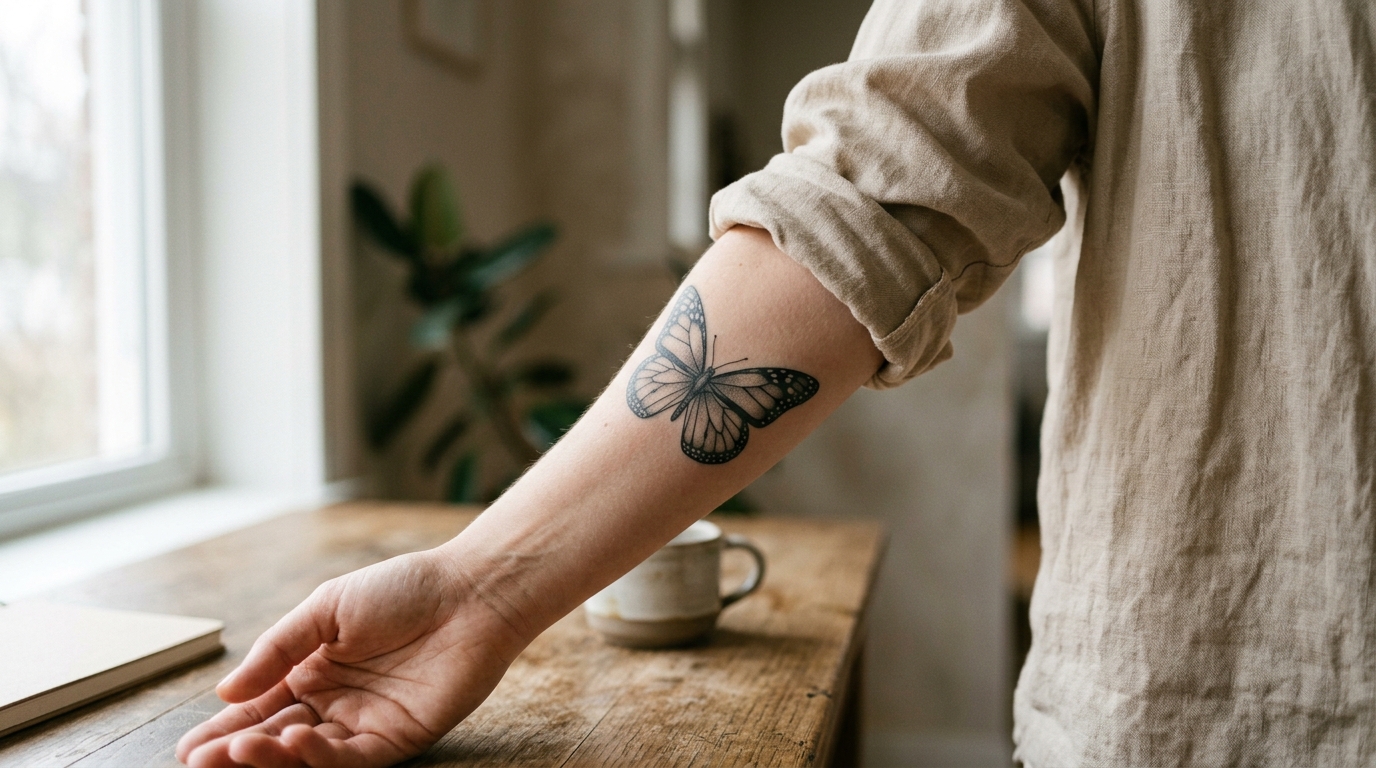
These are our editorial picks, based on what tends to age well and feel personal rather than on any claim about what is trending.
- A medium realistic monarch with a fine-line botanical accent. It gives you accuracy and a personal touch without crowding the wings.
- The life-cycle trio. Caterpillar, chrysalis, and butterfly in a diagonal flow. It is a rich design with a clear story.
- A black outline monarch with orange accents only. Modern, durable, and easy to touch up.
- A stained-glass monarch on the forearm or calf. It uses the monarch’s real vein structure in a way that looks intentional.
- A monarch with a dotted migration path. Simple, symbolic, and flexible for any placement.
- A small fine-line monarch behind the ear or on the wrist. Quiet and elegant, best kept simple.
Common mistakes to avoid: going too small for a detailed design, adding too many symbols, using a reference that confuses the monarch with another species, skipping the stencil, and choosing an artist by price alone.
14. Monarch Butterfly Tattoo FAQ
Click a question to reveal the answer.
What does a monarch butterfly tattoo mean?
Where is the best place to get a monarch butterfly tattoo?
How much does a monarch butterfly tattoo cost?
Does a monarch butterfly tattoo hurt?
How long does a monarch butterfly tattoo take?
Will the orange in a monarch tattoo fade?
Can I get a monarch butterfly tattoo in black and gray?
Is a monarch butterfly tattoo only for women?
Can a monarch butterfly tattoo honor someone who has passed away?
How do I tell a monarch from other orange butterflies in a tattoo design?
15. Final Thoughts
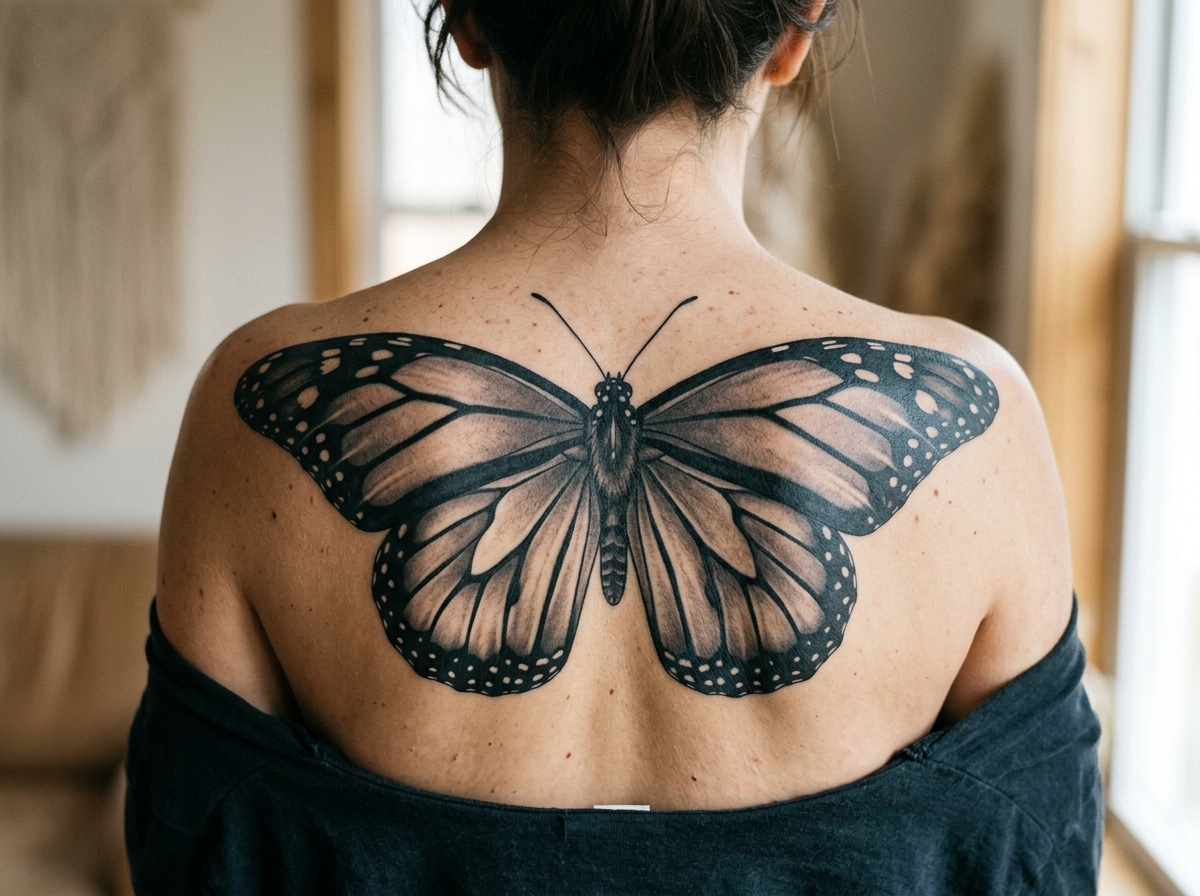
A monarch butterfly tattoo works because it combines instant recognition with real depth. The bold orange wings catch the eye, and the story behind them, from metamorphosis to migration to remembrance, gives the tattoo something to say.
The best monarch butterfly tattoo design is the one that fits your story, your body, and your tolerance for upkeep. Start with the meaning, choose a style that suits the amount of detail you want, pick a size that lets the wings breathe, and work with an artist whose healed portfolio matches your vision.
To explore other species and styles, continue with the full Inkelys Butterfly Tattoos: 50+ Ideas, Meanings, Styles & Placement Guide. For a deeper look at symbolism, read Butterfly Tattoo Meaning: Transformation, Freedom & Symbolism Explained.
3 thoughts on “Best Monarch Butterfly Tattoo Designs for 2026 (Meaning + Ideas)”