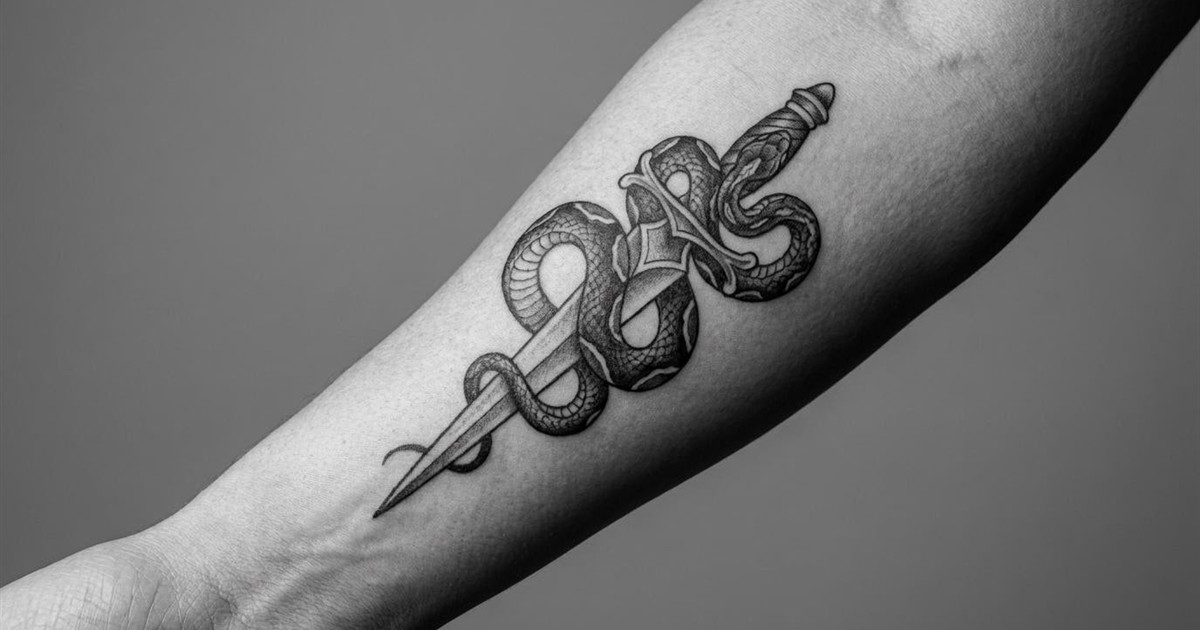
The snake and dagger tattoo meaning is rarely a single fixed idea. Together, the two symbols most often point to conflict resolved, a threat confronted, protection, knowledge, or a trait reclaimed — and the way the design is drawn decides which of those is loudest. A serpent coiled around a lowered blade reads very differently from a dagger driven through a rearing snake, even though both use the same two objects.
This guide sets out what the snake means on its own, what the dagger means on its own, and what changes when they are combined. It then covers the main design variations, how tattoo styles affect the look and the ageing, where the composition sits best on the body, and the practical questions of cost, pain and aftercare. Everything here is editorial guidance drawn from tattoo convention and documented symbolism rather than a dictionary of fixed answers, because meanings are conventions and personal interpretation varies.
Quick Answer: What Does a Snake and Dagger Tattoo Mean?
A snake and dagger tattoo usually signals conflict resolved or a trait reclaimed. The snake supplies meaning around renewal, knowledge, temptation, danger, or healing; the dagger supplies the act of facing what the snake represents. Which reading wins depends on the composition: a snake wrapped around the blade tends to read as control or containment, a blade piercing the snake as victory over something difficult, and the two lying side by side as balance between them. None of these is a fixed code — the pairing is a set of conventions, and the wearer’s own reason sits on top of them.
Table of Contents
- What a Snake and Dagger Tattoo Means at Its Core
- What the Snake Symbolises
- What the Dagger Symbolises
- What the Two Symbols Mean Together
- 7 Snake and Dagger Design Ideas
- Snake and Dagger vs Other Combinations
- Snake and Dagger Tattoo Styles and How They Age
- Where a Snake and Dagger Tattoo Looks Best
- Choosing a Design and an Artist
- Cost, Pain, Healing and Aftercare
- Snake and Dagger Tattoo Meaning FAQ
- Final Thoughts
What a Snake and Dagger Tattoo Means at Its Core
Most tattoo symbols are pictures of a feeling. A snake and dagger is a picture of an encounter. That is the first thing to understand: the pairing is rarely about the snake or the blade in isolation, but about the relationship between them — who is holding whom, which one is winning, and how the two are arranged.
People who ask what a snake and dagger tattoo means are usually really asking whether the design in front of them will be read the way they intend. The honest answer is that the combination is unusually elastic. It can carry danger, healing, transformation, loyalty, betrayal, or mastery, and the same drawing can shift between those readings depending on the direction of the blade, the posture of the snake, the surrounding elements, and the style.
That elasticity is also why the design lasts. It reads as considered at 25 and still reads as deliberate decades later, because it never depended on a trend in the first place. The object is old, the animal is older, and the meaning is assembled from the two rather than borrowed from fashion.
What the Snake Symbolises
The snake is one of the most loaded symbols in existence, which is exactly why it works so well beside a blade. It sheds its skin and appears renewed, it moves without limbs, and in many traditions it is associated with wisdom, temptation and life. That range is the point: a snake can stand for the thing that threatens you, the thing that heals you, or the thing you are trying to master.
In healing traditions the association is unusually concrete. The Rod of Asclepius, a single serpent wound around a staff, became the enduring emblem of medicine, which is why the snake appears in so much medical iconography today. Worn in that spirit, a snake in a tattoo leans towards recovery and protection rather than threat.
In other readings the snake is knowledge, transformation, or a quiet warning. It also carries a bridal or protective role in several folk traditions. The practical point for a tattoo is simple: decide which side of the snake you mean before you decide how to draw it, because a snake in attack posture and a snake at rest are read as two different symbols.
What the Dagger Symbolises
The dagger carries a similarly wide but differently sourced charge. It is a tool before it is a feeling: short, symmetrical, double-edged, and carried for close work rather than reach. In medieval and Renaissance Europe it was a constant companion rather than a battlefield weapon, and that ordinariness is where its modern symbolism was set.
The blade’s meaning turns on direction and intent. Held upward it reads as readiness and defence; resting downward it reads as grief, remembrance, or a warning laid down rather than raised. Across tattoo practice the dagger most often signals protection, sacrifice, loyalty, danger, or self-reliance, and the way it is rendered decides which of those is loudest. For a fuller treatment of the blade on its own, see our guide to dagger tattoo meaning, but the short version is that a dagger is a statement of capacity and resolve before it is a statement of violence.
What the Two Symbols Mean Together
Put the two together and the meaning becomes relational. The most common reading across tattoo practice is conflict resolved or a trait reclaimed — the blade against the thing that threatens, or the hand that finally holds the snake. There are three broad arrangements, and they do noticeably different work.
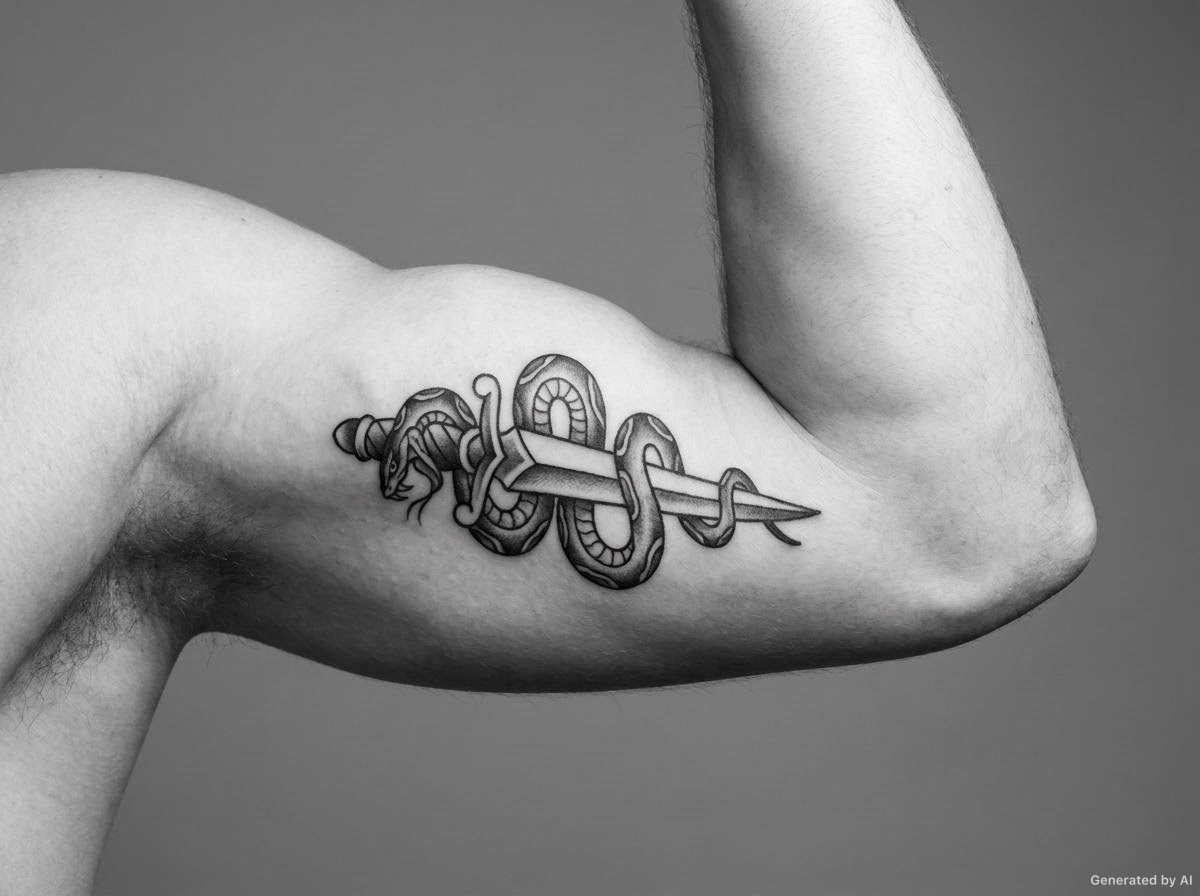
- Snake wrapped around the blade. Control, containment, or a difficult thing brought to heel. The snake is present, but it has been given a shape by the dagger.
- Dagger driven through the snake. Victory over something difficult. Usually recovery, release, or an obstacle finally faced, and the harshest of the three arrangements.
- Snake and dagger side by side. Balance and duality — the threat and the answer to it held at once, neither dominating the other.
Two cautions belong here. First, none of this is a fixed code; the reading shifts with culture, region and the company the symbols keep, and plenty of wearers choose the pairing for reasons that have nothing to do with the conventions above. Second, the composition exists for a practical reason as well as a symbolic one: a snake gives the dagger movement and lets the design wrap a limb, which solves a real layout problem that a straight blade alone cannot.
7 Snake and Dagger Design Ideas
The pairing has been drawn so often that the strongest designs are usually a deliberate variation on a familiar arrangement rather than an entirely new idea. These seven are the compositions most worth understanding before you brief an artist.
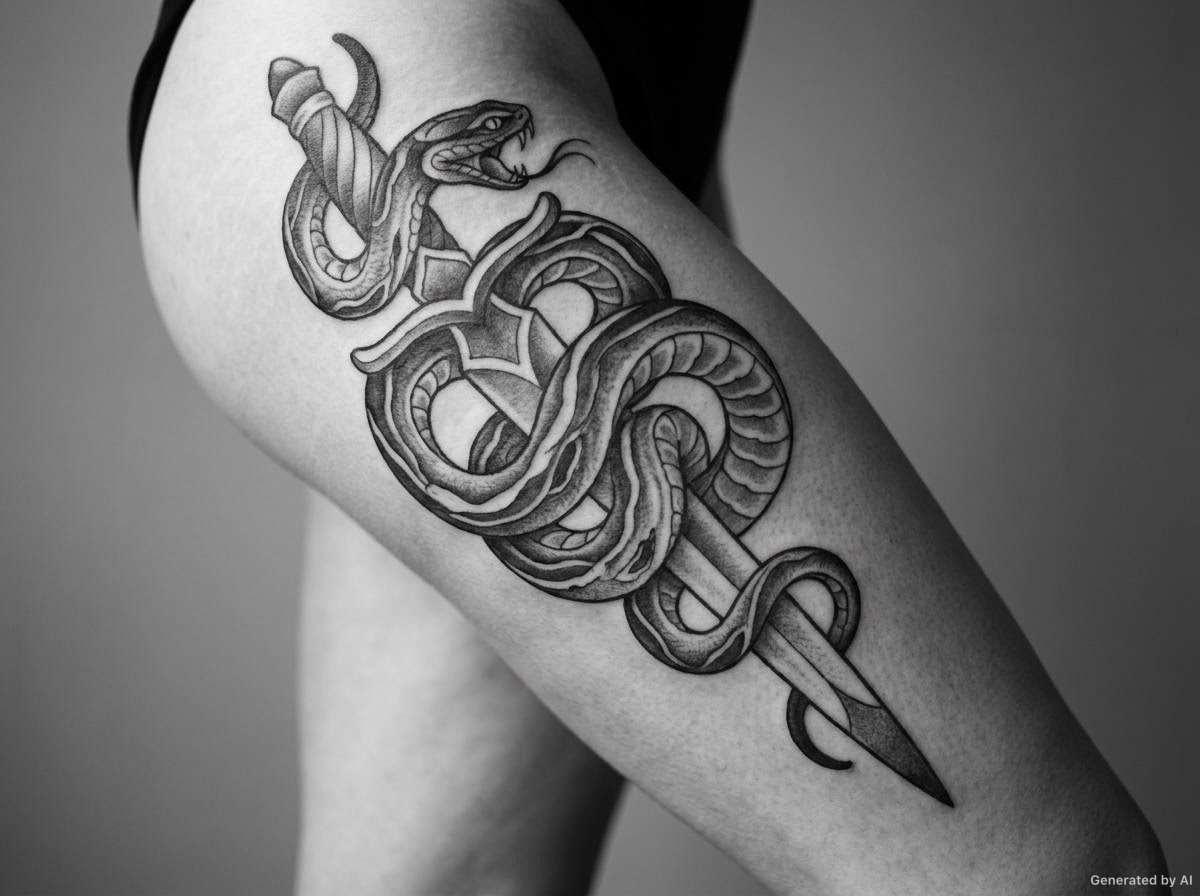
1. Snake coiled around the blade
The classic and the most legible. The snake winds from the handle toward the point, which gives the dagger a sense of movement and lets the whole design wrap an arm or a lower leg. The snake is typically rendered with visible scales and a defined head, and its direction — climbing toward the point or sliding down toward the guard — is what changes the reading from mastery to surrender.
2. Dagger piercing the snake’s head
The most direct version. A rearing or open-mouthed snake is pinned by the blade, and the tension of the pose is the whole drama. This composition is heavier and more confrontational, so it works best at a larger size where the snake’s pose and the blade’s angle can both read clearly.
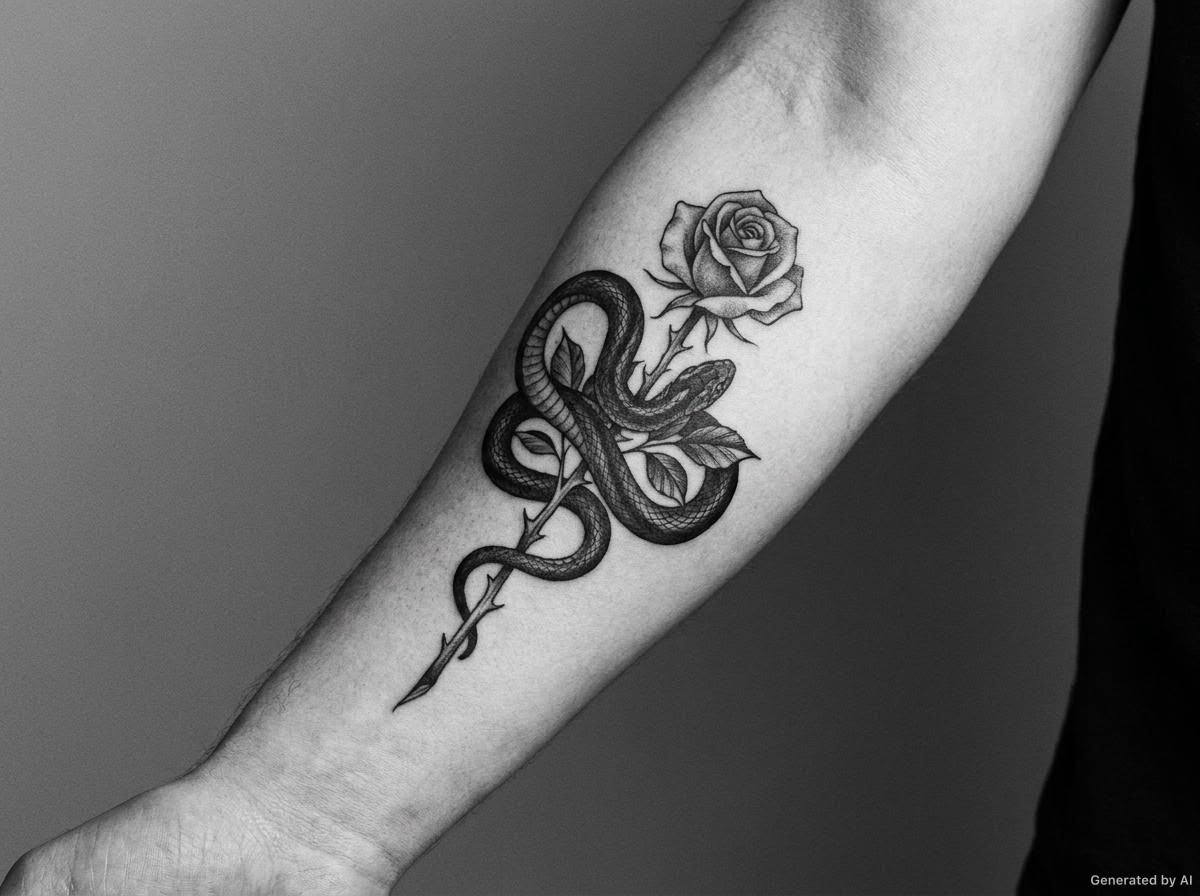
3. Snake and dagger with a rose
Adding a flower softens the pairing and layers in love, loss, or beauty with a cost. A rose beside or behind the blade reads very differently from a rose impaled on it, and thorns reinforce the same idea without a single word of script.
4. Ouroboros with a central dagger
An ouroboros — a snake swallowing its own tail — is a symbol of cycles and continuity. Placing a dagger through the centre turns the composition into a statement about breaking or completing a cycle, and the symmetry makes it a natural fit for a chest, shoulder or upper arm.
5. Snake and dagger with a skull
A mortality pairing in the tradition of memento mori art. Here the dagger is the agent and the skull is the outcome, which makes the design stricter and less sentimental than a floral arrangement. Blackwork or heavy black-and-grey shading suits it, because the drama comes from contrast rather than detail.
6. Snake and dagger with a banner or script
A ribbon or banner threaded through the design allows a name, a date, or a short phrase to sit inside the composition rather than beside it. This is the natural choice for a memorial or a tribute piece, where the message is specific and personal. The banner also adds horizontal balance to a design that is otherwise very vertical.
7. Framed and ornamental arrangement
Fine-line, geometric or neo-traditional framing — arcs, symmetry, dotwork borders — turns the pairing into a jewellery-like ornament. This is the least aggressive of the seven, and it suits the wrist, the sternum, or a small neck piece where a heavy composition would overwhelm the space.
Snake and Dagger vs Other Combinations
The snake and dagger sits in a family of blade pairings, and the alternatives shift the meaning before any other decision. The table below sets out how the most common options tend to be read and where they work best. These are conventions drawn from tattoo practice rather than fixed definitions, and plenty of designs deliberately mix them.
| Combination | Elements | What it usually reads as | Where it works well |
|---|---|---|---|
| Snake and dagger | Serpent plus short double-edged blade | Conflict resolved, a trait reclaimed, control or mastery | Forearm, upper arm, calf, thigh |
| Snake and sword | Serpent plus long hilted blade | Honour, lineage or justice contested; a larger, more formal statement | Back, ribs, thigh — needs scale to read |
| Snake and rose | Serpent plus flower and thorns | Love with a cost, beauty and danger, temptation | Forearm, shoulder, thigh |
| Snake alone | Serpent only | Renewal, knowledge, protection or threat, depending on posture | Anywhere with a linear axis: arm, spine, ribs |
| Dagger alone | Blade only | Protection, sacrifice, resolve or self-reliance | Forearm, calf, chest, spine |
Two practical points follow. First, the snake is doing most of the narrative work in the pairing; swap it for a rose and the design becomes warmer and more romantic, swap it for a skull and it becomes colder and more final. Second, adding a blade to a snake changes scale — a snake alone can be delicate and small, while a snake wrapped around a dagger needs enough length for both silhouettes to survive, which usually pushes the piece toward the forearm, thigh or upper arm.
Snake and Dagger Tattoo Styles and How They Age
Style is not only a look. On this pairing it decides how much detail can survive, how the piece reads at a distance, and how it will look in a decade. The same arrangement drawn in different styles produces genuinely different tattoos.
Traditional
Bold outlines, a limited palette, and high contrast. Traditional snake and dagger work reads from across a room and ages more predictably than almost anything else, because it relies on line weight and silhouette rather than fine shading. For a large piece it is the safest long-term choice.
Neo-traditional
Traditional bones with more depth: layered shading, ornament, and a wider colour range. It keeps the readability of traditional work while allowing more individual detail, which suits decorated handles and an ornate snake pattern.
Realism and black and grey
Realism treats both subjects as studies — scale texture, steel reflections, worn edges, skin highlights. It is the most detail-hungry approach and needs a specialist, and it needs the most space, because a small realism piece loses the very texture it was chosen for.
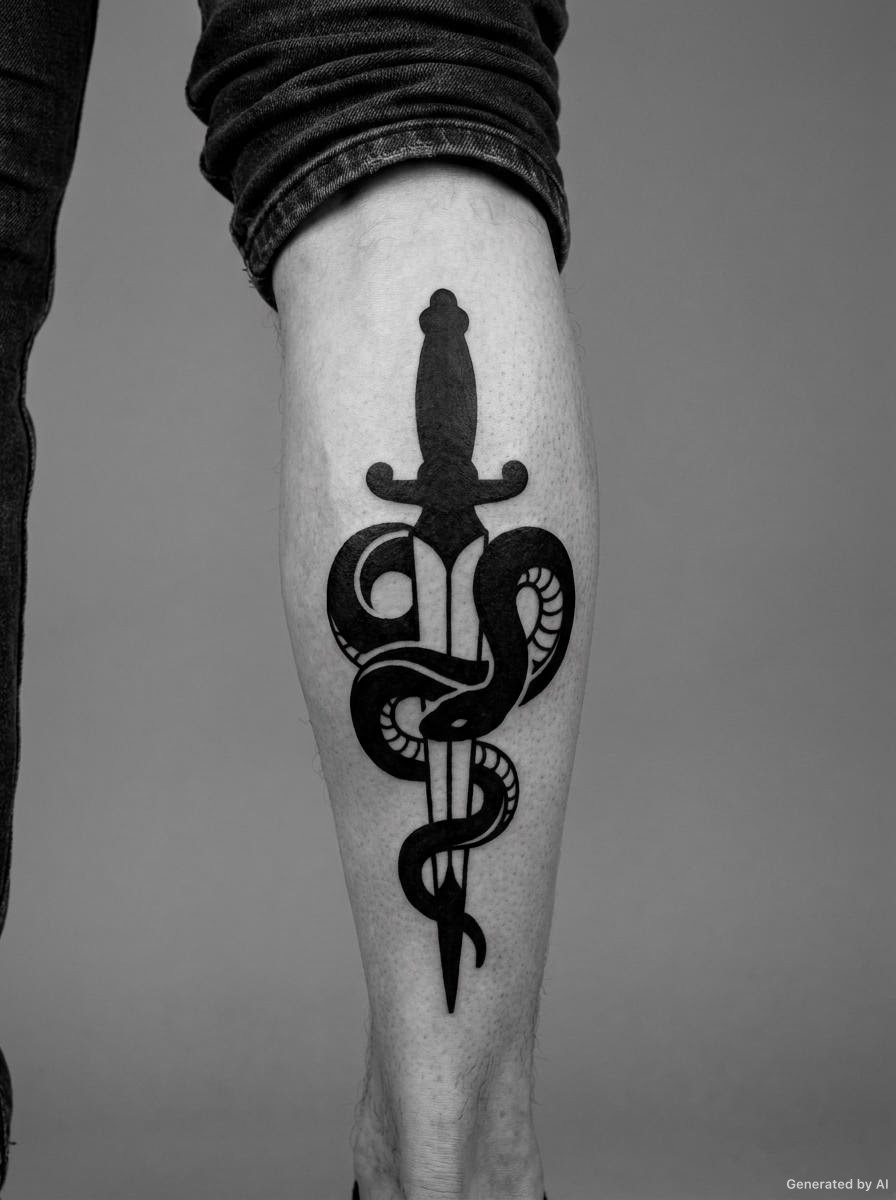
Blackwork
Solid black mass, negative space, and silhouette. Blackwork is the most durable of all, because it barely depends on detail. If you want a piece that still looks deliberate in twenty years, this is the most forgiving choice.
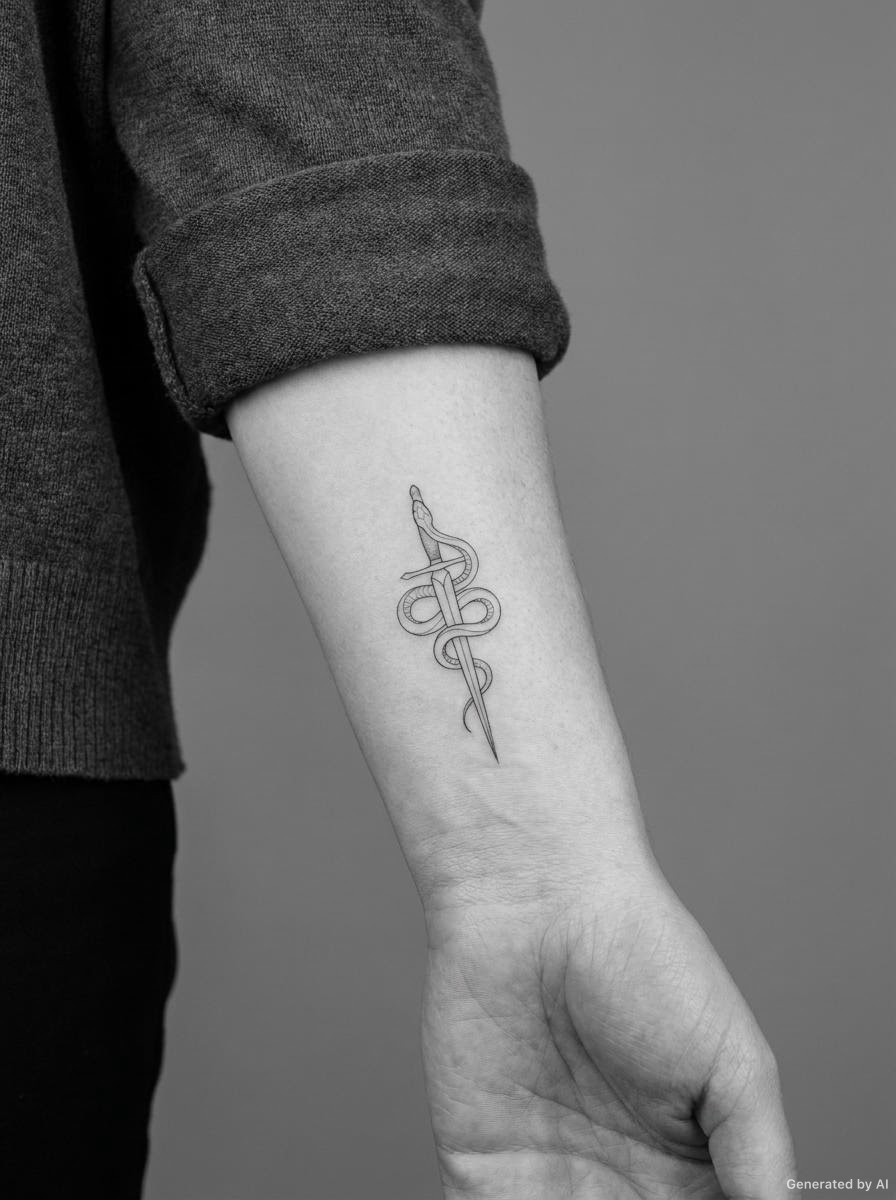
Fine line
Single-needle or very thin strokes, usually with open negative space. A fine-line snake and dagger reads as intimate and considered rather than confrontational, but very fine work softens and spreads over time, so it is worth asking honestly how the lines will hold before committing.
Dotwork
Texture built from stippling rather than solid fill. Dotwork gives softer gradients and a hand-drawn quality, and it suits symbolic and ornamental versions of the design. It is slower to tattoo and softens gently with age.
Geometric
The snake and dagger broken into planes, repeated shapes, or precise line work, often combined with dotwork. Geometric versions are crisp and modern, and they depend entirely on clean execution, so alignment matters more here than in any other style.
None of these is better than the others. The question is which one carries your meaning: a memorial piece often wants the restraint of fine line or blackwork, while a statement of resolve often wants the weight of traditional.
Where a Snake and Dagger Tattoo Looks Best
Placement is a bigger decision than most people expect, because the composition has a strong vertical axis — the dagger is straight and the snake wraps. It follows the long lines of the body unusually well, which is why it works on limbs, the spine, and the ribs, and tends to look cramped in wide, flat areas.
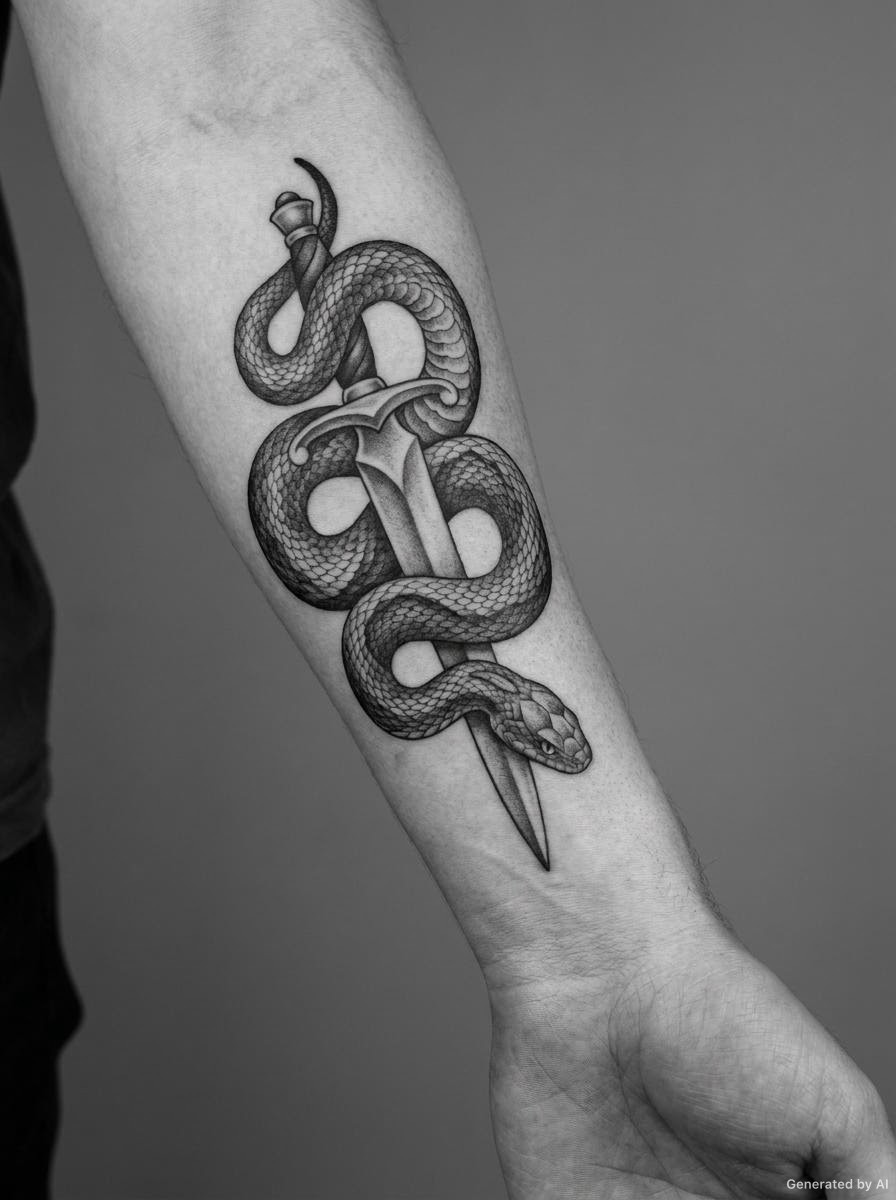
Forearm, inner or outer. The default for a reason: the blade sits vertically along the arm, the snake has room to wind, and the piece is easy to see and straightforward to cover with long sleeves. Both small fine-line work and large traditional pieces work here.
Upper arm and shoulder. The classic position for a large composition. There is room for a full arrangement of snake, blade and supporting elements, and the silhouette reads clearly at a distance.
Thigh. The largest canvas on the body and the easiest place to build a detailed, layered piece. Comfortable to sit through at the lower end, harder to reach at the top, and simple to conceal.
Calf and shin. Natural vertical space, and usually covered by clothing. Lower legs take bold work well and suit a snake that wraps the leg, and they are a common first placement.
Ribs and side. Ribs suit elongated designs that follow the curve of the ribcage. They move with breathing, which most people find the harder part of the session, and they are best for a design you do not need to see every day.
Spine. A strong vertical axis and a naturally symmetrical composition. Alignment is doing all the work here, so it is worth choosing an artist who has placed work on a spine before and looking at photographs of their finished pieces on real backs.
Hand, wrist and ankle. The most visible and the smallest. Fine-line and minimalist versions suit these placements, but they are also the fastest areas to fade and the ones most likely to be seen in a workplace.
On pain: it is individual and placement-dependent. Areas over bone or close to the ribs are commonly reported as more uncomfortable, and fleshier areas as easier, but no ranking applies to everyone. How a session feels has as much to do with the artist’s pace, the length of the appointment, and your own state on the day as with the location itself, which is why placement guidance is best taken from your artist rather than from a general list.
Choosing a Design and an Artist
The gap between a good snake and dagger tattoo and a poor one is usually execution rather than idea. A short checklist before you book:
- Use references as direction, not as a brief. Show three or four pieces you like and say what appeals about each one — the line weight, the composition, the placement. Asking for a photograph to be copied exactly rarely produces the best result, and many artists will not do it.
- Check the portfolio for your style specifically. A strong realism artist is not automatically a strong fine-line artist. Look for healed photographs as well as fresh ones, because healed work shows how a design actually settles.
- Ask how the detail will age. A good artist will say honestly when a composition is too detailed for its size, and will offer to simplify it rather than accept the booking as described.
- Confirm the stencil in a mirror. Direction, placement, and size are easy to change on a stencil and almost impossible to change afterwards. Check it standing up rather than lying down, because the design shifts when you move.
- Match detail to size. Fine detail needs space. A detailed composition squeezed into two inches will blur into a smudge, while the same design at six inches will hold its shape.
- Talk about visibility before you commit. Tell the artist where you work and how much of the tattoo needs to be coverable. It is a normal part of the conversation, and it affects placement as much as size.
The same principle applies across tattoo symbolism generally — how a symbol is drawn changes what it says more than the symbol itself does. Our guide to butterfly tattoo meaning walks through the same idea in a completely different visual language, which is a useful comparison if you are deciding how much detail to specify.
Cost, Pain, Healing and Aftercare
Cost. Price varies with the artist, their location, the size of the piece, the complexity of the design, and whether it is colour or black and grey. There is no meaningful average, because the same snake and dagger can be an hour’s work or several full sessions depending on scale and detail. The reliable approach is to ask for a quote for your specific design and size before booking, and to treat any hourly figure you read online as a local rate rather than a universal one.
Pain. Pain is individual and placement-dependent, as covered above. What is more predictable is duration: a piece completed in one pass is a different experience from one built over several sessions, and the later sessions are often the ones people find harder.
Healing. A tattoo heals on the surface within a few weeks, and the skin underneath continues to settle for longer. Expect some peeling and a dull, flat look in the first fortnight; both are normal. If the area becomes unusually painful, looks infected, or a reaction spreads beyond the tattoo, that is a medical question rather than a tattoo question, so speak to a doctor.
General aftercare. Keep the area clean and dry, wash it gently without scrubbing, apply a thin layer of whatever ointment your artist recommends rather than a thick one, and avoid soaking, swimming, and direct sun while it heals. Do not pick or scratch at it, even when it itches. Sun protection matters permanently rather than only during healing, because sun exposure is the main reason tattoos soften and fade.
This is general guidance only. Your artist’s aftercare instructions are specific to the work they did, and medical advice overrides both.
Snake and Dagger Tattoo Meaning FAQ
What does a snake and dagger tattoo mean?
What does a snake wrapped around a dagger mean?
What does a dagger through a snake mean?
Do snake and dagger tattoos have a religious meaning?
Where does a snake and dagger tattoo look best?
How much does a snake and dagger tattoo cost?
Does a snake and dagger tattoo have to be black and grey?
Is a snake and dagger tattoo painful?
Final Thoughts
A snake and dagger tattoo means whatever the wearer has decided the encounter is about. The two symbols give you the vocabulary — renewal, knowledge, danger, healing, protection, resolve — and the arrangement decides which word the tattoo actually says. Decide the meaning first, then let the direction of the blade, the posture of the snake, and the style follow from it, and you will end up with a piece that still reads clearly in twenty years.
If you are still working out the design itself, the knife and dagger tattoo ideas guide is the natural next step, and you can browse everything in the cluster at Knife Tattoos guides. Our editorial approach explains how every guide here is researched and written.
3 thoughts on “Snake and Dagger Tattoo Meaning: Symbolism, Designs and Placement”