Quick Answer: What Does a Dagger Tattoo Mean?
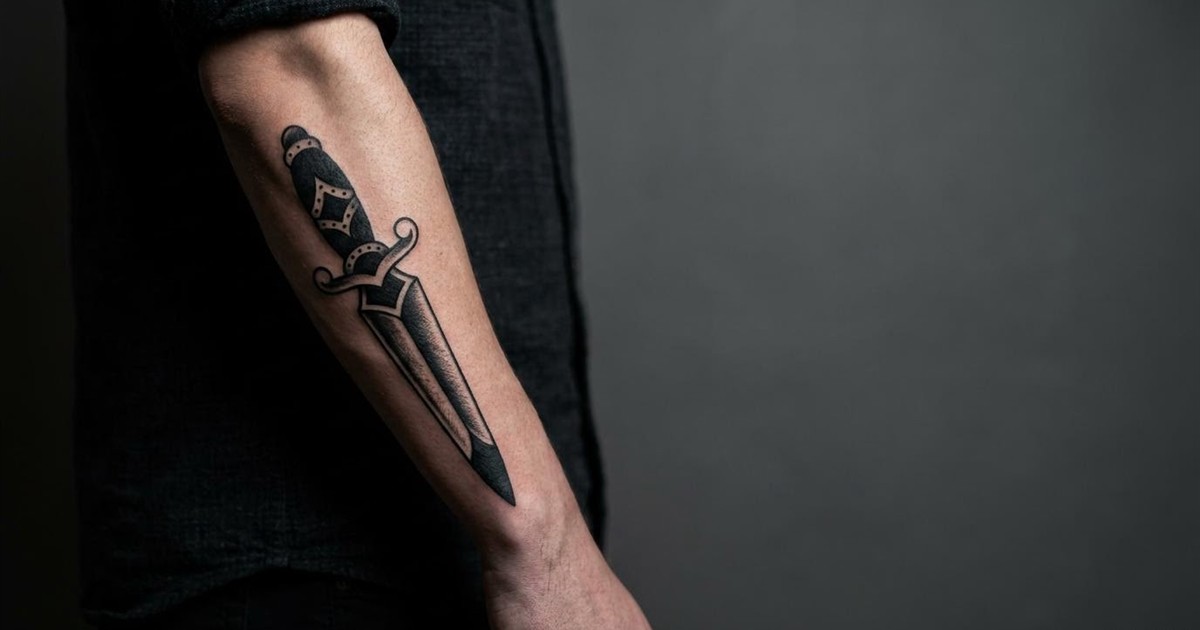
A dagger tattoo usually signals one of six things: protection, strength, sacrifice, loyalty, danger, or self-reliance. Which one it means depends far less on the blade than on how it is drawn and who is wearing it. A dagger pointing down often reads as grief, memorial, or a warning; pointing up, it reads as readiness and defence. Because a dagger is an object rather than a picture of a feeling, almost all of its meaning comes from context.
Table of Contents
- What a Dagger Tattoo Means at Its Core
- Where the Meaning Comes From
- The Six Meanings a Dagger Most Often Carries
- What a Dagger Tattoo Means for Men
- What a Dagger Tattoo Means for Women
- Military Dagger Tattoos
- Dagger Combined With Other Symbols
- How Orientation, Colour and Detail Change the Meaning
- How a Dagger Tattoo Gets Misread
- Choosing a Meaning That Is Actually Yours
- Dagger Tattoo Meaning FAQ
What a Dagger Tattoo Means at Its Core
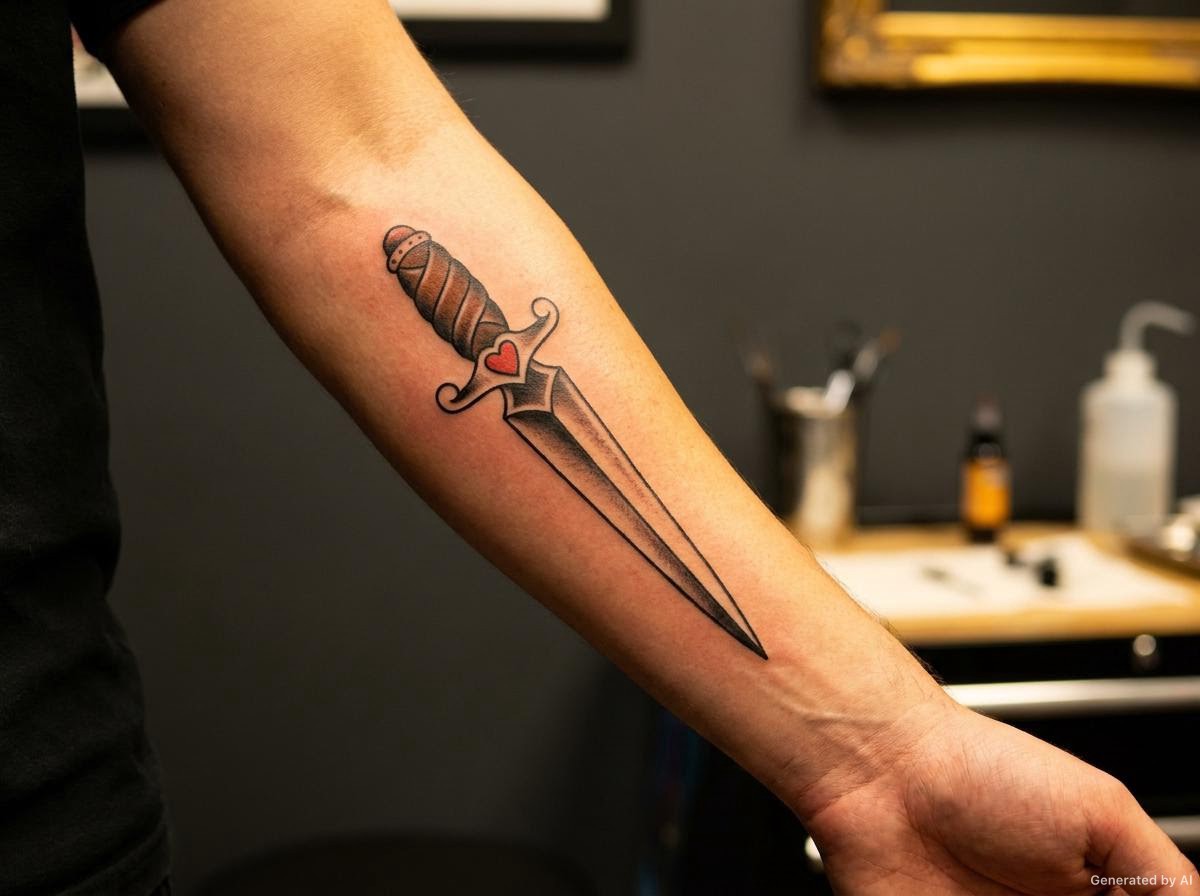
Most tattoo symbols are pictures of something. A dagger is a picture of a tool. That distinction matters, because a tool has no fixed emotional charge: it is competent, deliberate, and slightly threatening all at once. When you wear one, you are not declaring a single feeling. You are aligning yourself with a family of ideas and then narrowing it with design choices.
People who ask what a dagger tattoo means are usually really asking whether the design in front of them will be read the way they intend. The honest answer is that a plain dagger is a statement of capacity and resolve. Everything more specific — mourning, service, defiance, devotion — has to be added through the direction of the blade, the surrounding elements, colour, and size.
That is also why the dagger works so well as a long-term tattoo. It reads as serious at 25 and still reads as considered at 60, because it never depended on a trend in the first place.
Where the Meaning Comes From
The dagger is one of the oldest categories of sidearm, and its history is where its modern symbolism was set. A dagger is defined by its proportions rather than its decoration: a short blade carried for close work rather than for reach. In medieval and Renaissance Europe it was not a battlefield weapon of first resort but a constant companion — the thing you carried every day because it was useful, and the thing you reached for when a fight closed to grappling distance.
Two designs explain most of the symbolism. The rondel dagger used disc-shaped guards and a pommel, gripped in a closed fist and driven with body weight — a design built for punching through mail. It is the ancestor of the heavy, businesslike daggers that still show up in traditional tattooing.
The second design gave the dagger its gentler meanings. The misericorde was a narrow blade meant to deliver a final stroke to a gravely wounded combatant — a killing act framed, in the language of the time, as mercy. That single historical detail is the reason a dagger can carry grief and release at the same time as it carries violence. It is also why so many memorial dagger tattoos read as compassionate rather than aggressive, even though the object is a weapon.
What survives in arms and armour collections is mostly ordinary kit rather than heroic props. The daggers that were kept were carried by people going about their day, which is a fair description of what most dagger tattoos are for: an everyday object made personal.
The Six Meanings a Dagger Most Often Carries
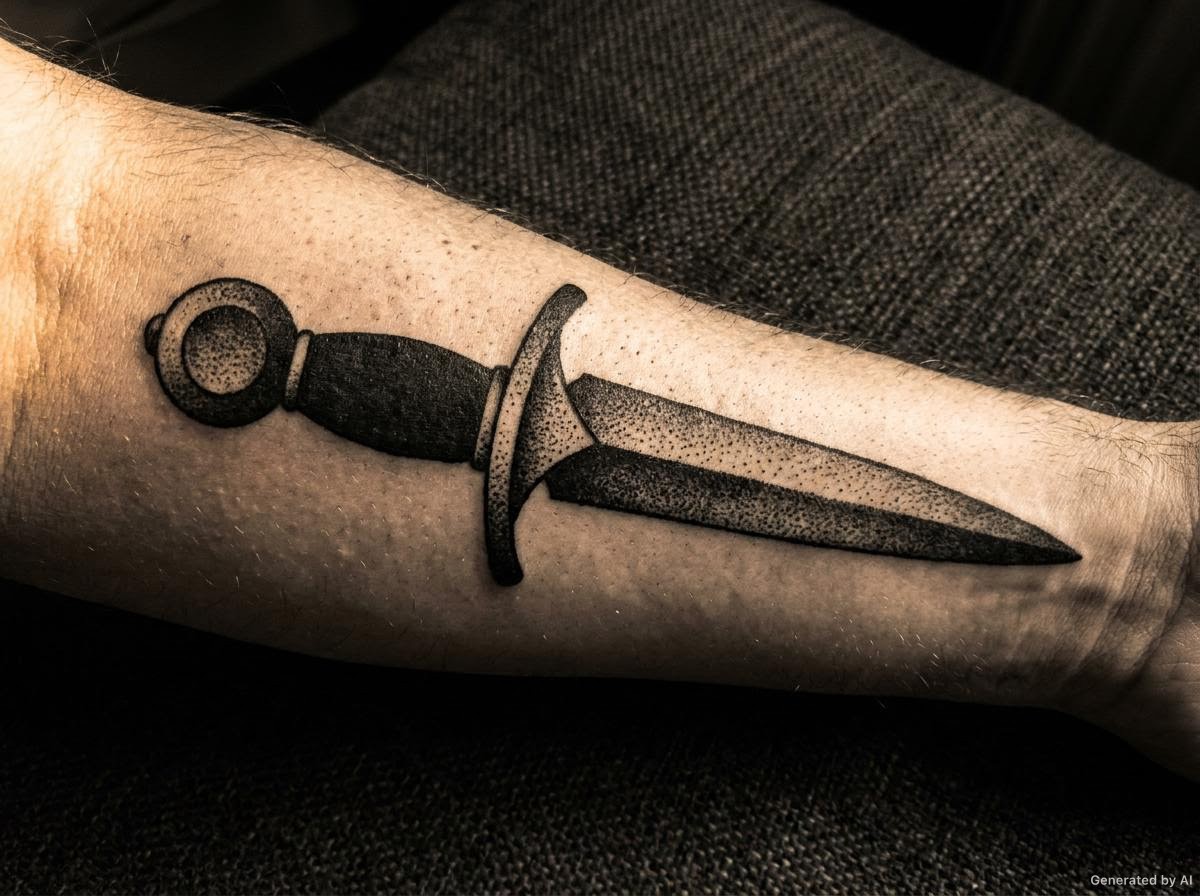
Almost every specific interpretation of a dagger tattoo resolves into one of these six. They overlap, and a well-designed tattoo often carries two at once.
1. Protection and readiness
The most common reading, and the most literal. A dagger is the tool you have already decided to carry. Worn this way it is not a threat so much as a reminder — a claim that you are prepared, that you look after yourself, that you have handled difficult things before. Upward-pointing blades lean hardest into this meaning.
2. Strength and endurance
Strength here means the capacity to keep going, not aggression. A dagger with a wrapped handle, worn metal, or heavy blackwork construction tends to read as endurance: a tool that has been used and maintained. It is a common choice after a period of illness, recovery, or a sustained hard stretch of life.
3. Sacrifice and memorial
This is where the misericorde’s history surfaces. A blade carried for someone else, or carried in memory of someone who served, protected, or gave something up. Downward-pointing daggers, daggers paired with dates, initials, or flowers, and daggers drawn at rest rather than in motion all sit in this group.
4. Loyalty and brotherhood
A dagger is a personal weapon, which makes it an unusually good symbol for a personal bond. Shared daggers between friends, sleeve and shoulder placement, and matching designs across a small group all lean on this meaning. The blade stands for a promise that has a cost attached to it.
5. Danger, betrayal, and the double edge
Every blade cuts both ways, and dagger symbolism has always used that. This reading acknowledges harm — received, caused, or recognised. It suits people who want a tattoo that does not pretend their history was clean. Handled well it is reflective. Handled carelessly it is the version most likely to be misread, which is covered further down.
6. Independence and self-reliance
The dagger as the smallest possible toolkit: no help required, no burden on anyone else. This meaning is common among people who moved countries, left difficult situations, or simply do not want to be looked after. It is quiet, and it reads well in small formats.
What a Dagger Tattoo Means for Men
“Dagger tattoo meaning for guys” is one of the most-searched variants of this question, and the honest answer is that there is no separate male meaning. What differs is construction and placement. Male-directed dagger tattoos are usually larger, heavier in line weight, more likely to be traditional or blackwork, and more often placed on the forearm, hand, chest, or calf, where they are read at a distance.
Those choices push the same six meanings toward the harder end. Protection reads as capability. Loyalty reads as service. Sacrifice reads as mourning. A large, shoulder-placed dagger with no supporting elements is making a broad statement of resolve; the same tattoo at two inches and fine line is making a private one.
What genuinely does change with scale is cost and commitment. If you are weighing up size and placement, the practical breakdown — size, session time, cost, and pain by body part — sits in the design guide for this cluster, which covers it in detail so this article can stay on meaning.
What a Dagger Tattoo Means for Women
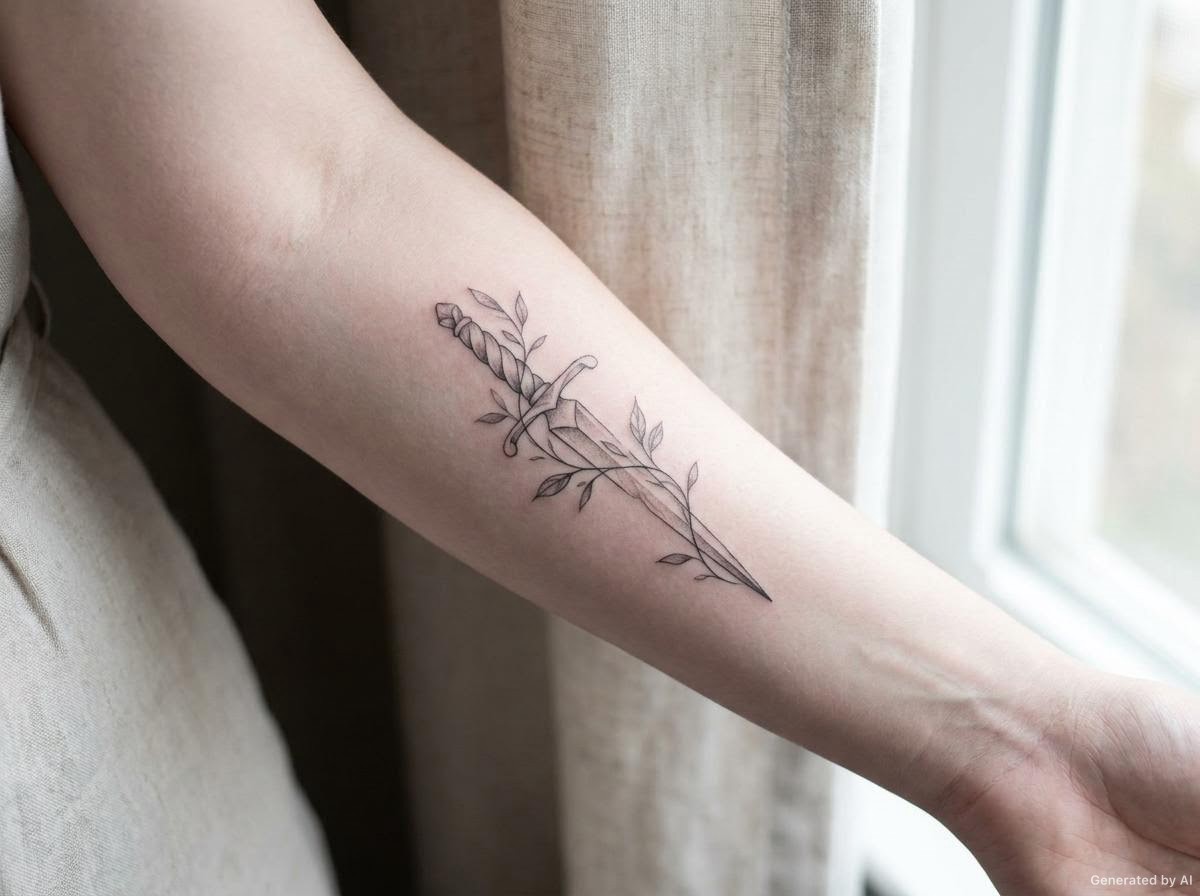
Dagger tattoos on women are frequently built as fine-line or ornamental work: delicate line weight, negative space, geometric or floral framing, and placement on the forearm, sternum, ribcage, thigh, or behind the ear. The message these designs carry is usually one of two things — strength without aggression, or protection of something specific.
A dagger threaded through a flower, wrapped in a vine, or drawn in single-needle line work reads as capability that does not need to announce itself. That is a meaning the heavier traditional dagger cannot easily produce, and it is why the fine-line dagger has become so popular on its own terms rather than as a “softer” version of a male tattoo.
It is worth being blunt about one thing: “feminine dagger tattoo” is largely a marketing category. The symbolism does not change with the wearer’s gender. What changes is the visual language, and therefore which of the six meanings becomes the loudest one. If you want the tattoo to read as protective rather than decorative, blade direction and line weight do that work — not the category it was sold under.
Military Dagger Tattoos
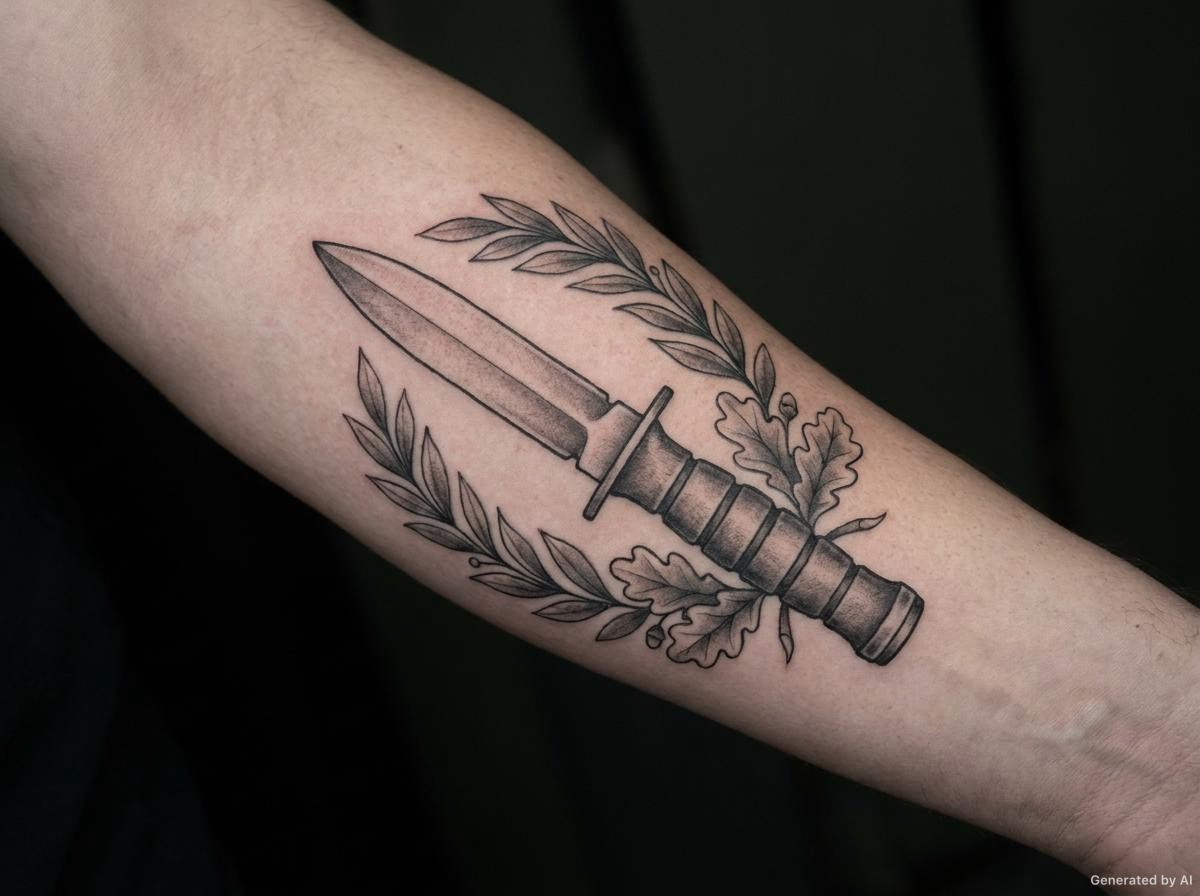
Military dagger tattoos are their own tradition, and they have a specific anchor in the Fairbairn–Sykes fighting knife, designed in 1940 and issued to British commandos during the Second World War. Its slim blade and narrow point made it a recognisable silhouette, and recognisable silhouettes become unit symbols.
Worn in this context, a dagger usually means service, unit identity, or a named comrade. The National Army Museum documents how strongly personal equipment shapes military identity, which is the mechanism at work: a knife you were issued becomes a knife that stands for the people you served with.
Two cautions are worth stating plainly. First, not every dagger tattoo is military, and a World War II–pattern blade in a tattoo does not by itself indicate service — plenty of people choose it purely for the shape. Second, wearing a symbol that implies service you did not perform is a genuinely bad idea, both socially and in the specific communities where that meaning is read correctly. If the meaning you want is “I served,” the design has to be honest about it.
Dagger Combined With Other Symbols
Most dagger tattoos are combinations, and the second element usually supplies the specific meaning the dagger alone cannot.
Dagger and snake
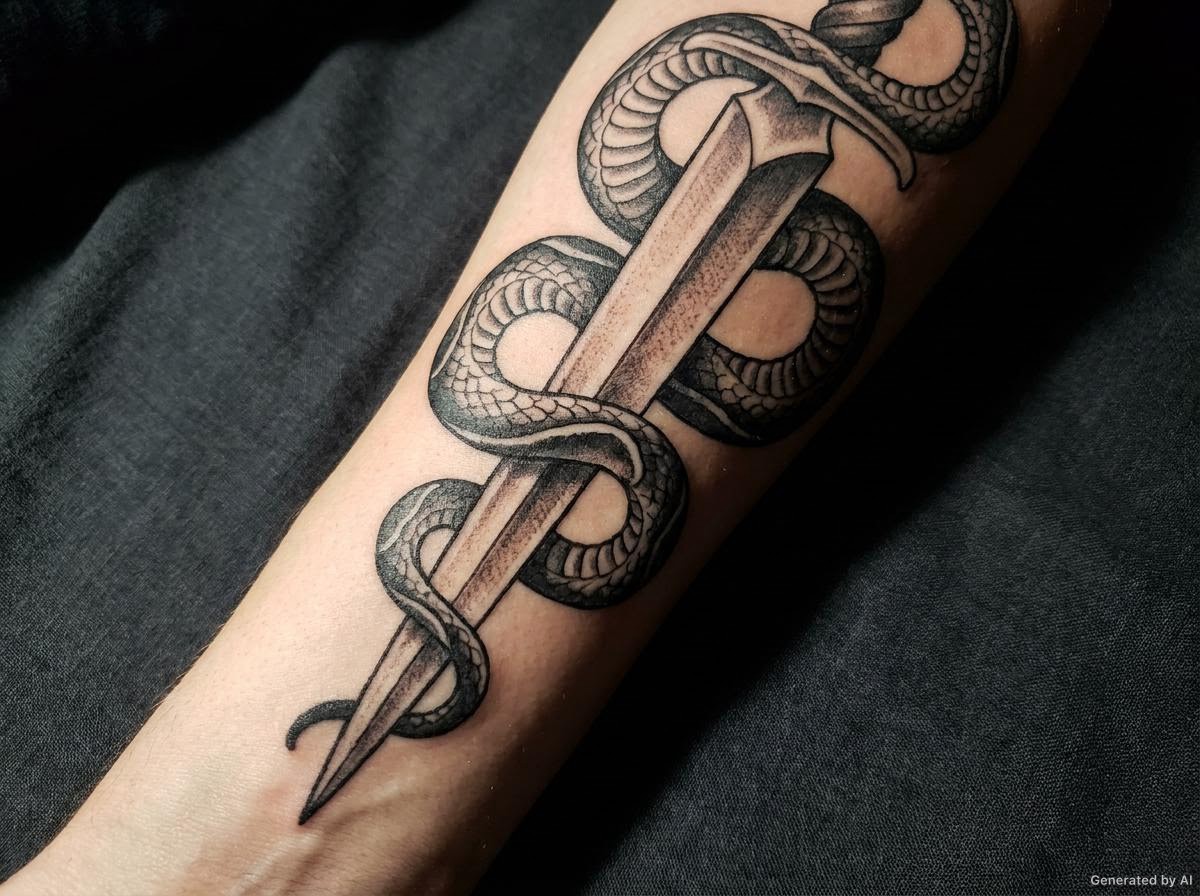
The most-requested pairing. Snakes carry an unusually wide range of meaning — renewal through shedding, knowledge, temptation, danger, and in some traditions healing. Combined with a dagger, the reading is usually conflict resolved or a trait reclaimed: the blade against the thing that threatens, or the hand that finally holds the snake. As a design, it also solves a real compositional problem, because a snake gives the dagger movement and lets it wrap a limb. If the pairing is what you are settling on, our guide to snake and dagger tattoo meaning takes the combination apart on its own terms.
Dagger and rose
Love and loss, beauty and cost. A rose with a blade through it is one of the oldest pairings in tattooing and one of the most legible: something worth protecting, something that hurt. Thorns reinforce the same idea without adding a word.
Dagger and skull
A mortality pairing, sitting in the same tradition as memento mori art — work built to remind you that time runs out. Here the dagger is the agent rather than the victim, which makes this combination stricter and less sentimental than a flower pairing.
Dagger and heart
Two very different readings, and the design has to choose. A blade through a heart usually means heartbreak, betrayal, or grief. A blade behind or beside a heart, especially in a traditional or sacred style, can mean devotion or protection. Whether the blade is drawn passing through the heart or laid across it is doing most of the work.
How Orientation, Colour and Detail Change the Meaning
If you take one practical thing from this article, make it this: on a dagger tattoo, the details are not decoration. They are the meaning.
- Pointing down. Grief, memorial, rest, or a warning laid down rather than raised. The most common direction for remembrance work.
- Pointing up. Readiness, defence, alertness. The blade is held, not finished with.
- Horizontal or angled. Momentum and intent. Common with snakes wrapped around the blade, because the angle gives the composition direction.
- Red or blood. Sacrifice, violence, or passion — the most emotionally direct version, and the one most likely to be read as aggressive by strangers.
- Blackwork. Weight and permanence. Ages exceptionally well, because it relies on silhouette rather than fine detail.
- Fine line. Intimacy and restraint. Reads as considered rather than confrontational, but needs a light-handed artist and honest advice about how it ages.
- Worn or broken blades. Endurance, damage survived, or something given up.
The same principle applies across tattoo symbolism generally — how a symbol is drawn changes what it says more than the symbol itself does. Our guide to butterfly tattoo meaning walks through the same idea in a completely different visual language, which is a useful comparison if you are deciding how much detail to specify.
How a Dagger Tattoo Gets Misread
A dagger is one of the few tattoo symbols that can create a real-world problem, and it is worth knowing where the misreadings come from before you commit.
Gang and prison associations. In some regions and some correctional systems, blades and blade-and-drop combinations carry established meanings, including threat, rank, or a specific act. Those conventions vary by place and change over time, and they are not universal. The practical takeaway is not that daggers are “off-limits” — it is that a plain dagger plus blood, placed somewhere highly visible, is the combination most likely to be read as a threat by someone who does not know you.
Employment. A hidden or covered dagger is nobody’s business. A large, high-contrast blade on the hand, neck, or face will be seen in interview settings, and in conservative industries it will be judged. That is not a reason to avoid the design; it is a reason to choose placement deliberately.
The “bisexual” question. Search demand for “dagger tattoo meaning bisexual” exists, so it deserves a straight answer: there is no established, documented dagger symbolism tied to bisexuality. Searches like this almost always trace back to a specific design being discussed in one community online rather than to any real tradition, and meanings that circulate that way do not hold outside the conversation that produced them. If that meaning is personal to you, that is entirely valid — but do not expect a stranger to read it from the tattoo.
Symbol overload. The most common misreading is self-inflicted: adding a snake, a rose, a date, and a banner to one dagger until no single meaning survives. Two elements is usually the ceiling.
Choosing a Meaning That Is Actually Yours
The reason so many dagger tattoos end up meaning nothing in particular is that people choose the image first and the meaning afterwards. Reversing that order takes about ten minutes and produces a better tattoo.
- Write one sentence. Finish this: “This tattoo is for ___.” If you cannot finish it, you have a picture rather than an intention, and no amount of design work will fix that.
- Pick the meaning before the blade. Decide which of the six meanings you are buying. Everything else is downstream.
- Let the meaning choose the direction. Memorial or grief means down. Readiness means up. Deciding this early saves a redraw.
- Let the meaning choose the weight. Private and considered means fine line. Public and permanent means blackwork or traditional.
- Then choose the style. Traditional, neo-traditional, blackwork, fine line, geometric, or realism — the style question only becomes answerable once the first four are settled.
- Stop at two elements. One supporting symbol, maximum. Restraint is what keeps a dagger readable at a glance.
Whatever meaning you settle on, treat the write-up as a decision aid rather than a dictionary — which is how we approach everything published here, as explained in our editorial approach. Tattoo symbolism is a set of conventions, not a code with fixed answers.
Dagger Tattoo Meaning FAQ
What does a dagger tattoo symbolize?
Does a dagger tattoo mean death?
What does a dagger pointing down mean?
Are dagger tattoos only for men?
What does a snake and dagger tattoo mean?
Is a dagger tattoo gang-related or offensive?
Does a dagger tattoo have to be black?
Final Thoughts
A dagger tattoo means whatever the wearer has decided the blade is for. The object gives you the vocabulary — protection, strength, sacrifice, loyalty, danger, self-reliance — and the design choices decide which word the tattoo actually says. Decide the sentence first, then let the direction, weight, and elements follow from it, and you will end up with a tattoo that still means something in twenty years.
If you are still working out the design itself, the knife and dagger tattoo ideas guide is the natural next step, and you can browse everything in the cluster at Knife Tattoos guides.
4 thoughts on “Dagger Tattoo Meaning: What a Dagger Symbolises and How to Read It”