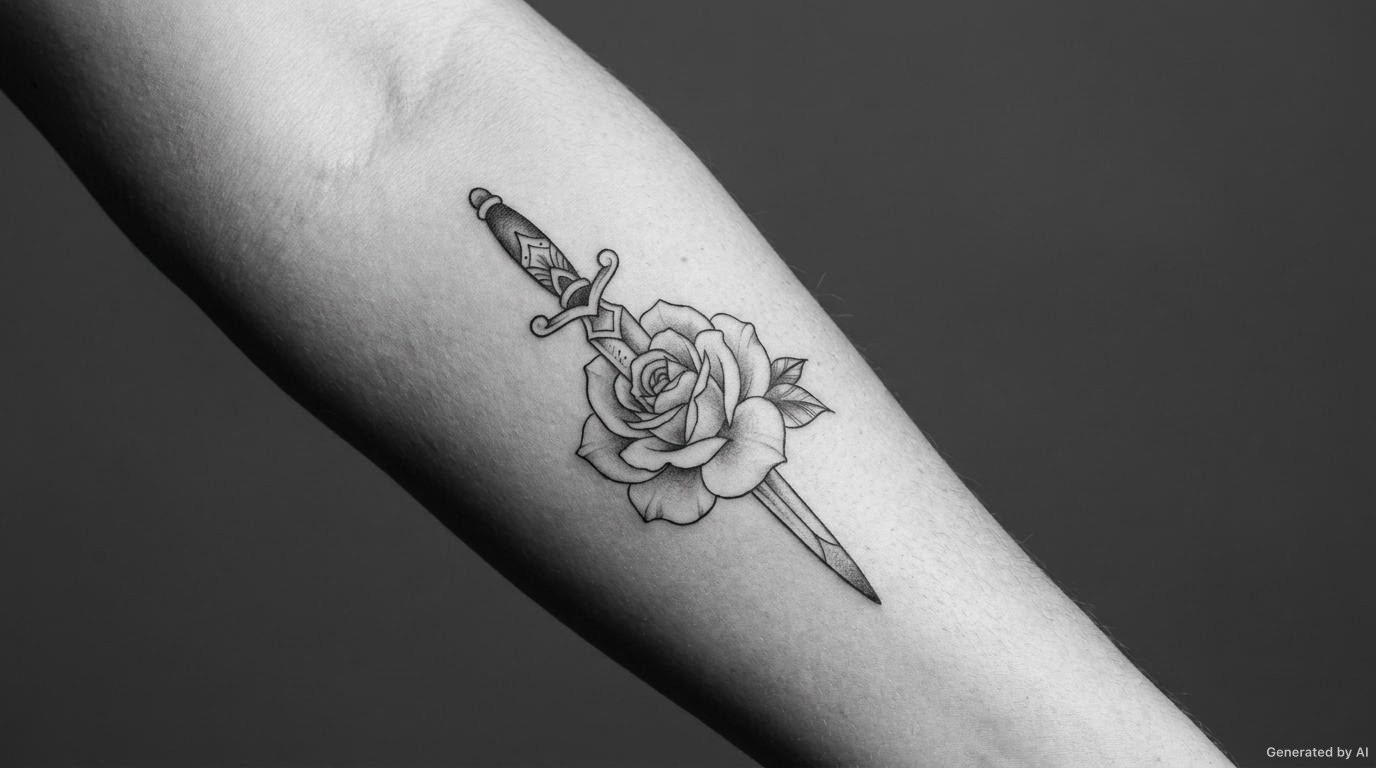
A dagger and rose tattoo meaning is rarely a single fixed idea. The two symbols pull in opposite directions — the blade towards danger, sacrifice and endings, the rose towards love, beauty and renewal — and what the tattoo actually says lives in the tension between them. That tension is why the pairing has lasted: it is old, elastic, and impossible to mistake for a trend.
This guide sets out what a dagger means on its own, what the rose means on its own, and what changes when the two are combined. It then covers the main design variations, how tattoo styles change the look and the way a piece ages, where the composition sits best on the body, and the practical questions of cost, pain, healing and aftercare. Everything here is editorial guidance drawn from documented symbolism and tattoo convention rather than a dictionary of fixed answers, because meanings are conventions and personal interpretation varies.
Quick Answer: What Does a Dagger and Rose Tattoo Mean?
A dagger and rose tattoo most often means love and pain held together. The dagger carries protection, sacrifice, loyalty, betrayal, or the ending of something; the rose carries love, beauty, desire, hope, and renewal. Which reading wins depends on how the two are arranged. A rose wrapped around the blade usually reads as devotion that survives hardship, a blade driven through the flower leans towards heartbreak or the loss of something beautiful, and a dagger laid beside an unbroken rose reads as balance or guardianship. None of these is a fixed code — the pairing is a set of conventions, and the wearer’s own reason sits on top of them.
Table of Contents
- What a Dagger and Rose Tattoo Means at Its Core
- What the Dagger Symbolises
- What the Rose Symbolises
- What the Two Symbols Mean Together
- 7 Dagger and Rose Design Ideas
- Dagger and Rose vs Other Combinations
- Dagger and Rose Tattoo Styles and How They Age
- Where a Dagger and Rose Tattoo Looks Best
- Choosing a Design and an Artist
- Cost, Pain, Healing and Aftercare
- Dagger and Rose Tattoo Meaning FAQ
- Final Thoughts
What a Dagger and Rose Tattoo Means at Its Core
Most tattoo symbols are portraits of a single feeling. A dagger and rose is a portrait of a relationship — between force and gentleness, between something that cuts and something that grows. That is the first thing to understand about it: the design is rarely about the blade or the flower in isolation, but about how the two are arranged, which one is given power, and what the composition implies about the person wearing it.
People asking what a dagger and rose tattoo means are usually really asking whether the design in front of them will be read the way they intend. The honest answer is that the pairing is unusually elastic. It can carry devotion, grief, loyalty, loss, protection, or recovery, and the same two objects can shift between those readings depending on the direction of the blade, the condition of the rose, the surrounding elements, and the style the artist chose.
That elasticity is also what makes the design durable. It reads as considered at twenty-five and still reads as deliberate decades later, because it never depended on a trend in the first place. The blade is ancient, the flower is older than the language used to describe it, and the meaning is assembled from the two rather than borrowed from fashion.
What the Dagger Symbolises
The dagger is one of the oldest marks in tattooing and one of the most loaded. In its plainest sense it is a short, double-edged blade designed for close work — a personal weapon rather than a battlefield one — and that intimacy matters. A dagger is held, hidden and used at arm’s length, which is why it has always carried meanings that a sword does not.
Across tattoo convention the dagger most often stands for:
- Protection and guardianship — a blade kept close, ready if needed.
- Sacrifice — the willingness to take the hit for someone else.
- Loyalty and oath — a bond treated as unbreakable.
- Loss and endings — a blade through something is a statement that it is finished.
- Betrayal — the classic reading of a knife in the back, which is why the direction of the blade matters so much.
- Resolve or survival — the weapon you carried through something hard.
What makes the dagger unusually useful in a composition is that it has a clear direction. Point up, it reads as defence or aspiration. Point down, it reads as a threat, a warning, or something laid to rest. Held in a hand, it becomes a decision. Pointed towards another element — a flower, a snake, a heart — it acts on that element, and the whole tattoo becomes a sentence rather than a list of nouns.
What the Rose Symbolises
The rose carries the longest paper trail of any flower in the visual arts. In European tradition it became the emblem of love, secrecy and beauty, and it was associated with discretion long before it was associated with romance — the phrase sub rosa, “under the rose,” described something said in confidence.
The habit of using flowers to say things that could not be said aloud gave the rose a second layer of meaning. In the language of flowers that developed in the nineteenth century, different colours, stages and arrangements each carried a distinct message, and a rose could mean devotion, silence, secrecy, or farewell depending on how it was presented. That idea survives directly in tattoo design: the state of the rose still does most of the talking.
Botanically the rose is a genus of thorny climbing shrubs and shrubs in the family Rosaceae, and the plant’s own structure is part of why it has stayed a symbol. It is genuinely defended — the same stem that produces the flower carries the thorns — which is the detail most designs lean on.
In tattoo terms the rose generally stands for:
- Love and devotion — the default reading, and still the most common.
- Beauty held with caution — a bloom on a thorned stem.
- Renewal — a bud opening or a stem growing back.
- Remembrance — a single bud or a half-open rose for someone who has died.
- Love that has changed — a wilting, drooping or petal-shedding rose for something that ended.
What the Two Symbols Mean Together
Alone, each symbol is broad. Together they become specific, because the interaction tells you which of the many possible readings is intended. There are four arrangements that cover most of the designs you will actually see, and each produces a different sentence.
The rose wrapped around the blade. This is the most common composition and usually the most positive. The flower is not being destroyed — it is binding the weapon, which reads as love that contains or survives strength, protection offered, or devotion strong enough to hold something dangerous. It is a common choice for a partner, a child, or a close friendship.
The blade driven through the rose. The opposite dynamic. Here something beautiful has been pierced, which reads as heartbreak, betrayal, grief, or the end of a relationship. Because that can be heavy, many people soften it — the rose stays alive, the blade is slim, or a second intact bloom sits nearby — so the tattoo becomes about surviving a loss rather than being defined by it.
The dagger and rose side by side. Neither acts on the other, which makes the composition a balance rather than a conflict. This is the arrangement to choose if the point of the tattoo is that you are both, or that you have learned to hold two contradicting things at once — softness and a hard edge.
The dagger as a stem. A single rose growing from the blade, or the handle acting as the base of the flower, merges the two into one object. That reads as change over time: something difficult that produced something good, which makes it a natural choice for recovery, a career change, or the end of a hard chapter rather than a person.
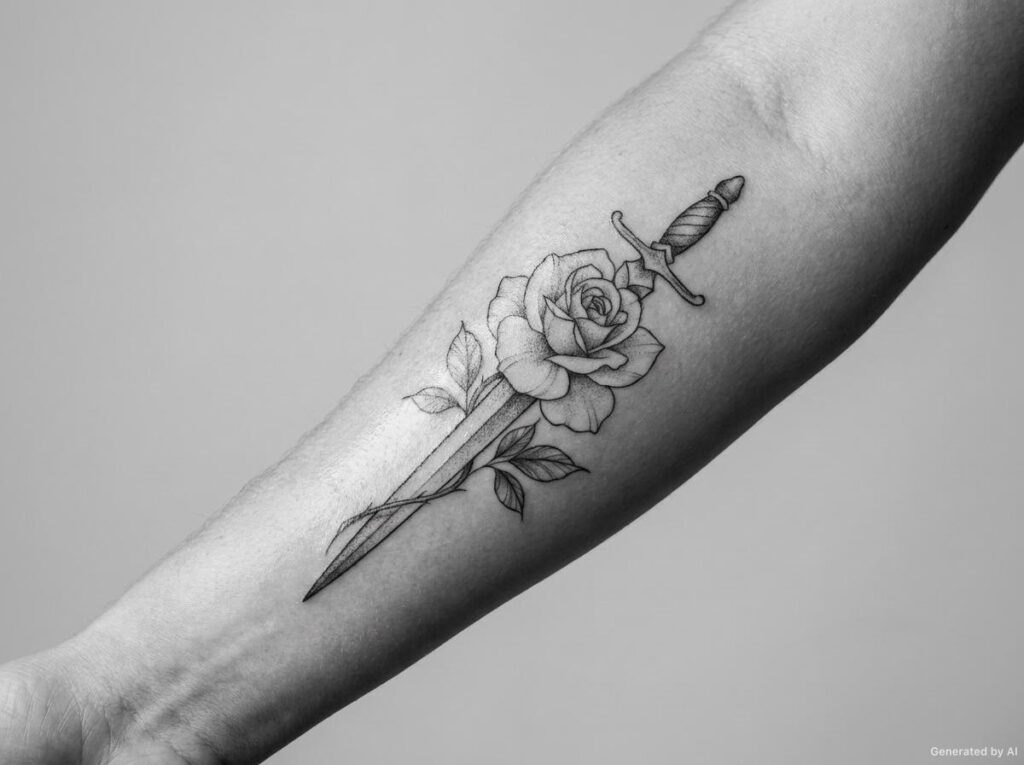
Two smaller variables matter as much as the arrangement. The first is the number of roses: one bloom keeps a design focused, while a cluster or a trailing stem suggests family, generations, or a timeline. The second is whether the dagger is clean, ornate, or worn. A polished blade reads as control; a chipped or rusted one reads as damage that was survived.
7 Dagger and Rose Design Ideas
The variations below are the ones that turn up most often, roughly in order of how much detail they need.
1. Traditional dagger through a rose
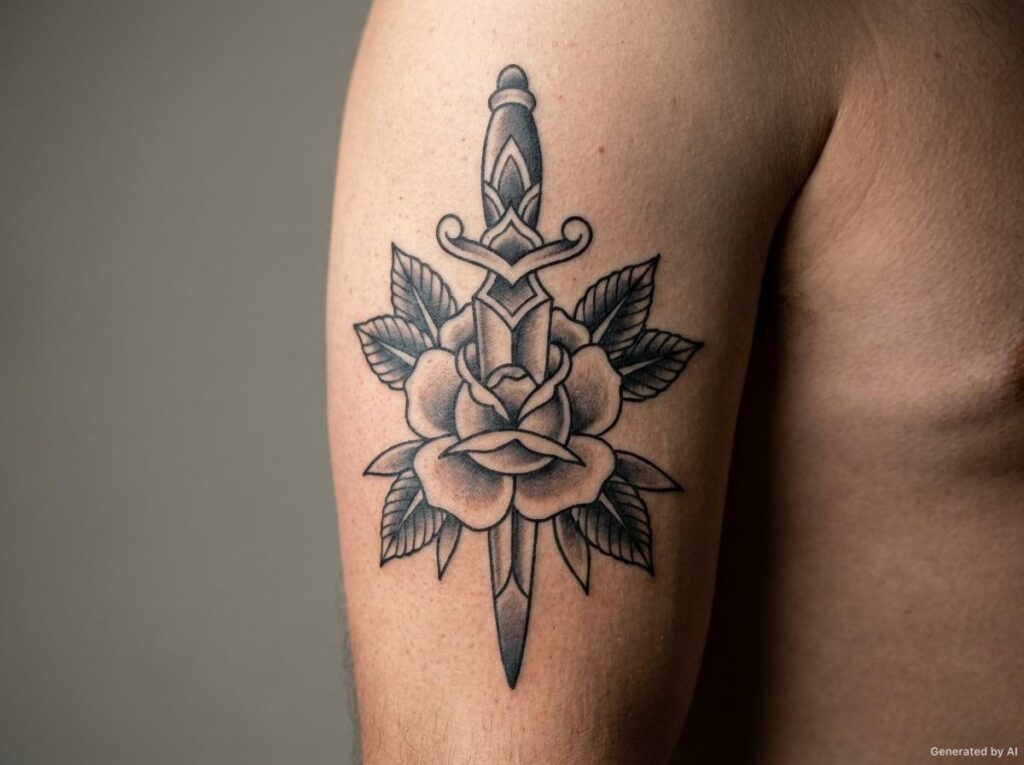
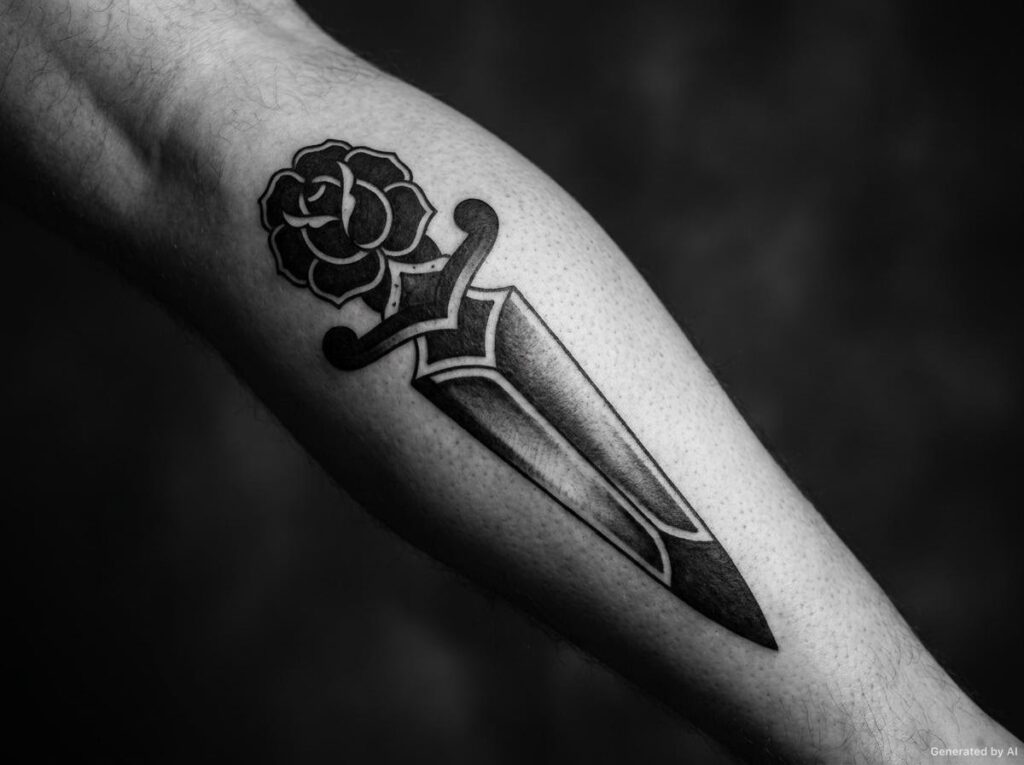
Bold outlines, flat black shading, limited detail, and a limited palette. This is the version most people picture when they think of a dagger and rose tattoo, and it is also the version that ages the best, because there is nothing small enough to blur into itself. A strong first tattoo, and a strong filler piece around larger work.
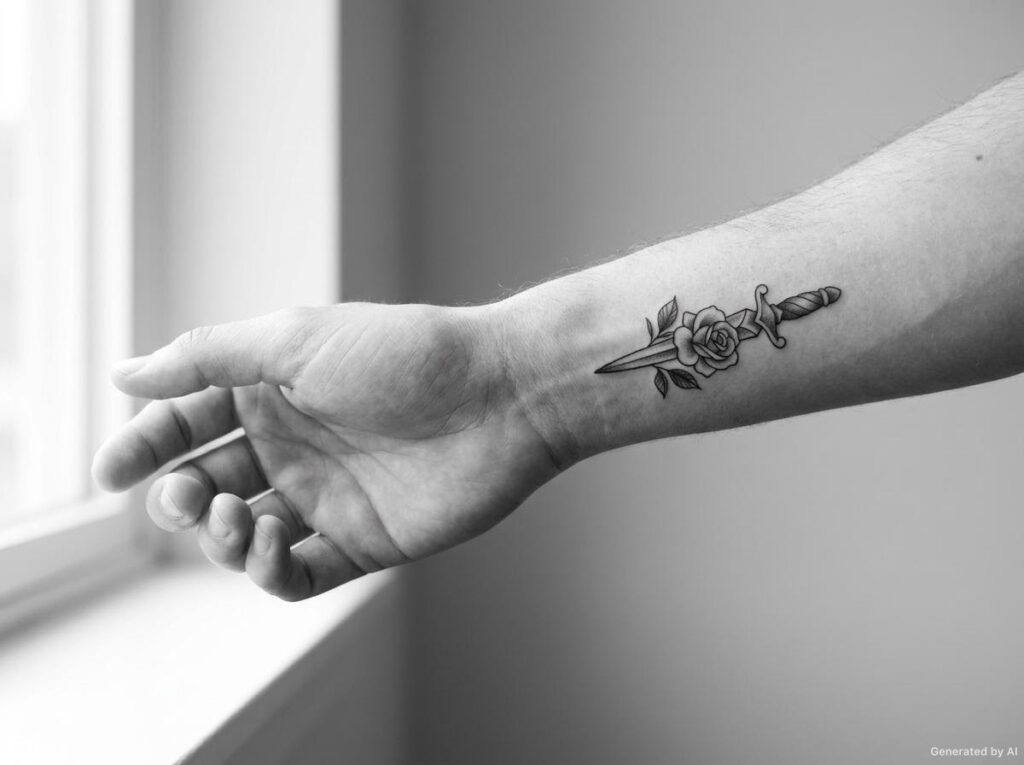
2. Fine line rose around a slim dagger
Single-needle linework with light stippled shading, usually small and placed on the inner forearm, wrist, or behind the ear. Elegant and quiet, and it suits people who want the symbols without the weight. The trade-off is longevity: very fine lines and pale shading soften faster than bold work, so this style needs more care in the sun.
3. Blackwork dagger and rose
Heavy solid black, high contrast, negative space used as drawing. A black rose inside solid blackwork is a graphic, almost poster-like image. It is the boldest option and the one that keeps its shape best at a distance, which makes it work well on the calf, thigh, or upper arm.
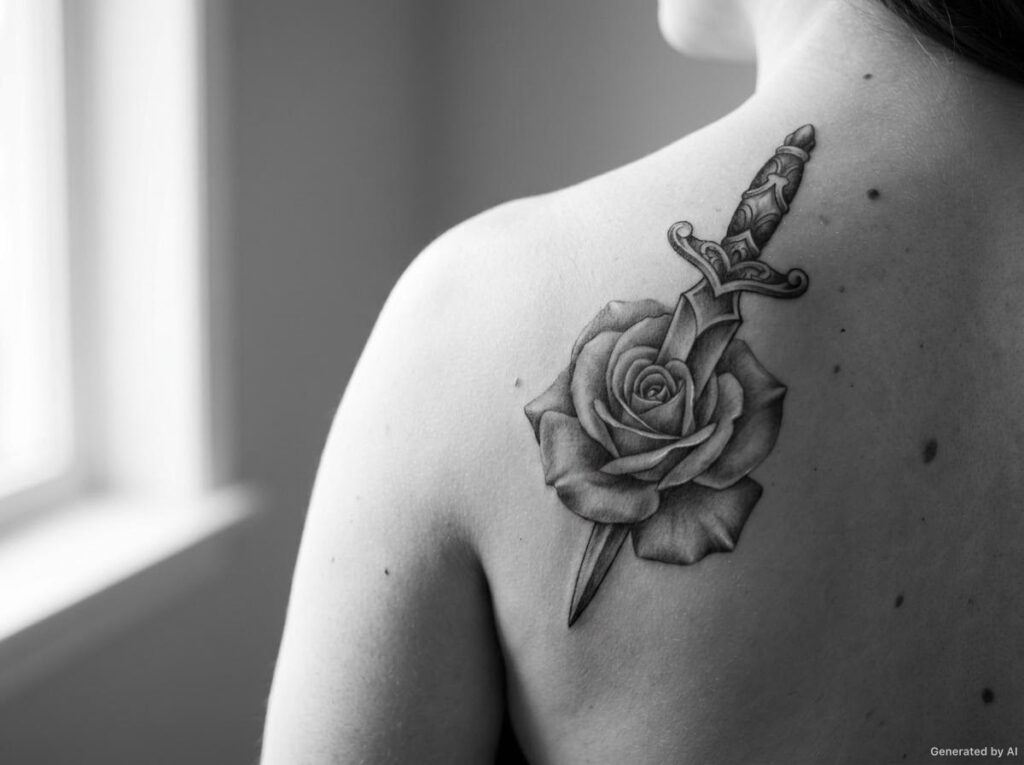
4. Black and grey realism
Photorealistic metal with visible reflection, a rose rendered petal by petal, soft transitions and no hard outline. The most technically demanding of the group, and the one that depends most on the artist’s skill. It needs the largest amount of space to read properly and the most care over time.
5. Neo-traditional with an ornate dagger
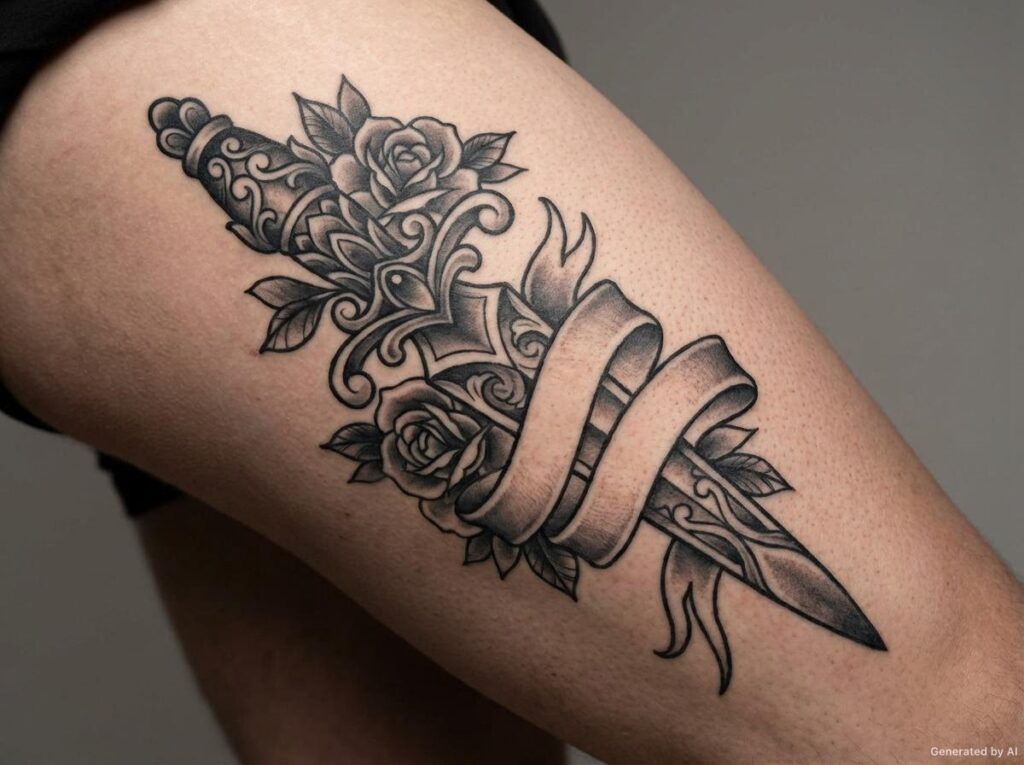
Traditional structure with richer detail: a decorated hilt, symmetrical rose placement, and often a ribbon or banner. Banners are traditionally left blank in the design and filled in later, which makes this a flexible option if you want to add a name or a date without redesigning the piece.
6. Small, single-subject placement
A compact dagger and a single rose, sized for the back of the hand, the wrist, the ankle, or the collarbone. Small work forces simplification — one bloom, a shorter blade, fewer petals — and the result is usually more graphic than illustrative.
7. Dagger and rose with a second companion symbol
Adding a snake, a banner, a heart, a sparrow, or a set of initials narrows the meaning quickly. A snake wrapped with the rose pushes the design towards temptation or transformation; a heart turns it squarely towards love; a set of initials makes it a memorial or a dedication. This is also the version that connects most directly to a snake and dagger tattoo, which uses the same logic with a different companion.
Dagger and Rose vs Other Combinations
Because the dagger appears in several pairings, it helps to see how the companion changes the meaning. The table below compares the most common blade combinations.
| Combination | Dominant reading | Best suited to |
|---|---|---|
| Dagger and rose | Love and pain together; devotion, heartbreak, balance | Partners, family, grief, recovery |
| Dagger and snake | Conflict and its resolution; knowledge, healing, mastery | Personal growth, protection, duality |
| Dagger alone | Protection, sacrifice, loyalty, resolve | Straightforward statement pieces |
| Dagger and heart | Heartbreak, betrayal, or an oath sworn | Explicit romantic meaning |
| Dagger and skull | Mortality, defiance, a survived danger | Bold, dark compositions |
| Dagger and banner | A personal motto, name, or date | Memorial and dedication pieces |
If the rose is the element you care about, it is worth knowing that the flower behaves the same way in other pairings: a butterfly and rose leans towards change, while a rose with a name or a date becomes a memorial almost immediately.
Dagger and Rose Tattoo Styles and How They Age
Style is not only a look. It decides how the tattoo behaves over the next twenty years, and that is the part most people underestimate when they are choosing from a screen.
Traditional and neo-traditional
Bold outlines and solid fills hold their structure for a very long time. Lines may thicken slightly as ink spreads, but because the design was drawn thick to begin with, it stays legible. The most forgiving choice for a first tattoo or for anyone who wants minimal touch-ups.
Fine line and single needle
Beautiful when fresh, and the fastest to soften. Very fine lines blur over time, and light shading fades first. Sun exposure accelerates this noticeably. Fine line work is a good choice if you accept that it will need refreshing eventually, and a poor choice if you want the same crispness in fifteen years.
Black and grey realism
Reads as a small piece of photography on skin when it is done well, and shows every mistake when it is not. Soft gradients rely on subtle values, and those are the first thing to drift. It needs a larger canvas, a genuinely experienced artist, and diligent protection from the sun.
Blackwork
Large fields of solid black are extremely durable and read clearly from a distance. The main consideration is commitment: heavy black is difficult to cover or rework later, so it suits designs people are certain about.
Where a Dagger and Rose Tattoo Looks Best
The dagger has a strong vertical axis, so the composition usually wants a body part that can accommodate height. Where you put it also changes how public the meaning is.
- Forearm — the most popular placement, and the easiest to show or cover. Two-edged blades and trailing stems fit the shape naturally.
- Upper arm and shoulder — enough space for a detailed rose and a fully rendered hilt. The most forgiving area for larger work.
- Thigh — a large, relatively private canvas that works well for ornate or neo-traditional versions.
- Calf — suits bold blackwork and traditional designs, and holds a strong vertical composition.
- Ribs and back — the biggest canvas, and the best option if the design needs to breathe. Both areas are more painful than the arm or leg.
- Wrist, hand and ankle — good for small single-bloom versions, but these areas see more friction and sun, so fine detail fades faster there.
Choosing a Design and an Artist
The single most reliable predictor of whether a knife tattoo looks good in five years is the artist, not the idea. A brilliant concept drawn badly ages badly; a simple concept drawn well lasts. So the order of operations should be: decide the meaning, decide the general style, then find someone whose existing work in that style you actually like.
A few practical filters when you are looking:
- Look for healed photographs, not only fresh ones. Fresh work hides how a tattoo settles.
- Find at least one example of the specific style you want in their portfolio — realism, fine line and traditional are genuinely different skills.
- Ask to see how their straight lines and circles hold up. Daggers are unforgiving because a wobbly blade is obvious.
- Bring references for the arrangement, not just for the objects. What you are really commissioning is the composition.
- Be willing to take their advice on scale. Dagger and rose designs are frequently ruined by being made too small.
It is also worth deciding early whether you want the tattoo to be readable to strangers. A minimalist version is a private symbol; a large blackwork piece is a statement. Both are valid, but they ask for different designs, different placements, and often different artists.
Cost, Pain, Healing and Aftercare
Cost. There is no meaningful average to quote, because price depends on the artist’s rate, the size, the detail, and the city. A small fine line piece and a large realistic back piece are not in the same bracket. Most artists charge either an hourly rate or a flat price per design, and the correct approach is to ask for a quote in person after they have seen the reference and the placement. A good sign is being told upfront how many sessions a design will need.
Pain. Most people describe the sensation as a persistent scratch or burn rather than a sharp pain, and it becomes harder to tolerate as the session goes on. Placement matters more than design: the forearm and upper arm are among the most comfortable areas, while the ribs, spine, sternum, hands, and feet are considerably more intense. Line work tends to be sharper than shading, and sessions over roughly three or four hours get progressively more uncomfortable regardless of where the tattoo is.
Healing. Superficial healing usually takes around two to four weeks, and the deeper layers of skin can take considerably longer to settle. During that time the tattoo will peel and may look dull or slightly cloudy — this is normal. Full settling, including the final depth of the blacks, is typically judged at around four to six weeks, which is why artists ask you to wait before judging the result.
Aftercare. The principles are simple and consistent: keep the area clean, wash gently with lukewarm water and a mild soap, pat dry, apply a thin layer of recommended ointment or unscented moisturiser, and do not pick or scratch the peeling skin. Avoid soaking — baths, pools, sea and long showers — while it is healing, and keep it out of direct sun. Sun exposure is the single biggest cause of fading, both during healing and for the life of the tattoo. The American Academy of Dermatology publishes general guidance on caring for tattooed skin and on when to seek medical advice.
Dagger and Rose Tattoo Meaning FAQ
Click a question to reveal the answer.
What does a dagger and rose tattoo symbolise?
Is a dagger and rose tattoo positive or negative?
What does a rose wrapped around a dagger mean?
What does a black rose with a dagger mean?
Can a dagger and rose tattoo be a memorial?
Does a dagger and rose tattoo mean something different for men and women?
How big should a dagger and rose tattoo be?
Is a dagger and rose tattoo a good first tattoo?
Final Thoughts
A dagger and rose tattoo means whatever the wearer has decided the relationship between the two is about. The symbols give you the vocabulary — love, loss, protection, devotion, survival, resolve — and the arrangement decides which word the tattoo actually says. Decide the meaning first, then let the direction of the blade, the state of the rose, and the style follow from it, and you will end up with a piece that still reads clearly in twenty years.
If you are still working out the design itself, the knife and dagger tattoo ideas guide is the natural next step, and you can browse everything in the cluster at Knife Tattoos guides. Our editorial approach explains how every guide here is researched and written.
2 thoughts on “Dagger and Rose Tattoo Meaning: What the Symbols Say Together”