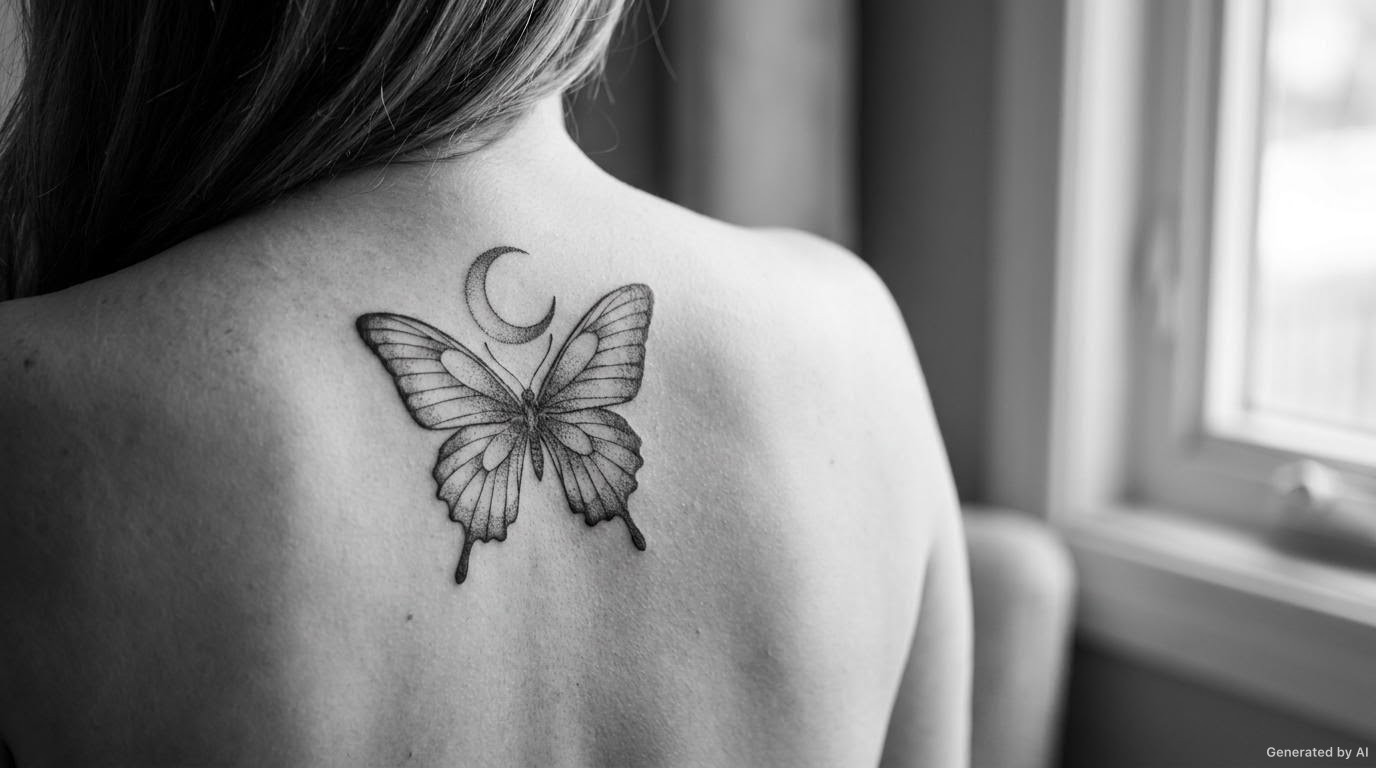
A butterfly and moon tattoo meaning sits at the meeting point of two of tattooing’s oldest ideas: change and time. The butterfly carries transformation — the literal shift from caterpillar to winged adult — while the moon carries cycles, patience and the phases a person moves through without noticing. Put the two together and the design stops being about change alone. It becomes about changing on a schedule you did not choose, and coming out of it anyway.
Most people arrive at this pairing for one of three reasons: a chapter that closed, a phase they are still inside, or a reminder that both are temporary. It is also unusually flexible. A crescent, a full moon, a slim row of phases, a single butterfly or a mirrored pair all read differently, and the style you pick — fine line, dotwork or heavy blackwork — shifts the tone as much as the symbols do. If you are still deciding how butterflies carry meaning on their own, our butterfly tattoo meaning guide covers that first. This article stays on the pairing: what it means, how the moon phase changes it, where it works best on the body, and what to expect from cost, pain and healing.
Quick Answer: What Does a Butterfly and Moon Tattoo Mean?
A butterfly and moon tattoo most often means transformation guided by intuition. The butterfly supplies change, growth and rebirth; the moon supplies cycles, patience and the passage of time. Together they read as a reminder that change arrives in phases rather than all at once. The moon phase you choose is the strongest dial on that meaning — a waxing crescent leans towards beginnings, a full moon towards completion and clarity, a waning moon towards release, and a new or dark moon towards rest and a private reset. Adding stars, flowers or a sun pushes the design towards celestial, feminine or balanced readings. Nothing here is a fixed code; it is a set of conventions, and your own reason sits on top of them.
Table of Contents
- Butterfly and Moon Tattoo Meaning in One Line
- What Each Symbol Brings to the Pair
- How the Moon Phase Changes the Meaning
- Meaning by Combination: Stars, Sun, Lotus and Moth
- What It Means on a Woman (and on a Man)
- Styles That Suit a Butterfly and Moon Tattoo
- Placement: Where This Design Works Best
- Design Decisions That Change the Reading
- Choosing an Artist: Fine Line, Shading and Red Flags
- Cost, Pain, Healing and Aftercare
- Butterfly and Moon Tattoo FAQ
- Final Thoughts
Butterfly and Moon Tattoo Meaning in One Line
In one line: change that takes its time. That is the difference between this pairing and most other butterfly combinations. A butterfly with a dagger or a skull talks about conflict — something beautiful meeting something sharp. A butterfly with a moon talks about timing. It is a softer, more patient design, and it suits people who are not declaring a war or announcing a victory but marking a stretch of time they lived through.
The second layer is intuition. The butterfly is the one symbol in tattooing that is drawn from a documented biological process rather than folklore: caterpillars dissolve most of their own tissue inside the chrysalis and rebuild into a completely different animal. The moon, meanwhile, is the most reliable cycle a human being can see with the naked eye. Pair a transformation you cannot rush with a clock you cannot argue with, and the meaning becomes something like: it will change when it changes, and that is fine.
That framing also explains why the design is forgiving. There is no correct moon, no correct wing shape and no correct number of butterflies, because the theme is process rather than a fixed statement. The rest of this guide is about the choices that do change the reading — starting with what each half of the tattoo is actually contributing.
What Each Symbol Brings to the Pair
It helps to separate the two halves before recombining them, because a butterfly and moon tattoo is really two statements sharing one composition. The butterfly decides what is happening. The moon decides when.
The butterfly’s half
The butterfly is metamorphosis taken literally — the same organism, entirely rebuilt. In tattoo vocabulary that translates into rebirth, growth, freedom and the end of a version of yourself. It also carries a quieter idea that people miss: brevity. Many adult butterflies live only weeks. That is why butterfly tattoos work so well for remembrance, and why they are so often chosen after a loss rather than after a triumph. For the full cultural background, the butterfly entry is a solid starting point, and if you want the biological detail, our reference for the process is the metamorphosis overview.
Wing shape matters more than most people expect. Rounded wings read gentle; long, swallowtail-style points read more elegant and more restless; a moth silhouette reads nocturnal and understated. The complete butterfly tattoo guide covers wing anatomy and species differences in depth if you want to get that right before adding a moon.
The moon’s half
The moon brings a completely different register. It is the cleanest example of a repeating cycle available to the eye, which is why it has been used across cultures to mark time, planting, tides and gathering. In tattoo work it carries cycles, intuition, the night, femininity, and the honest fact that a person passes through phases they do not control. A useful general introduction is the lunar phase article — mainly because it shows how many distinct phases there actually are, which is exactly what makes the symbol adjustable.
Because the moon arrives with a built-in sequence, it gives the butterfly something a flower or a dagger cannot: a timeline. That is the whole reason this pairing rewards a little planning rather than a quick flash pick.
How the Moon Phase Changes the Meaning
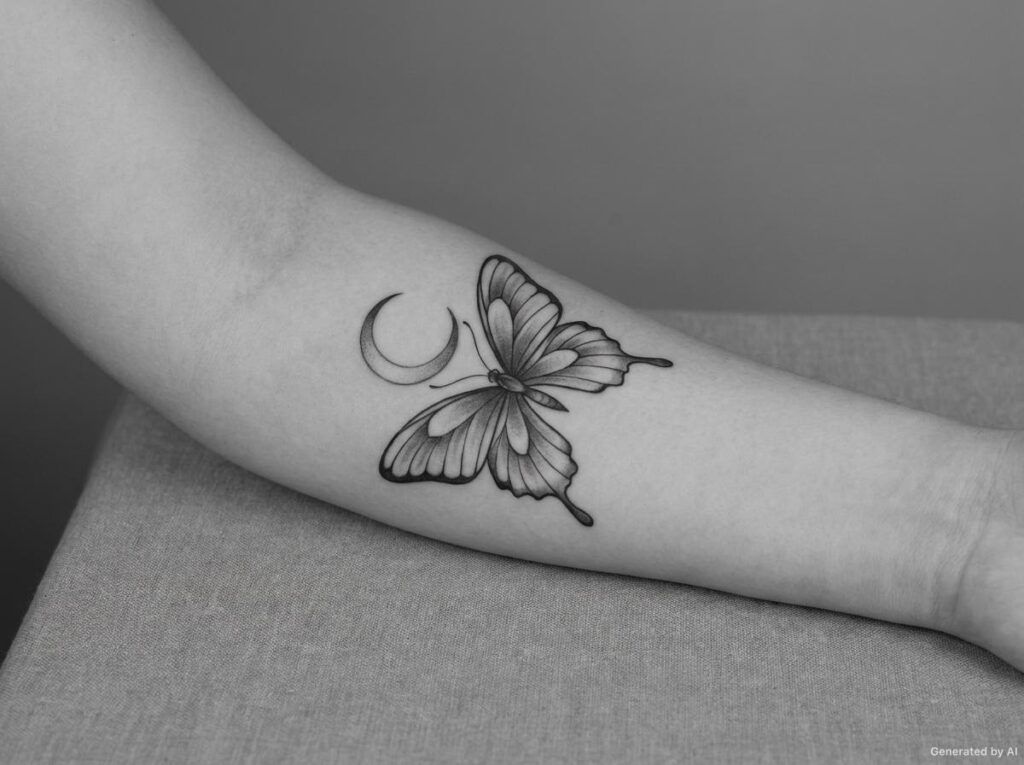
If you change one thing about the design, change this. The phase is the strongest meaning dial the tattoo has, and it is the detail most people choose casually and then live with. The table below reflects how these phases are conventionally read — not rules, just the shared shorthand most artists and wearers are working from.
| Moon phase | What it emphasises | Often chosen for |
|---|---|---|
| Waxing crescent | Beginnings, intention, hope, something still small | A new chapter, early recovery, a first step |
| Half moon | Decision, effort, momentum, the halfway point | Pushing through, keeping a promise to yourself |
| Full moon | Completion, clarity, visibility, harvest | A milestone, self-acceptance, remembering someone |
| Waning moon | Release, gratitude, letting something go | Closing a chapter, coming out of a hard year |
| New or dark moon | Rest, privacy, a quiet reset | Starting over without announcing it |
| A row of phases | The entire cycle; nothing stays in one phase | Patience, long recovery, a design that ages calmly |
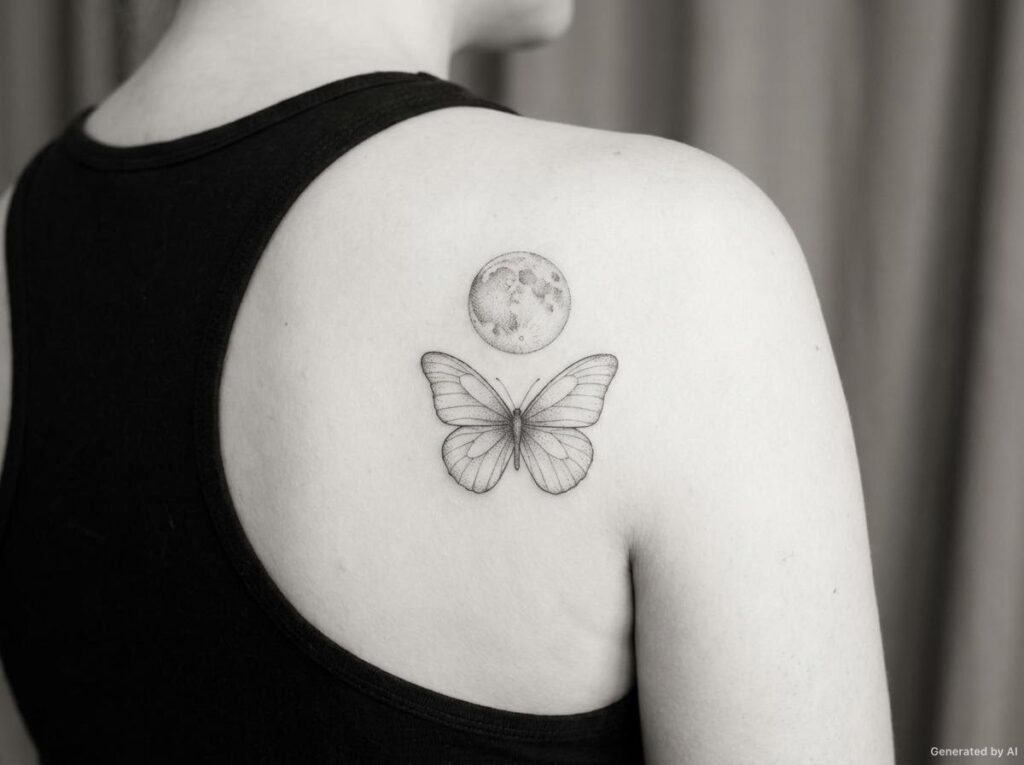
Two practical notes. First, a full moon is the easiest phase to draw badly — crater texture and grey shading need restraint, or the circle turns into a smudge within a few years. Second, a row of phases along the spine or forearm is the most legible long-term option, because small circles hold their shape better than a detailed crescent with a face in it.
Meaning by Combination: Stars, Sun, Lotus and Moth
Once a butterfly and a moon are in place, the next element you add usually decides the final reading. These are the pairings that come up most often in consultations.
| Combination | Dominant reading | Notes |
|---|---|---|
| Butterfly, moon and stars | Change under a wide sky; guidance, direction, wonder | Reads as “celestial”. Keep the stars small and few or the piece gets noisy |
| Butterfly, sun and moon | Balance of opposites; day and night, action and rest | Needs a strong composition or it splits the eye in two |
| Butterfly and lotus | Growth out of difficult ground; purity after hardship | A natural fit — both symbols are already about emerging from something |
| Butterfly with a moth | Two kinds of change: the day version and the night version | A genuinely personal choice; moths carry a darker, nocturnal read |
| Butterfly, moon and flowers | Renewal and beauty; change that blooms rather than breaks | Easier to keep delicate; suits fine line and small placements |
| Butterfly, moon and a date | A memorial or an anniversary of a personal turning point | Keep lettering short and simple — thin script blurs first |
If you already know you want a specific butterfly species rather than a generic one, the monarch butterfly tattoo meaning article covers how a single species changes the symbolism, and the monarch design guide shows how that plays out in layout.
What It Means on a Woman (and on a Man)
“Butterfly and moon tattoo meaning on a woman” is one of the most searched versions of this question, so it is worth answering plainly. The honest answer is that the symbols do not change with the wearer — the butterfly still means transformation and the moon still means cycles. What changes is how the piece is read by other people, and that comes down to size, placement and style rather than gender.
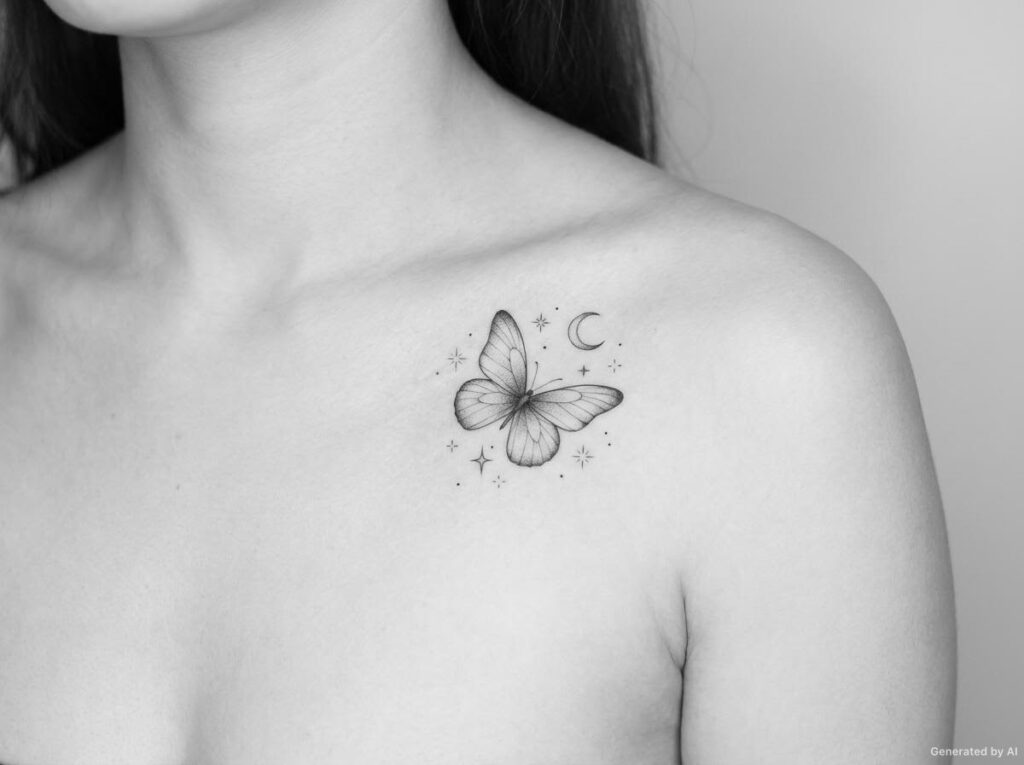
A small, fine-line version behind the ear, on the wrist or at the collarbone tends to be read as delicate, personal and feminine, and it is the version most often chosen as a first tattoo or a memorial piece. A large blackwork or heavily shaded version on the shoulder, thigh or spine reads bolder and more graphic, and is equally common on men. Neither is more “correct”. The pairing simply has an unusually wide range, which is why it appears in so many very different portfolios.
One thing worth being deliberate about: because the design is popular, the difference between a meaningful piece and a generic one is almost entirely in the drawing. A traced butterfly with a clip-art crescent looks like what it is. A custom wing shape that follows the curve of your shoulder, with the moon sitting at a specific phase because that phase means something to you, does not. If you want the wider context on how these designs are personalised, the butterfly tattoo meaning guide walks through that process.
Styles That Suit a Butterfly and Moon Tattoo
The style choice affects this design more than most, because a moon is mostly empty space and a butterfly is mostly line. Here is how the main options behave, including how they age.
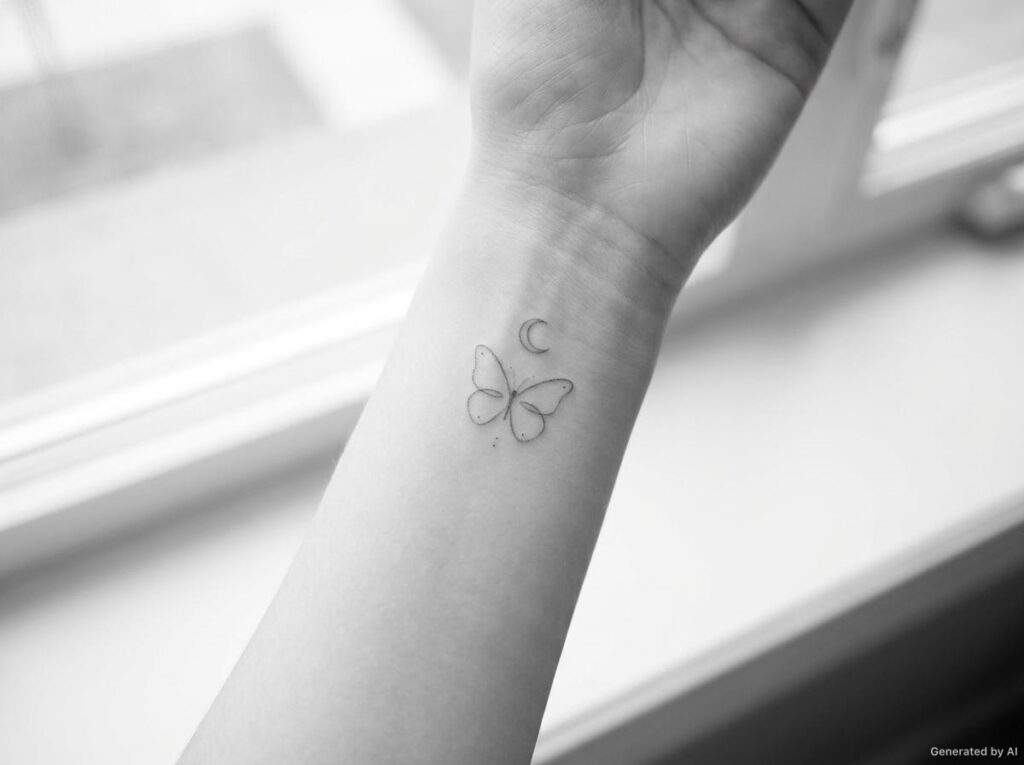
Fine line and single needle. Thin, even outlines with almost no shading. The most delicate and the most popular version of this tattoo right now. It suits small placements and produces the cleanest crescent. The trade-off is longevity: very thin lines fade and blur sooner than anything else, especially in sun-exposed spots, so budget for a touch-up and be realistic about size.
Dotwork and stipple shading. The moon is built from thousands of tiny dots, which gives it a soft, grainy, almost printed texture. This is arguably the best match for a moon of any phase, because the shading does the work a gradient would do, and it ages more gracefully than a flat grey wash. It is slow to apply, so expect a longer session and a higher cost for the same area.
Black and grey shading. Soft grey gradients, the classic tattoo look. Flexible, works at almost any size, and gives the moon real volume. The risk is a muddy moon — too much shading and it stops reading as a moon at all. Ask to see healed photos, not fresh ones.
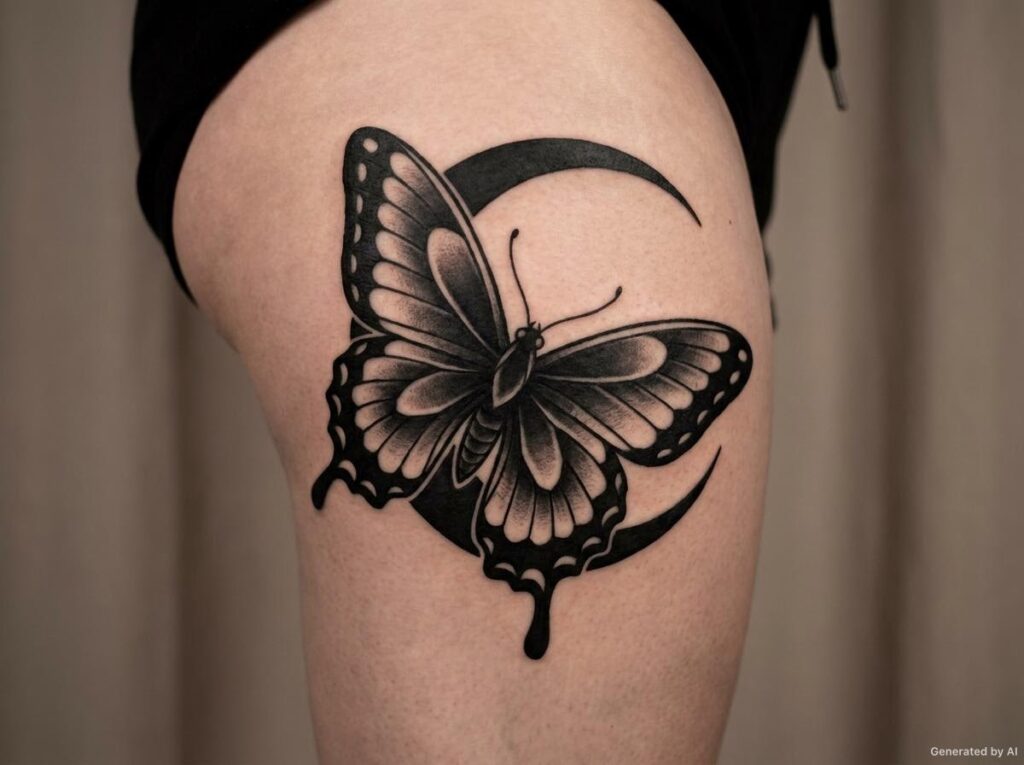
Blackwork and bold traditional. Solid black fills, strong outlines, no grey. The butterfly becomes a silhouette and the moon a hard crescent. This version holds up best over decades, and it borrows the same visual grammar as traditional blade and rose pieces — if that bold vocabulary appeals to you, our knife and dagger tattoo guide shows the same approach used on a completely different symbol set.
Neo-traditional. Bold outlines with ornamental detail, usually decorative borders and a more illustrative moon. Striking, but it needs space, so it rarely works below a certain size. Colour is optional here; in a monochrome palette it reads closer to engraved illustration.
Placement: Where This Design Works Best
Placement decides whether the design reads as a delicate detail or a full statement, and it also decides how the details survive. A short guide to the spots that work.
Inner wrist. The classic small placement, and the origin of most “crescent moon tattoo on wrist” searches. Visible, personal and easy to cover. The inner wrist takes a lot of friction and sunlight, so fine line here needs a touch-up sooner than the same design elsewhere.
Behind the ear. Very small, very discreet, and it works with an almost abstract version — a sliver of moon and one wing. The skin is thin, it heals quickly, and it is one of the few placements where a genuinely tiny piece still reads clearly.
Collarbone and sternum. The collarbone is a natural curve for a single butterfly, and the moon sits neatly above or below it. The sternum is for slightly larger, symmetrical versions. Both are more painful than average, and the sternum area moves a great deal, so the artist needs to plan for that.
Shoulder blade and upper back. The best combination of visibility and durability. This is where a detailed moon with real crater texture survives longest, and where a mirrored pair of butterflies works best, with the moon centred between them.
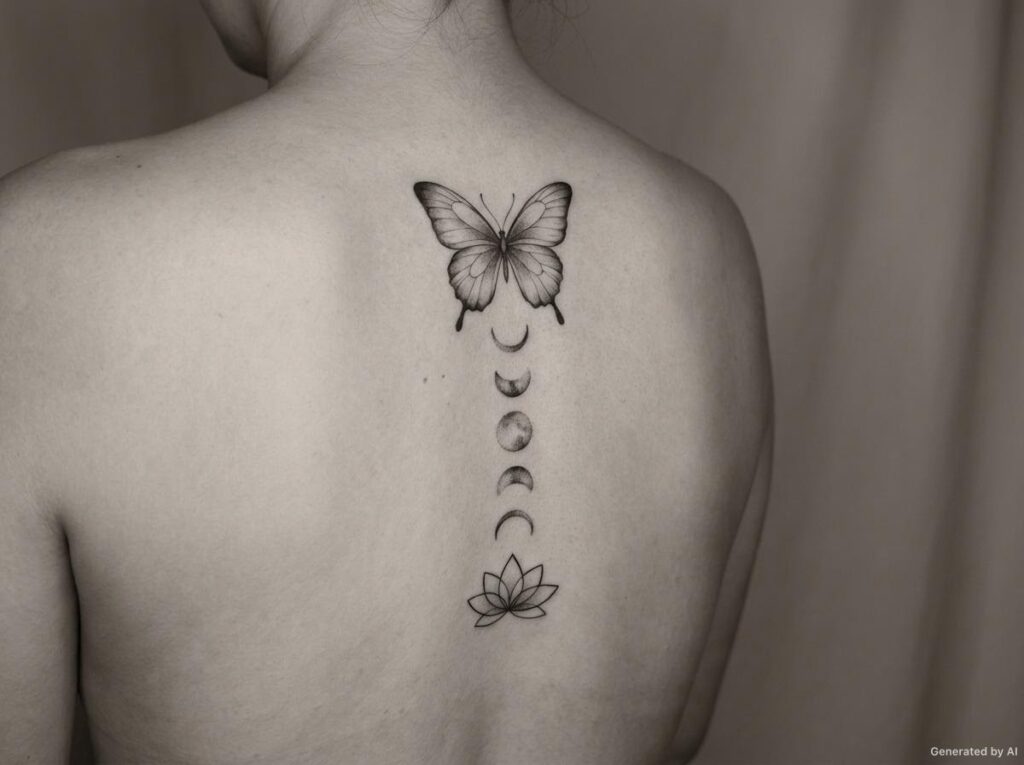
Spine. Ideal for a vertical composition — butterfly above, a row of moon phases below. Long and narrow, it reads clearly from behind, and it suits the “cycle” reading of the design better than any other placement.
Thigh. Underrated. Large, flat and easy to cover, which makes it the right choice if you want a bold blackwork or neo-traditional version without committing to a visible spot. Ages well.
Design Decisions That Change the Reading
Small choices inside the drawing do more work than most people expect. These are the ones worth deciding on purpose rather than leaving to chance.
The moon behind or in front of the wings. A moon placed behind the butterfly turns the design into a backdrop — the change happens against the cycle, which is a calmer, more contemplative reading. A moon in front, overlapping the wings, puts the two symbols in contact and reads as more active, almost like the cycle is touching the person.
One butterfly or two. A single butterfly reads as a personal journey. Two mirrored butterflies, wings framing the moon, read as symmetry, partnership or two sides of the same change. Two is also easier to compose around a full moon.
Symmetry or asymmetry. Symmetrical designs feel formal and calm; deliberately uneven wings feel more natural and are often used to suggest a transformation still in progress rather than completed.
Negative space. On dark skin tones, the most durable version uses the un-inked skin to describe the wings and keeps the ink as outline and shading. This is a conversation to have with an experienced artist early, not after the stencil is on.
Line weight. A single consistent line weight reads modern and clean. Varying it — heavier where the wings meet the body, finer at the tips — adds depth, but only if the artist is confident with it.
Complexity budget. Fine line and detail have physical limits. Below roughly a coin-sized area, crater texture, tiny stars and layered wing patterns collapse into a grey smudge. If the design is intricate, the tattoo must be bigger than you first imagined, or the detail has to be simplified.
Choosing an Artist: Fine Line, Shading and Red Flags
This is a specialist design, and the specialist part is not the butterfly — it is the moon. Clean circles, even grey gradients and controlled dotwork are the three hardest basic skills in tattooing, and they are exactly what this piece requires. Look for an artist whose portfolio shows moons, mandalas, dotwork or geometric work, not just florals and script.
Ask for healed photographs. Fresh tattoos always look sharp; the real question is how a piece looks after a year. Any artist working in fine line or dotwork should have healed examples to show, and should be comfortable talking about what has faded on past clients.
Red flags worth taking seriously. No healed work at all. A willingness to tattoo a very intricate design at a very small size. Drawing only on the day of the appointment with no chance to review the design in advance. Any reluctance to discuss hygiene — fresh needles, gloves and a clean station should be visibly obvious. Pressure to add elements you did not ask for.
Three questions that save trouble. Which parts of this design will blur first, and how would you change it to last? Can you show me this on skin rather than on paper? If I want a touch-up in a year, how does that work?
If you want a design that is genuinely yours rather than a redraw of something you found, describe the phase and the reason behind it and let the artist solve the composition. That is the difference between a personalised piece and a copy.
Cost, Pain, Healing and Aftercare
There is no standard price for a butterfly and moon tattoo, and any article quoting a fixed figure is guessing. Cost is driven by size, the amount of detail, the style, the artist’s rate and the city you are in. A tiny single-needle crescent behind the ear and a large blackwork thigh piece are not the same product. Dotwork and fine line are slower to apply than bold traditional work, so more detailed versions cost more per square centimetre even at the same size. Most studios charge either an hourly rate or a flat quote per design — ask which, and ask for the quote before the appointment, not after.
Pain follows placement more than it follows size. Ribs, sternum, spine, ankle and the inner wrist are on the sharper end; shoulder blade, outer forearm and thigh are considerably easier. Delicate designs also mean more time under the needle per unit of area, so a small fine line piece can feel longer than a bigger, bolder one. Eat beforehand, sleep properly, and do not book a long session as your first tattoo.
Healing is a process, not an event. The surface typically settles within a couple of weeks while the deeper skin keeps changing for longer, which is why a fresh tattoo often looks slightly hazy before it sharpens. Keep the area clean, do not pick or scratch it, avoid soaking it in baths, pools and the sea while it heals, and keep it out of direct sun. For proper guidance rather than internet folklore, follow a dermatology source such as the American Academy of Dermatology’s guide to caring for tattooed skin.
The long-term maintenance rule for this design is simple: sunlight is what fades a moon. Fine line and dotwork are the most vulnerable, so daily sun protection on an exposed piece is not optional if you want it to stay crisp. All blackwork holds up best, which is worth factoring in if you want a design you will not need to revisit.
Butterfly and Moon Tattoo FAQ
What does a butterfly and moon tattoo mean?
What does a butterfly and moon tattoo mean on a woman?
What does a crescent moon with a butterfly mean?
Does the moon phase really change the meaning?
Butterfly and moon, or moth and moon — what is the difference?
Where should I put a butterfly and moon tattoo?
How much does a butterfly and moon tattoo cost?
Do butterfly and moon tattoos age well?
Final Thoughts
A butterfly and moon tattoo is one of the few designs that gets better the more deliberately you plan it. The symbols are familiar, which makes the piece easy to recognise, but the meaning lives in details most people do not think about: which phase the moon is in, whether it sits behind the wings or in front of them, and whether the style you chose will still look like that in ten years.
So decide the phase first and let it explain the rest. If you are marking something beginning, a waxing crescent will say it more honestly than a full moon. If you are closing something, the waning moon is the more accurate symbol. And if the point is that you have moved through all of it, a row of phases along the spine will keep saying that long after a single crescent has faded.
Whatever you land on, keep the drawing custom, keep the size honest for the detail you want, and pick an artist with healed dotwork or moon work in their portfolio. The symbol does the rest.