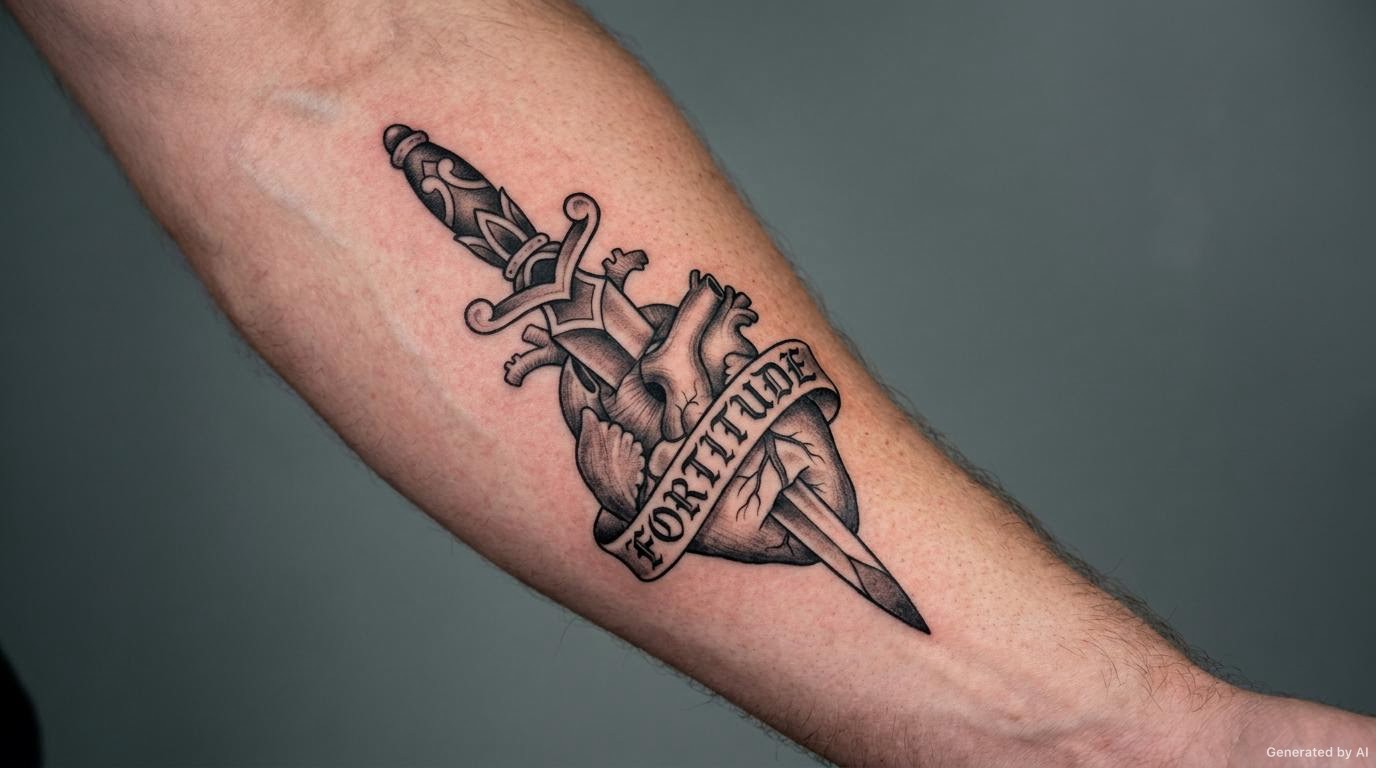
A dagger through heart tattoo is one of the oldest images in Western tattooing, and one of the few that almost anybody can read without being told what it means. The blade carries force, sacrifice or a wound. The heart carries love, devotion or vulnerability. Put the two together and the picture says something specific: love that was damaged, an oath that was sworn, or pain that has already been survived. That is why it has stayed on flash sheets for more than a century while other designs came and went.
This guide sets out the four readings the symbol actually carries, what changes when the blade points up rather than down, how the type of heart shifts the meaning, and how the design behaves across styles and placements. It also covers what to expect in the chair, how the piece ages, and the questions worth asking before you book. If you are still deciding on the blade itself, our guide to what a dagger means on its own covers the symbol by itself, and the knife and dagger tattoo guide covers the wider family of designs.
Quick Answer: What Does a Dagger Through Heart Tattoo Mean?
A dagger through a heart tattoo most often means love that came with pain. The four readings it carries are heartbreak, betrayal, devotion or sacrifice, and survival. Which one the tattoo actually holds depends on three things: whether the blade points up or down, what kind of heart it passes through, and what the wearer says it means. A blade driven down through a cracked heart leans towards heartbreak and what followed it. A blade held upright at the centre of an intact heart leans towards an oath, loyalty or devotion. A dagger through a Sacred Heart is a religious reading first. None of these is a fixed code — the symbol is a set of conventions, and the wearer’s own reason sits on top of them.
Table of Contents
- Why the Dagger and the Heart Share a History
- The Four Readings of a Dagger Through a Heart
- Point Up or Point Down: What Changes
- How the Heart Itself Changes the Meaning
- Dagger Through Heart vs Other Heart Symbols
- Styles That Suit a Dagger Through Heart Tattoo
- Placement: Where This Design Works Best
- Does It Mean Something Different for Men and Women?
- Before You Book: Design, Artist and Red Flags
- Cost, Pain, Healing and Aftercare
- Dagger Through Heart Tattoo FAQ
- Final Thoughts
Why the Dagger and the Heart Share a History
The pairing is not a modern invention, and it did not start as a romantic gesture. Daggers and hearts both entered Western tattooing through the same channels: sailors, soldiers, and the flash sheets drawn for them. A blade surrounded by hearts and banners was a working tattoo, not a decorative one. It said something about the person wearing it, usually something about what they had survived or what they had promised.
By the early twentieth century the combination was standard equipment on flash sheets, sitting alongside anchors, swallows, roses, and names on ribbons. Sailor tattoos were built on a small vocabulary of symbols that had to be legible at a glance, and a dagger through a heart was one of the clearest entries in that vocabulary. It could mark a lost love, a hard posting, or a loyalty that was expected to hold. Because the same design could carry any of those, it never went out of use.
What survives from that tradition is not a rulebook but a set of habits. A heart is drawn in a particular way. A blade is drawn in a particular way. Banners are added when something needs to be written down. If you have looked at more than a handful of traditional tattoos you already know the grammar, even if you have never had to name it. That grammar is what a tattoo artist is reading when you describe what you want.
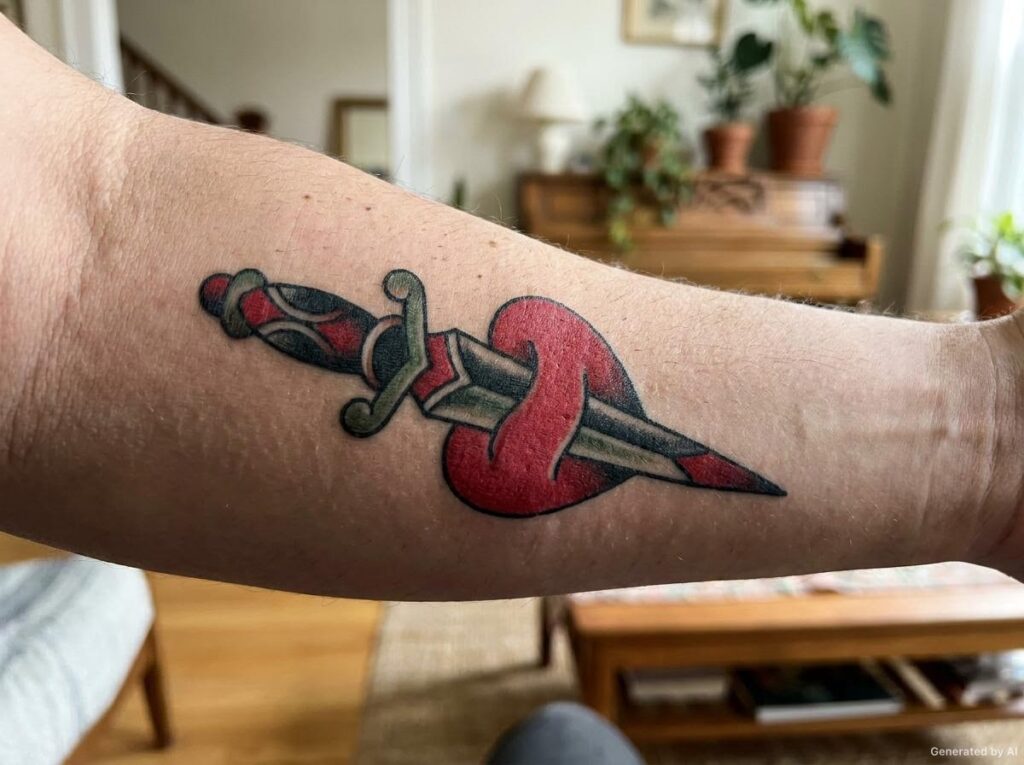
It is worth separating the history from the meaning. Knowing that a design is old does not tell you what it means to the person wearing it, and it does not oblige you to follow the old reading either. The history is useful for one practical reason: it tells you which version of the design is likely to still look good in twenty years. Older motifs were drawn to survive bad skin, cheap ink, and decades of sun. That is not a small thing.
The Four Readings of a Dagger Through a Heart
Almost every honest explanation of this tattoo settles into four readings. They are not exclusive, and most real tattoos sit between two of them. The point of listing them is to give you language for what you actually mean, so you can tell an artist something more useful than “a dagger through a heart”.
1. Heartbreak
This is the reading most people arrive with. The blade is the injury; the heart is what was injured. A dagger through a heart read as heartbreak is not usually about a wound that is still open. It is about a wound that has a date attached to it. The piece is often tied to a specific person, a specific year, or the end of a specific chapter, which is why the design so often carries a date or a name on a banner.
If this is your reading, the details matter more than usual. A clean, intact heart with a single blade reads differently from a heart that has visibly split. A blade that has gone all the way through reads differently from one that is only just entering. Decide which of those is true for you before you look at reference images, because it will cut your options down quickly and save a lot of back and forth.
2. Betrayal
The second reading is sharper and more specific. A dagger is a close-quarters weapon, which is why it has carried an association with betrayal for far longer than it has been a tattoo motif. The blade that reaches you is the one that was held by someone standing near you. A dagger through a heart can therefore be read as harm that came from a trusted direction rather than from an enemy in front of you.
In practice this reading tends to produce a different composition from heartbreak. It leans towards a single clean strike, a blade that is already embedded, and often a straight-on view rather than a three-quarter angle. The picture is quieter and colder. If a client asks for this meaning, most artists will steer away from anything that looks decorative — the point is the plainness.
3. Devotion, Sacrifice and the Oath
The third reading runs the opposite way, and it is older than the other two. In religious and military traditions a blade through a heart is not an injury at all. It is an offering. The Sacred Heart pierced by a lance or a dagger is a devotional image, and the same logic carries into secular tattoos: a heart that has been opened on purpose, in the service of something the wearer chose.
This is the reading behind a lot of dagger and heart tattoos that get misread as heartbreak. A blade held upright, centred, passing through a heart that is otherwise whole and undamaged, is usually making a statement about commitment rather than loss. So is a heart surrounded by flames, rays, or thorns. If you want the tattoo to read as devotion rather than damage, the heart has to look intact and the blade has to look placed rather than thrown.
4. Survival
The fourth reading is the one that has grown the most in recent decades, and it is the most common reason people give when they actually explain their tattoo out loud. The blade is in the past tense. The heart is still there. The image records something that happened and is finished, which is why these versions so often add a healed detail — a stitched heart, a closed wound, a blade that has been snapped, or a heart that has been repaired with thread.
Survival is also the reading that pairs most naturally with a banner carrying a date, because a date makes the tense explicit. Without one, survival and heartbreak can look nearly identical on the skin. If the difference matters to you, it is worth building it into the drawing rather than hoping the viewer guesses.
Point Up or Point Down: What Changes
Orientation is the single most useful decision in this design, and it is also the one most people make by accident. The direction of the blade does not have an official rulebook behind it, but it does produce two recognisably different pictures, and viewers read them differently whether or not you intended it.
A blade pointing down through a heart tends to read as something that has landed. The strike is complete. This is the composition behind most heartbreak and betrayal versions, and it is the one that looks most like a wound. It also tends to sit better on a vertical body part, because the eye follows the blade downwards along the limb or the torso.
A blade pointing up through a heart is read as placed rather than thrown, and in many designs it reads as a heart raised on the blade — closer to an offering or a standard than to an injury. This version often looks more ceremonial or devotional, particularly when the heart is intact and the blade is straight.
There is a practical dimension too, and it is the one that matters most. A dagger is a long, rigid object. It wants a long, straight space. A blade drawn slightly crooked will be obvious in a way that a crooked rose never is, because the eye is very good at spotting a bent straight line. Whichever way you point it, the blade needs to sit on an axis the artist can keep true — which is why the forearm, calf and thigh are so common, and why the ribs are so much harder than they look.
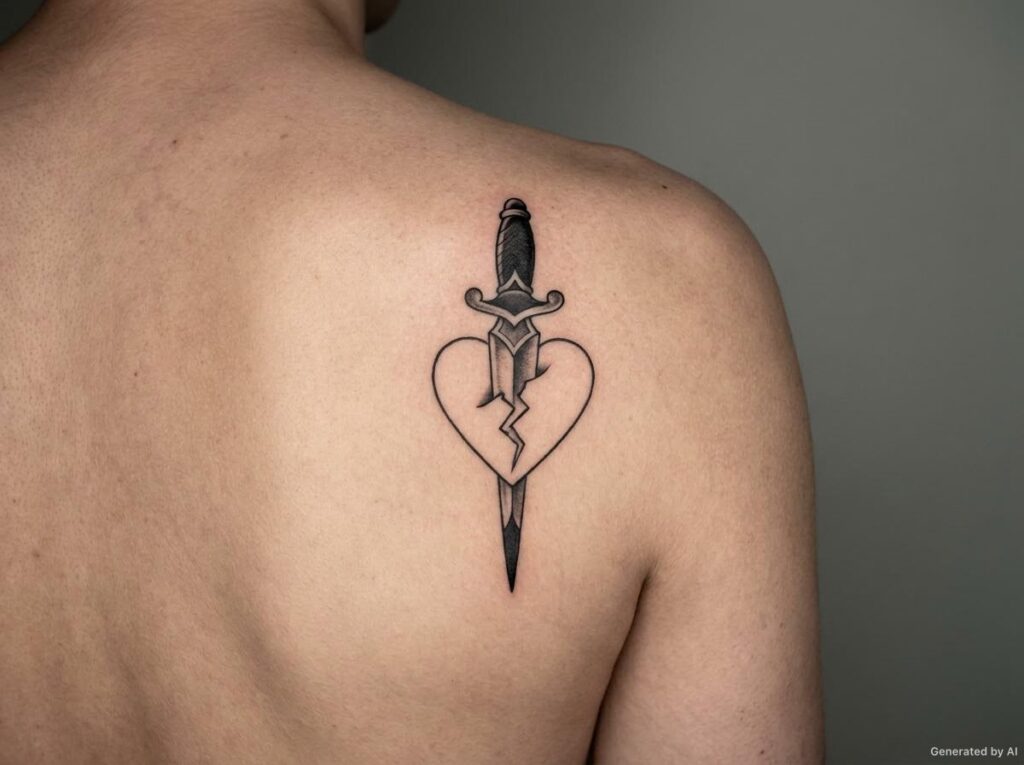
If you want the most conventional version of the design, take the down-pointing blade with a heart that is either cracked or cleanly pierced, and put it on a limb. If you want something that reads as an oath rather than a wound, turn the blade up and keep the heart whole. Both are common. Neither is wrong.
How the Heart Itself Changes the Meaning
The blade gets most of the attention, but the heart does at least as much work. Four versions cover almost everything you will see, and each one pulls the reading in a different direction.
The classic flash heart. Rounded, symmetrical, usually red in traditional work and grey in black and grey. This is the neutral option. It is the version that lets the blade carry the meaning, and it is the one that reads fastest from across a room. If you want people to understand the tattoo at a glance, this is the heart to use.
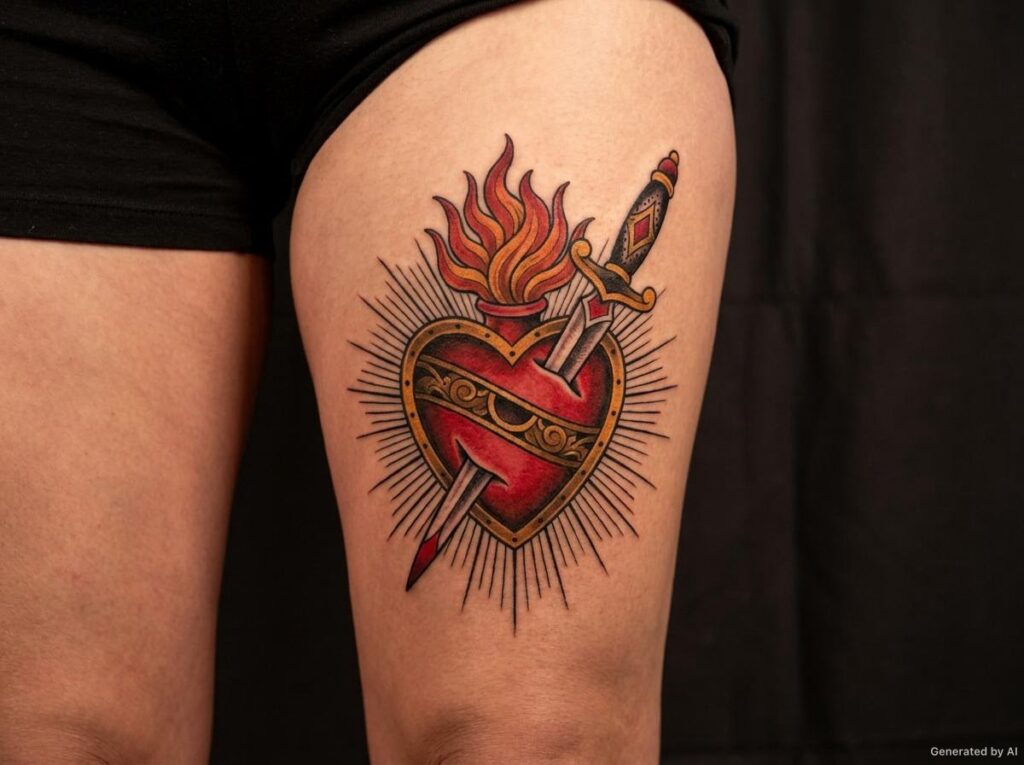
The Sacred Heart. A heart in flames or rays, often wrapped in thorns, sometimes with a cross above it. This is a devotional image rather than a romantic one, and a dagger through it is read as devotion, sacrifice or faith. The Sacred Heart has its own long iconographic history, and it carries a weight that the flash heart does not. If you have a religious reason for the tattoo, this is the version that will be read correctly by the people who matter to you.
The anatomical heart. Chambers, arteries, valves. This version makes the meaning clinical and literal rather than figurative, and it tends to read as more modern and more serious. Anatomical hearts are usually done in black and grey or in fine line, and they pair well with a blade drawn at an angle. Note the practical trade-off: anatomy wants shading to read properly, which means a larger piece and a longer session.
The cracked or stitched heart. A heart that is already split down the middle, or one that has been sewn back together. This is the version that carries the survival reading most clearly. A crack says the damage happened; stitching says it has been dealt with. Both are strong, and both are easy to add to a design you already like.
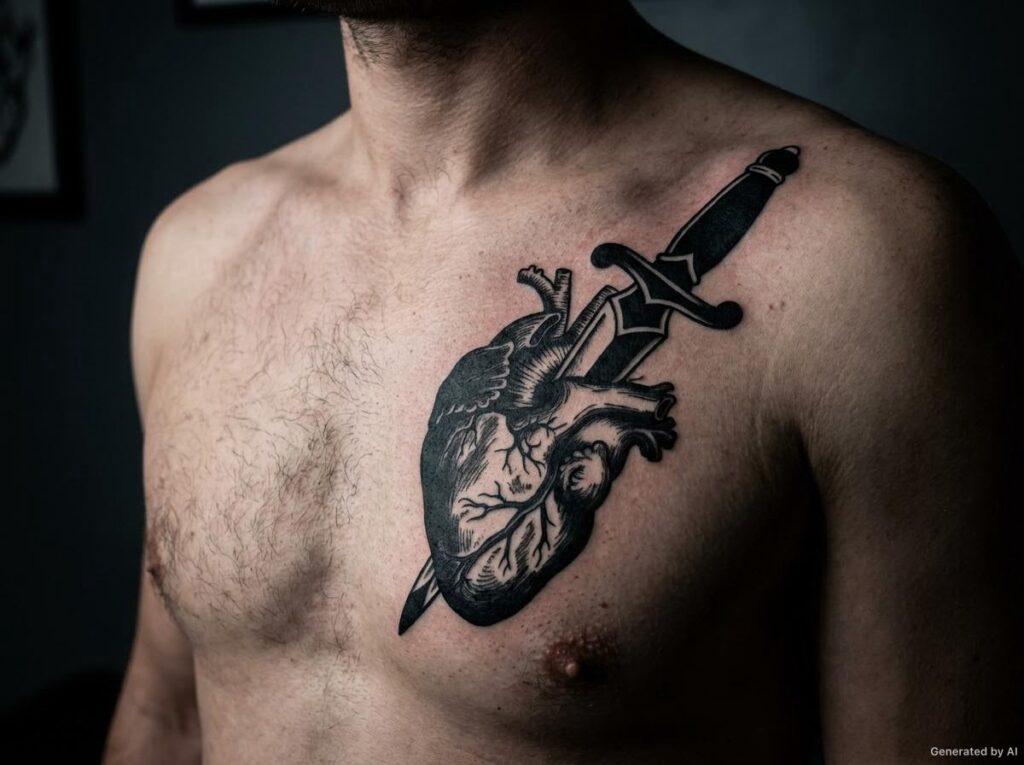
Dagger Through Heart vs Other Heart Symbols
A heart with something through it is a small family of designs, and they are easy to confuse. Here is how they differ, and what each one is best suited to.
| Symbol | Dominant reading | Best suited to |
|---|---|---|
| Dagger through heart | Heartbreak, betrayal, devotion, or survival | A specific event or promise you can name |
| Arrow through heart | Love arrived; courtship, romance, affection | Joyful, light-hearted or partner pieces |
| Sword through heart | Noble sacrifice, martyrdom, duty | Memorial, military or religious themes |
| Heart with rose | Love mixed with beauty, risk or loss | Softer, more decorative compositions |
| Broken heart alone | Loss with no additional detail | Small, simple, unambiguous pieces |
| Sacred Heart alone | Faith, divine love, devotion | Religious pieces without a violent element |
The distinction that catches people out most often is the first two rows. An arrow through a heart is romance arriving; a dagger through a heart is romance that cost something. They look similar in a thumbnail and they mean very different things, so if you are adapting a reference image, check which one you are actually looking at.
If you like the idea of a blade paired with a second symbol, the same logic extends further. A snake and dagger leans towards knowledge, healing and conflict resolved, while a dagger and rose leans towards love and pain held together. The heart is the most emotionally direct of the three.
Styles That Suit a Dagger Through Heart Tattoo
Style is not decoration here. It decides how long the design holds, how large it has to be, and how clearly the meaning reads. These are the versions that work, in roughly the order most people choose them.
American traditional. Bold outlines, a limited palette, solid blocks of colour or heavy black. This is the style the design was drawn for, and it is the one that ages best. A traditional dagger through heart can be built small and will still be legible decades later, because the whole composition relies on outline rather than shading. If you are unsure, this is the safe answer.
Black and grey. The same composition, rendered in shading instead of colour. It reads more serious and more subdued, and it suits the heartbreak and betrayal readings well. The trade-off is time: a black and grey version needs soft gradients to look right, which usually means a larger piece and more hours under the needle than the traditional version.
Fine line and single needle. Thin, delicate outlines with little or no shading. This style is genuinely beautiful and genuinely demanding. Very fine lines can soften and blur over years, and a design that depends on the blade being perfectly straight will show any drift. Fine line works best small, on a low-friction area, and with a realistic expectation that it may need a touch-up before the traditional version does.
Blackwork. Solid black shapes and heavy contrast, often with negative space doing the drawing. Blackwork is the most graphic option and it photographs extremely well. It also commits you: a large solid black heart is very hard to rework later, so the design needs to be settled before the first needle goes in.
Neo-traditional. Traditional bones with more dimension, richer colour and more ornamental detail. The dagger-through-a-Sacred-Heart composition above is a good example. This style looks striking and it needs space — neo-traditional detail collapses if you shrink it too far.
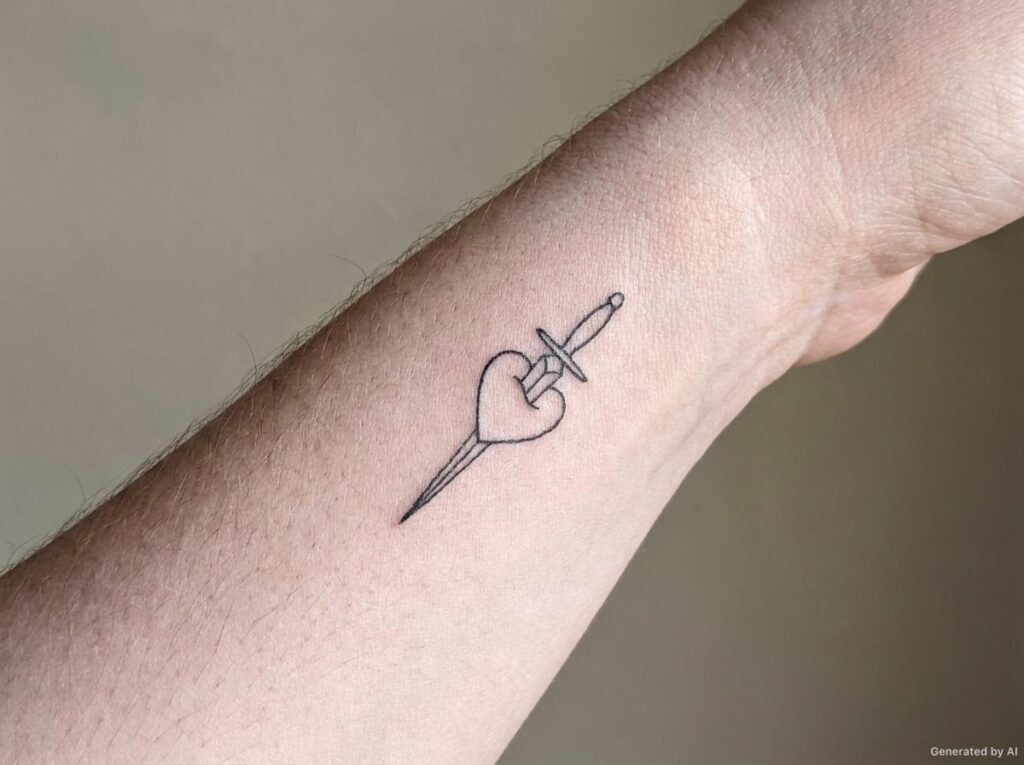
One practical rule cuts across all of them. A straight blade needs to be drawn straight, and it needs an artist who can do that repeatably. When you look at portfolios, look specifically at any long, straight elements — daggers, arrows, crosses, straight lettering. Those are the hardest things to fake, and the ones most likely to reveal whether the artist’s line control is as good as their shading.
Placement: Where This Design Works Best
Because the design is essentially a long line crossed by a shape, placement is mostly a question of finding a surface that lets the blade stay straight and gives the heart room to sit without distortion.
Forearm. The most common choice, and the easiest to get right. There is a clear axis down the middle, plenty of length for a blade, and the skin is relatively stable. Inner forearm suits fine line and small versions; outer forearm carries traditional and blackwork well.
Upper arm and shoulder. Good for larger traditional and neo-traditional pieces. The shoulder blade works particularly well for a down-pointing blade because the natural shape of the back gives the design a direction to follow.
Calf and thigh. Both give a long, straight surface and are easy to keep out of the sun. The thigh takes large pieces happily. The calf suits down-pointing blades especially well, since the muscle naturally lengthens the design.
Chest. The classic placement for the Sacred Heart version, and a strong one for blackwork. It is also one of the more painful areas, and the design has to be laid out around the sternum rather than being placed on a flat surface. Expect the artist to spend longer on the drawing.
Wrist, ankle, behind the ear. Fine for small, simple versions. Be realistic about scale: at these sizes the heart and the blade have to be reduced to their simplest outline. Ornamental detail or anatomical shading will not survive, and neither will lettering on a banner.
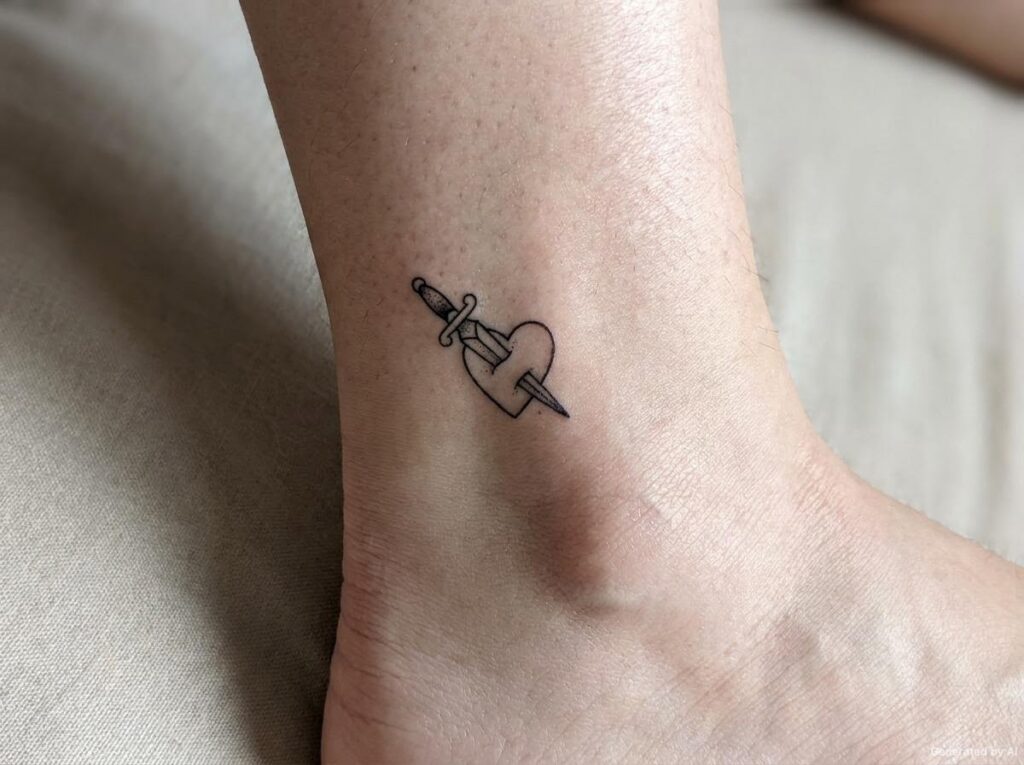
Worth saying plainly: a placement does not carry a meaning of its own. There is no tradition in which a dagger through a heart means one thing on the arm and another on the ribs. Placement changes visibility, pain, cost and how the design ages. The meaning comes from the drawing and from you. You can browse more designs across the knife and dagger tattoo collection to see how the same motif behaves in different positions.
Does It Mean Something Different for Men and Women?
No. The symbol is not gendered, and there is no separate reading attached to one sex. A dagger through a heart means what it means whoever is wearing it, and the four readings above apply in full to everyone.
What does change is convention, and it is worth being honest about it because it affects how the tattoo will be read by strangers. Sizing and placement habits still differ. Traditional dagger-through-heart pieces sit on forearms, upper arms and chests far more often on men; women more often take smaller, finer versions on the forearm, wrist, ankle or thigh. Sacred Heart versions have their own separate tradition and are worn by both, though the devotional context tends to be more visible in how the piece is framed and discussed.
The practical consequence is this: if you pick the smaller, finer-line version, more people will read the tattoo as personal and reflective. If you pick the larger traditional version, more people will read it as a statement. Neither is a judgement about the wearer, and neither is more authentic. It is simply how the same image gets interpreted at different scales.
The only convention genuinely worth knowing is that hearts on the hand, face and finger read as especially public. Once a tattoo is that visible, it stops being something you explain and becomes something you are asked about. That is a real consideration, and it has nothing to do with gender.
Before You Book: Design, Artist and Red Flags
The design is simple enough that almost any competent artist can execute it, which is exactly why the difference between a good one and a great one shows up so clearly. A dagger through a heart has nowhere to hide. The blade is either straight or it is not.
Look at straight lines in the portfolio. Not the shading, not the colour work — the straight lines. Daggers, arrows, banners, straight lettering. If those are clean and parallel, the artist has the control this design needs. If they wobble, keep looking.
Look at healed work, not fresh work. Every tattoo looks good in the chair. Ask to see photographs of pieces that have healed for at least six months, especially anything in the style you want. Fine line and black and grey look very different healed than they do immediately after.
Decide between custom and flash. A custom drawing costs more and takes longer, but it gives you the orientation, heart type and proportions you actually want. Flash is faster and cheaper, and the classic versions have been refined by repetition. Neither is better. What matters is that you know which one you are buying before you sit down.
Ask about the banner text early. If you want a name, a date or a short phrase, that has to be part of the drawing, not an afterthought. Lettering drawn on afterwards tends to sit awkwardly against the blade, and it is the most common reason these tattoos end up looking crowded. Keep it short — a date or a first name works far better than a sentence.
Walk away from these. No portfolio at all, or a portfolio that is clearly other people’s work. A refusal to draw anything in advance. A studio that will not show you healed results. Any artist who talks you out of a placement over concerns about how long it will take rather than how well it will work. And be sceptical of anyone guaranteeing a specific result, particularly around colour retention or how a fine line piece will hold up years later. Nobody can promise that.
One last thing that saves trouble: bring three reference images, not thirty. Say what you like about each — the angle of the blade, the style of the heart, the weight of the line. An artist can work with that. A folder of two hundred saved images mostly communicates that you have not decided yet. If you want a sense of how we approach this kind of piece, our studio standards and editorial approach are set out in full.
Cost, Pain, Healing and Aftercare
Cost. Tattoo pricing varies enormously between studios, cities and countries, and it depends on the style, the size and how much custom drawing is involved. A small fine line version and a large neo-traditional piece with a custom drawing sit at completely different price points, and neither is unreasonable. Most studios will give you an hourly rate or a flat quote for a specific design. Ask for the quote in writing before you book, and ask separately whether the drawing time is included. Do not judge a studio by its cheapest piece.
Pain. Discomfort depends mostly on the placement rather than on the design. Forearm, upper arm and thigh are generally among the easier areas. Ribs, chest, ankle bone, wrist and anywhere close to bone or thin skin are harder. Long straight lines hurt less than dense shading, so a traditional version is often more comfortable per hour than a soft black and grey one, even though the traditional piece may be bolder. Nobody can tell you what it will feel like for you, and nobody should try.
Healing and aftercare. Healing time depends on size, placement and your own skin, and it is not the same for everyone. Broadly: keep the fresh tattoo clean, follow the specific written aftercare instructions your artist gives you, keep it out of direct sun, do not pick or scratch it as it heals, and do not swim in pools, lakes or the sea while it is still an open wound. Suspect infections should be seen by a healthcare professional rather than treated at home, and anything you are unsure about is a question for your artist or a doctor rather than for a search engine.
Two practical notes that apply to this design in particular. First, sun exposure does more damage to fine line and soft shading than to bold traditional work, so if the piece is going somewhere permanently exposed, that is worth factoring into the style choice. Second, a dagger through a heart is a design people ask about, and it will be seen. Positioning it where you can control who sees it is a legitimate design decision, not a compromise.
Dagger Through Heart Tattoo FAQ
What does a dagger through heart tattoo mean?
Is a dagger through heart tattoo negative?
Should the dagger point up or down?
Does it mean the same thing for men and women?
What does a broken dagger through a heart mean?
Can a dagger through heart tattoo be a memorial piece?
Does it work as a small tattoo?
How much does a dagger through heart tattoo cost?
Final Thoughts
A dagger through heart tattoo works because it does not need to be explained. The blade and the heart are both immediately legible, and the meaning sits in how they are arranged rather than in any hidden detail. That is also why the same design can hold four different readings without contradiction: heartbreak, betrayal, devotion, and survival are all versions of the same sentence about love that cost something.
The decisions that matter are small and specific. Which way the blade points. What kind of heart it passes through. How bold the line is. Where it sits. Get those four right and the tattoo will read the way you intend for as long as you wear it. Get them wrong and you will spend years explaining a picture that says something else.
Take the time to decide what yours is actually about before you choose a reference image. The best version of this tattoo is not the most detailed one — it is the one where the drawing matches the reason.
1 thought on “Dagger Through Heart Tattoo Meaning: Symbolism, Styles and Placement”