
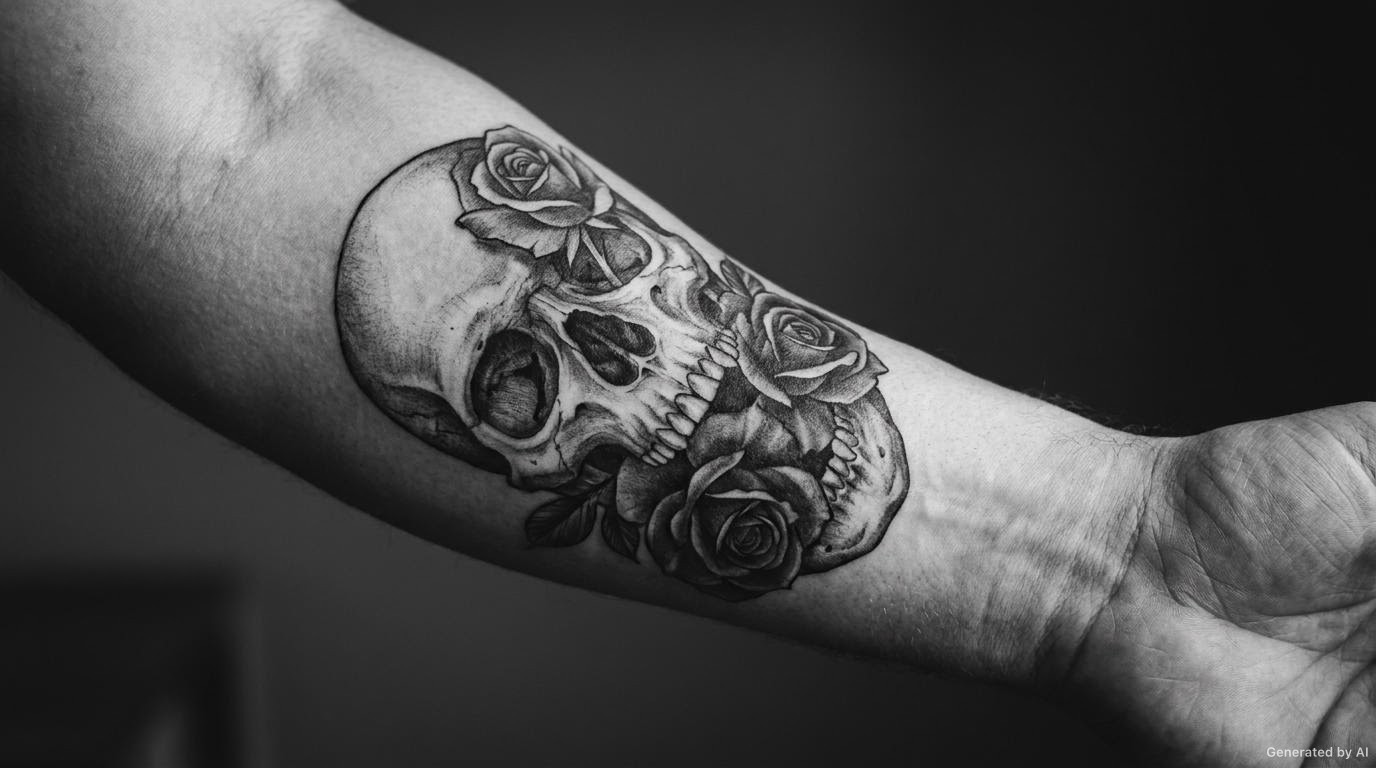
The skull and rose tattoo meaning is almost always the same idea told two ways: that beauty and decay share the same space, and that love is worth having even though everything ends. Put a rose with a skull and the skull stops being a pure memento mori. It becomes a pairing, and the pairing says something the skull could not say alone. This guide explains what the two halves bring to each other, how rose colour and composition shift the reading, and then covers styles, placement, size, cost, choosing an artist and aftercare so you can decide on a version that is actually yours.
Quick Answer: What Does a Skull and Rose Tattoo Mean?
A skull and rose tattoo most commonly means love and loss together: the rose stands for beauty, love and life, while the skull stands for mortality and time. Combined, they usually read as affection that is real precisely because it will not last forever, or as remembrance of someone who has died. The reading shifts with the rose itself. A red rose pushes toward passion, a black rose toward grief or a love that went wrong, a white rose toward purity and memory, and a bud toward something unfinished. Composition matters just as much: a skull holding a rose, a rose growing from the jaw, and a rose pushed through an eye socket each tell a slightly different story.
There is no single correct version. Choose the colour and the composition that match what you actually want to say.
Table of Contents
- 1. Skull and Rose Tattoo Meaning in One Line
- 2. The Two Halves: What Each Symbol Brings
- 3. Rose Colour and Rose Stage Change the Reading
- 4. How the Skull and Rose Meet in the Design
- 5. Meanings People Actually Choose
- 6. On a Man and on a Woman
- 7. Styles That Suit This Pairing
- 8. Placement Guide
- 9. Size, Cost, Time and Pain
- 10. Choosing the Right Artist
- 11. Healing and Aftercare
- 12. Skull and Rose Tattoo FAQ
- 13. Final Thoughts
1. Skull and Rose Tattoo Meaning in One Line
If you want the shortest version: the rose is what you love, and the skull is the fact that you will lose it. Everything else in this pairing is a variation on that sentence.
That is why the combination appears so often in memorial work, in pieces about a hard chapter that is finally behind the wearer, and in classic traditional designs where it functions as a general statement rather than a specific story. It is one of the few pairings in tattooing that works equally well as a tribute, a warning, a celebration, and a piece of decoration, which is exactly why it has stayed popular for so long.
For the broader framework behind the skull half, our skull tattoo guide covers memento mori, remembrance, resilience and the rest of the range in detail. This page is about what changes when the rose is added.
2. The Two Halves: What Each Symbol Brings
It helps to look at the two elements separately before looking at the combination, because the whole meaning comes from the tension between them.
What the skull brings
The skull contributes finality. It is the one part of a body that survives everything else, so it carries the memento mori idea by default: remember that you must die, and act accordingly. It adds weight, seriousness, and a refusal to pretend that things last. Depending on how it is drawn it can also add menace, which is why the composition and the expression of the skull matter so much.
What the rose brings
The rose contributes life, beauty, and love, along with the knowledge that all three are temporary. Rose symbolism runs through love, secrecy, devotion and loss, and in the European tradition of the language of flowers the colour, the stage of bloom, and even the presence of thorns each carried a distinct message. A rose is never only decorative. It always carries some version of “this is beautiful and it will not last”.
Put those two together and you get the whole point of the design. The rose is not there to soften the skull, and the skull is not there to ruin the rose. Together they say that the value of something is bound up with its impermanence. The same idea sits behind the vanitas painting tradition, where a skull and cut flowers were placed together on purpose.
3. Rose Colour and Rose Stage Change the Reading
This is the single biggest lever you have over the meaning, and it is the one people most often overlook. The colour and the maturity of the rose move the piece more than the skull does.
| Rose | Common reading with a skull | Note |
|---|---|---|
| Red rose | Passionate love, devotion, a love that persists past death | The warmest and most direct version of the pairing |
| Black rose | Grief, a love that ended badly, mourning | Works best in black and grey or solid blackwork |
| White rose | Purity, remembrance, innocence, a quiet memorial | Reads gentler; strong choice for tribute pieces |
| Closed bud | Something unfinished, a life cut short, unrealised potential | Particularly affecting in memorial work |
| Full bloom | A life fully lived, love at its peak | The most optimistic reading available |
| Wilting or falling petals | Loss already under way, time visibly passing | The darkest version; leans hard into decay |
| Thorned stem | Love that cost something, beauty with a price | Small detail with a large effect on the reading |
A useful habit is to choose the rose first and the skull second. The rose carries the emotion, and the skull carries the frame. If you already know the feeling you want, the rose tells you which way to take the design.
4. How the Skull and Rose Meet in the Design
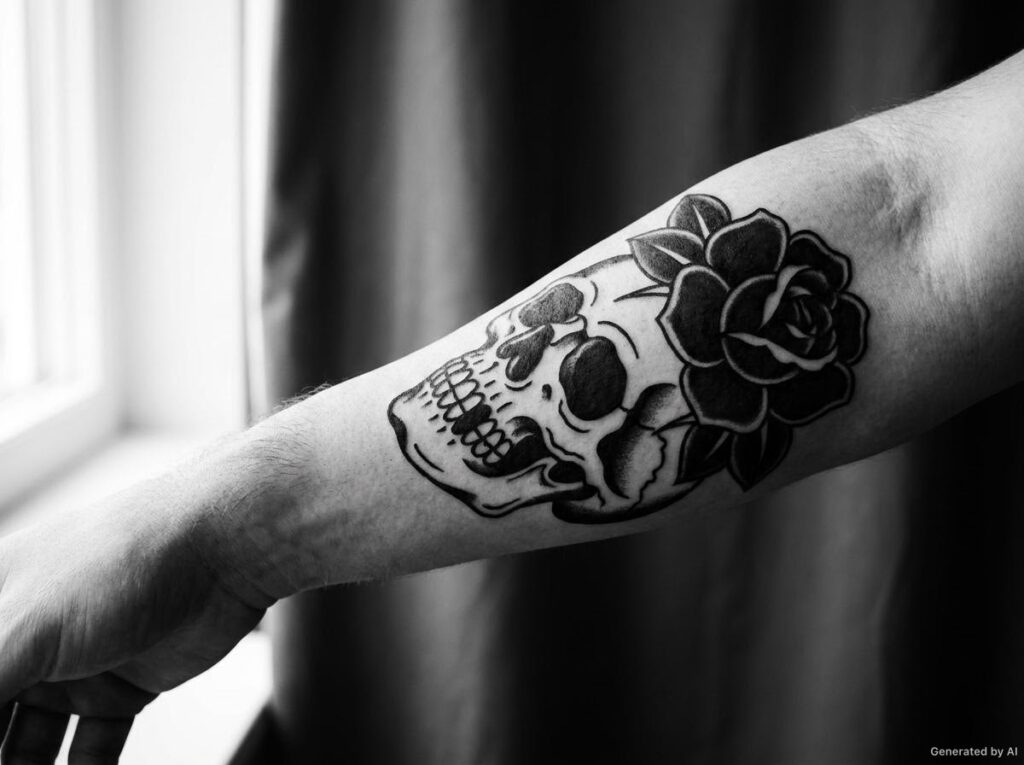
Where the rose sits relative to the skull decides whether the piece reads as tenderness, defiance, or decay. These are the arrangements that come up most often.
| Composition | What it reads as |
|---|---|
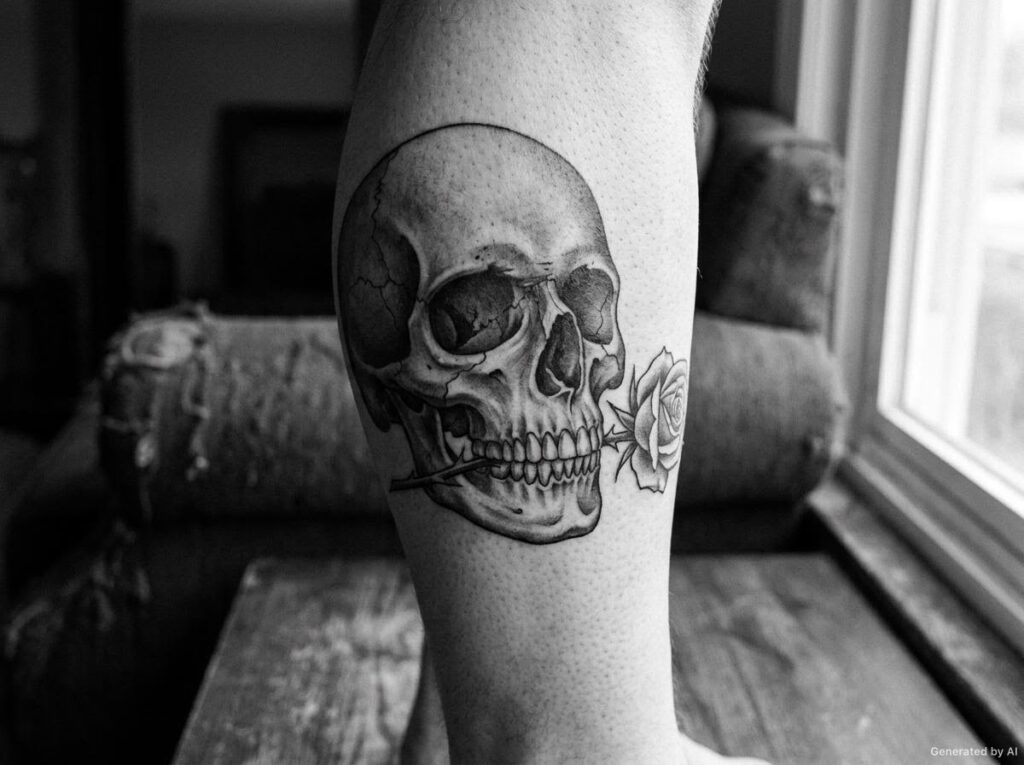
| Skull holding the rose in its teeth | Defiance, holding on to something beautiful anyway, life refusing to let go |
| Rose growing out of the jaw or cheekbone | Growth out of loss, something new coming from something ended |
| Rose through the empty eye socket | Memory, a person or feeling that still occupies the space |
| Rose crown around the top of the skull | Beauty surrounding death, reverence, sometimes devotion |
| Rose and vine wrapped around the whole skull | Love that outlasts, something holding on to the remains |
| Rose growing beside the skull, both facing forward | Two separate truths side by side; the calmest, least dramatic version |
| Skull behind, roses in front | Beauty in the foreground, mortality behind it; a hopeful reading |
Two of these are worth warning about. A rose through the eye socket divides opinion, because some viewers read it as tender and others find it unsettling; if you are planning something visible at work, that is a design to test on people first. A rose crown is beautiful but very close to the calavera tradition, so make sure you know which of the two you are referencing before you commit.
5. Meanings People Actually Choose
These are the specific reasons people give for a skull and rose tattoo, in roughly the order they come up. They are not mutually exclusive, and most real tattoos combine two of them.
Memorial and remembrance. This is the most common. The skull stands for the person who died and the rose for the love that continues. Add a name, date, or a favourite flower variety and the piece becomes specific rather than general. A closed bud or a white rose is a common choice here.
Love and loss held together. Not necessarily a death. This version is about a relationship that mattered and ended, and about the wearer refusing to pretend it was nothing. A black rose or a wilted bloom fits this reading.
Resilience after a hard chapter. The skull marks the version of the wearer that did not survive the period, and the rose marks what grew afterwards. This is the most hopeful version of the pairing and it usually uses a full bloom growing from the skull rather than beside it.
Beauty and decay as one idea. Less personal and more philosophical: the piece simply states that beautiful things end, and that this is what makes them beautiful. It is closest to the original memento mori and vanitas thinking.
Defiance and refusal. A skull holding or biting a rose says the wearer is not going to stop loving things just because they end. It is a small act of defiance, and usually drawn with attitude rather than sorrow.
Devotion and constancy. Sometimes the pairing is not about death at all. It says the love outlasts the person, which is why it appears so often in anniversary and marriage-adjacent pieces where the tone is warm rather than mournful.
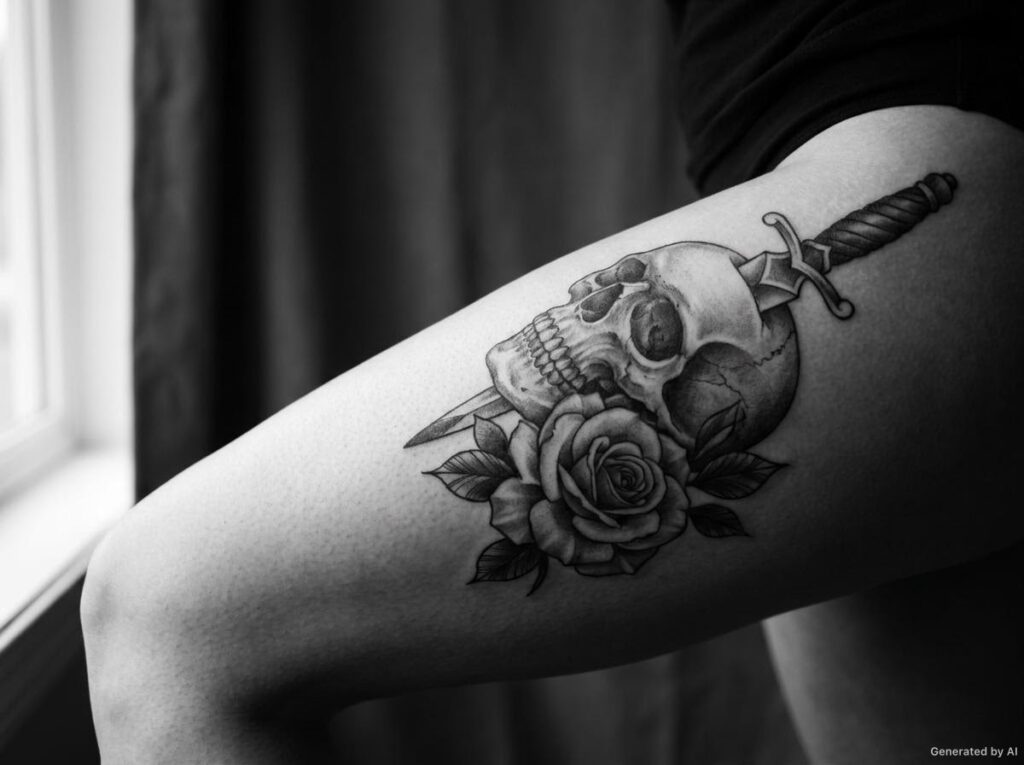
If your idea crosses into a blade as well, the additional element changes things again, and it is worth reading the dagger and rose tattoo meaning guide alongside this one, since the pairing logic is the same but the tone is sharper. The wider knife and dagger tattoo guide covers the blade side in full.
6. On a Man and on a Woman
The pairing works on anyone, but the design language tends to split, and it is useful to know which side you are leaning toward.
Skull and rose tattoos for men. Common choices are heavier outlines, fuller shading, and a larger scale, often traditional or neo-traditional. The skull usually dominates and the rose is built around it, sometimes with a dagger, banner, or script. Forearm, upper arm, chest and calf are the natural placements because they give the piece room to hold contrast.
Skull and rose tattoos for women. Fine line, blackwork, and delicate framing are more common, with the rose often larger relative to the skull and the composition more balanced. Smaller placements such as the inner wrist, shoulder, behind the ear, or the collarbone keep the piece elegant. None of this is a rule, and a large dark realistic version works beautifully too.
The practical point is that the ratio between the two elements is a design decision, not a gender one. A tiny skull with a large rose reads very differently from a large skull with a single small rose, and both are worth sketching before you decide.
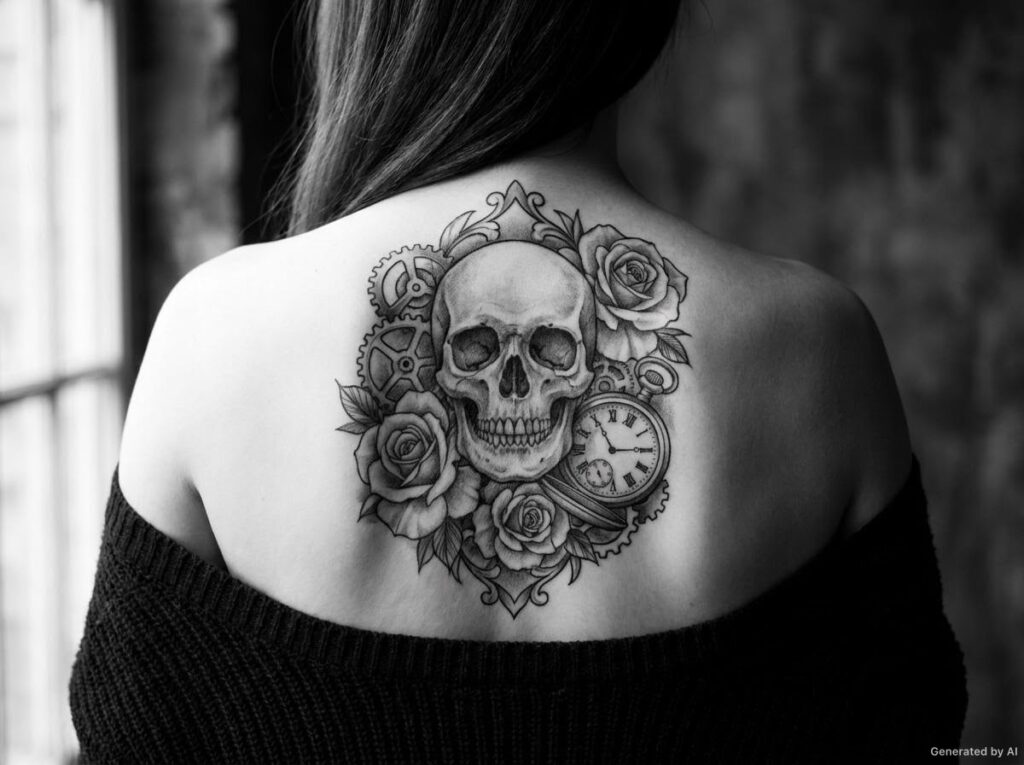
7. Styles That Suit This Pairing
Some styles handle this combination better than others, largely because both a skull and a rose depend on legible structure.
Traditional and American traditional. Arguably the natural home of the skull and rose. Bold outlines, limited palette, high contrast, and a composition that holds up over decades. If you want the pairing to still read clearly in twenty years, this is the safest choice.
Black and grey realism. The strongest option for emotional, memorial-style pieces. Realistic shading lets the rose look genuinely soft against the skull’s hard structure, and it suits larger placements where the detail has room.
Blackwork. Solid black shapes and strong negative space. The contrast between an unshaded rose and a packed black skull is striking, and this style ages particularly well because there is little fine detail to blur.
Neo-traditional. Adds ornament, richer shading, and decorative framing. Good if you want the piece to feel deliberate and a little theatrical. It also allows colour, which matters a great deal if you want a red rose.
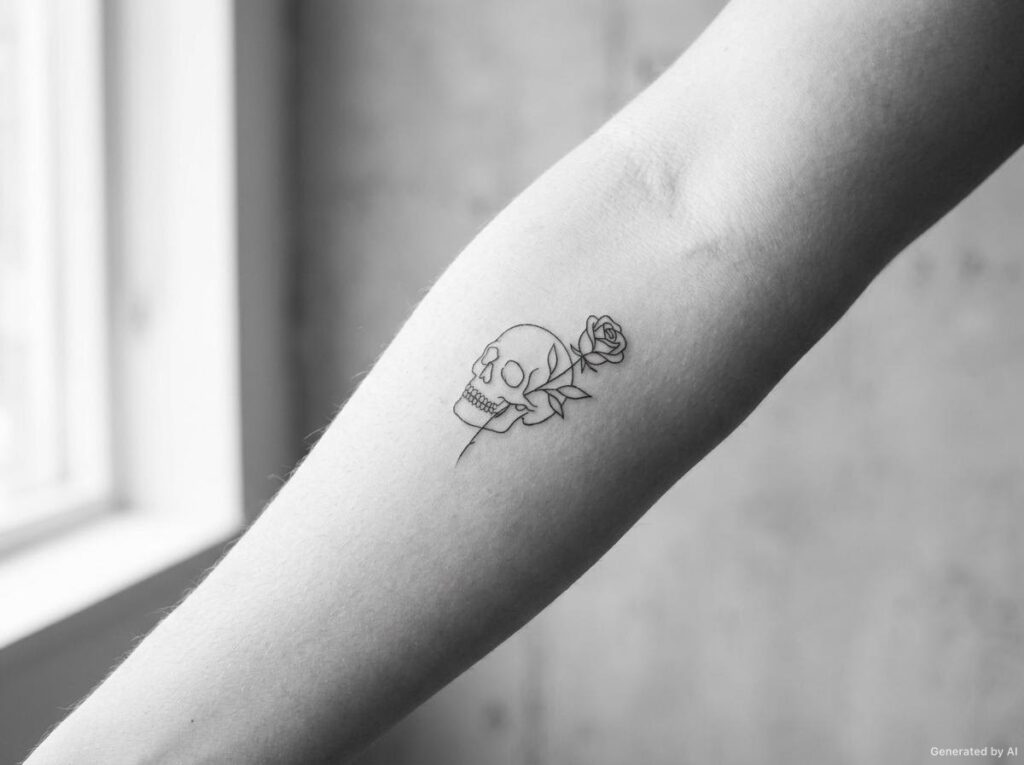
Fine line and minimal. Thin, quiet, and easy to place small. The trade-off is that very fine roses can lose definition over time, and a tiny skull with a tiny rose is the least legible version of this design. Keep the shapes simple if you go small.
Geometric and dotwork. Dotwork shading gives the rose a soft, handcrafted texture, while geometric framing around the skull gives the piece structure. A good fit if you like the symbolism but want a modern look rather than a classic one.
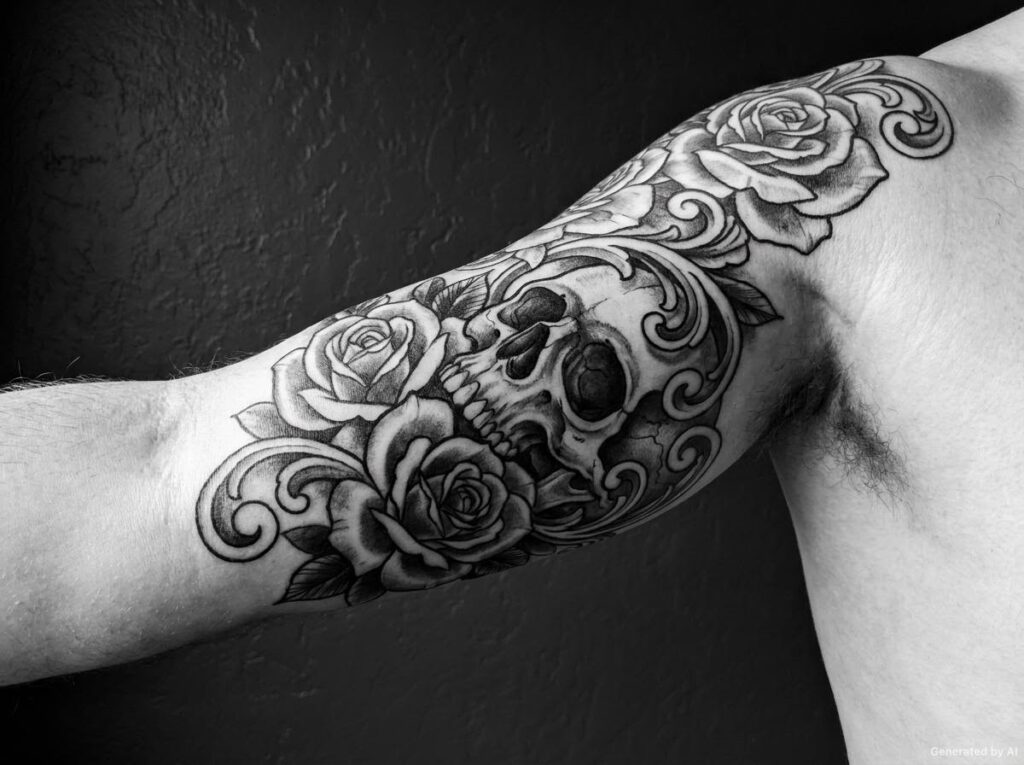
8. Placement Guide
Both elements need space, and the skull needs more than people expect. Fine detail in a rose is much easier to fit than fine detail in a skull, because the skull’s teeth and nasal cavity are small high-contrast features that turn to mush when compressed.
| Placement | Suits | Pain level |
|---|---|---|
| Forearm | The default placement; room for both elements at medium size | Moderate |
| Upper arm and shoulder | Half sleeves, layered roses, larger compositions | Low to moderate |
| Chest | Symmetrical pieces; easily covered by clothing | Moderate to high |
| Upper back | The best canvas for an elaborate memorial composition | Moderate |
| Thigh | Large detailed realism; a comfortable first big piece | Low to moderate |
| Calf | Detailed work with a natural vertical flow | Moderate |
| Inner wrist | Small fine line versions only | Moderate to high |
| Hand and fingers | Bold simplified versions; high visibility | High |
| Neck and behind the ear | Very small minimal outlines | High |
Two practical notes. Areas that see sun and friction every day will blur detail fastest, so if you want a small delicate version keep it somewhere covered. And because this design is often personal, consider whether you want it visible during work and family situations before choosing a forearm or hand placement.
9. Size, Cost, Time and Pain
The main constraint here is that you are paying for two subjects, so the piece is always larger and slower than a skull alone would be.
Size. Small versions exist and can work with a simple outline skull and a single stylised rose, but they lose the shading that makes the pairing feel emotional. Medium is the sweet spot for traditional and black and grey. Large is where realistic work belongs, because both a lifelike skull and a layered rose need room.
Cost. Price depends on the artist’s hourly rate, their demand, your city, and the total time the piece takes. A small outline version is usually a single short session. A detailed black and grey or half sleeve version is typically a multi-session project. Ask for a quote based on your actual reference rather than comparing other people’s figures, because rates vary enormously between studios.
Time. Detail drives time more than size. Rose petals need soft transitions and a skull needs crisp structure, and getting both right is slower than doing either alone. Plan for the possibility of more than one appointment if the piece is large.
Pain. Most people describe it as continuous scratching or burning rather than sharp pain. Areas over bone such as the ribs, spine, collarbone, hands and feet are more intense, while the outer arm, thigh and upper back are generally more manageable. Sessions get harder as they go on, so longer pieces are often split.
10. Choosing the Right Artist
This design tests an artist in two different ways at once. A skull demands structure and contrast; a rose demands softness and clean petal work. Not every artist is strong at both, and it is worth checking for each separately.
Look for both elements in the portfolio. A portfolio full of excellent roses and no skulls, or excellent skulls and weak florals, is a warning sign for this specific design.
Check healed photos. Fresh tattoos always look crisp. Healed photos show how the shading actually settles, which matters more here than in most designs because the contrast between the two elements is the whole piece.
Match the style. A traditional specialist and a fine line specialist will produce very different versions of the same idea. Decide the style before choosing the artist, not after.
Bring references, not a copy. Show several images that demonstrate the mood you want, then let the artist redraw. A copied composition usually distorts, and it may be someone else’s custom work.
Decide the sentiment out loud. Tell the artist whether the piece is a memorial, a celebration, or a statement. It changes the expression of the skull, the openness of the rose, and the amount of negative space, and it is much easier to get right before the stencil than after.
Watch the basics. Needles opened from sealed packaging in front of you, fresh gloves, a clean station, and a proper sharps container. A beautiful portfolio does not excuse a lapse here.
11. Healing and Aftercare
Soft shading is the most vulnerable part of this design. If the rose petals heal patchy, the piece loses the contrast that makes it work, so aftercare matters more here than for a bold linework tattoo.
The American Academy of Dermatology’s tattoo aftercare guidance is a reasonable baseline, and your artist’s instructions should always take priority over anything you read online, including this page.
First days. Keep the initial covering on for as long as your artist specifies. Wash gently with lukewarm water and a mild fragrance-free cleanser, pat dry with a clean paper towel instead of rubbing, then apply a thin layer of the recommended ointment or moisturiser. Thin is important; too much traps moisture and can cause problems.
Do not pick or scratch. Flaking and itching are normal. Picking takes ink with it and leaves patchy areas that need a touch-up, which is especially visible in soft rose shading.
Keep it out of water. No pools, baths, saunas, or sea while the skin is healing. Showers are fine; soaking is not.
Sunscreen forever. UV exposure fades ink and blurs fine lines more than anything else. Once the piece is healed, keep sunscreen on it whenever it is exposed. Soft grey shading is the first thing to lose definition under sun.
Expect a settling period. Tattoos look sharpest in the first weeks and then soften as the skin finishes healing. Mild dulling is normal. Clear patchiness means a touch-up, and most artists will handle that.
If you notice spreading redness, swelling, pus, fever, or pain that worsens instead of improving, contact a medical professional. The AAD also explains tattoo skin reactions and what to watch for.
12. Skull and Rose Tattoo FAQ
What does a skull and rose tattoo mean?
What does a black rose with a skull mean?
Is a skull and rose tattoo only a memorial tattoo?
Where is the best placement for a skull and rose tattoo?
Does a red rose change the meaning?
Should the rose go through the eye socket?
Which style ages best for this design?
How much does a skull and rose tattoo cost?
13. Final Thoughts
A skull and rose tattoo works because it refuses to choose between two things that feel like opposites. It says that love is real and that endings are real, and it holds both at the same time without flinching. That is a more honest statement than either symbol makes on its own, and it is why the pairing has survived as long as it has.
Decide the feeling first, then let the details follow. A memorial wants a white rose or a closed bud and a gentler composition. A love that ended wants black or wilting. A hard chapter survived wants a full bloom growing out of the bone. Once you know that, colour, style and placement fall into place much more easily.
Then take the artist choice seriously, because this is a design that needs two different skills in the same hand. Check for both, look at healed work, and take your time.